
New York AG wins $1.37B judgment vs. NovaTech founders in court

0
0
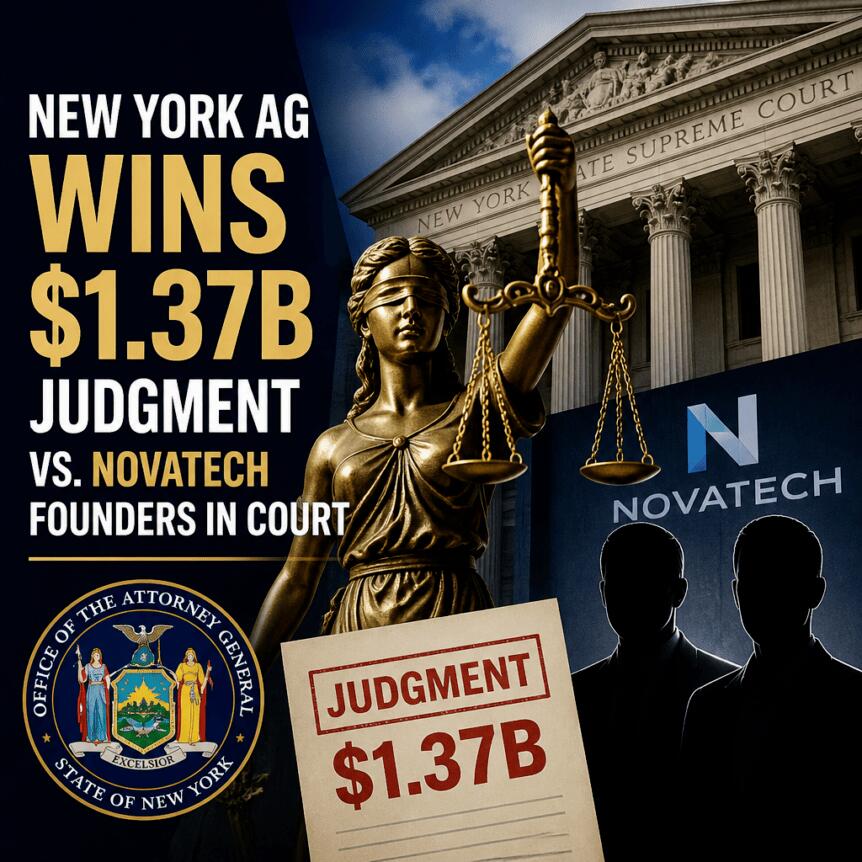
New York Attorney General Letitia James has obtained a $1.367 billion court judgment against Cynthia and Eddy Petion, founders of the defunct crypto and forex trading company NovaTech. The ruling stems from an investment scheme that New York said defrauded hundreds of thousands of people.
In a Wednesday press release, James described the decision as a step toward accountability for “the thousands of New Yorkers who were targeted” by what her office called a long-running scam. The judgment is now set to formalize the state’s case after years of litigation and defaults associated with the founders’ absence.
Key takeaways
- New York secured a $1.367 billion judgment against NovaTech founders Cynthia and Eddy Petion.
- The court found the defendants liable by default after the founders fled and did not respond to the lawsuit.
- New York alleged the scheme targeted immigrant communities through social channels and promises of high returns.
- The case traces losses connected to NovaTech as well as a prior collapsed mining operation, AWS Mining, which shut down in 2019.
- Investors and users should treat the scheme’s alleged recruitment and marketing approach as a cautionary example of how crypto fraud can scale.
A large judgment tied to investor losses
According to the New York Attorney General’s Office, the judgment amount totals $1.367 billion. The breakdown highlighted in the state’s filings includes roughly $1.13 billion in investor funds, along with $232.5 million in interest.
The press release notes that the request for payment was made after a default judgment previously entered in August 2025. In that phase of the case, the court found the company and its founders liable by default, after the Petions fled the country and failed to respond to the lawsuit.
For victims, large judgments can be pivotal, not only as a form of legal recognition of harm but also as a basis for attempts to recover funds—though actual recovery depends on whether assets can be identified and seized.
How New York said the NovaTech scheme operated
New York’s action against NovaTech was filed in June 2024. The state alleged that the platform specifically targeted immigrant communities—particularly Haitian New Yorkers—using community-based outreach such as prayer groups and social media.
As described in the case, NovaTech’s marketing emphasized the promise of high investment returns. The lawsuit also asserted that investors lost tens of millions of dollars through NovaTech and an earlier crypto mining-related operation known as AWS Mining.
The state further claimed that the scheme’s scale was significant: more than 11,000 New Yorkers were allegedly harmed, with losses reaching tens of millions as the business operated and collected funds from participants.
From AWS Mining to NovaTech: what changed, what stayed the same
The timeline matters for understanding how crypto-related fraud can evolve. AWS Mining collapsed in 2019, according to the reporting surrounding the case. NovaTech later followed—according to the sequence described by New York—when it collapsed in 2023.
While those failures occurred years apart, New York’s narrative connects the two ventures through alleged investor impact and the broader pattern of fundraising and marketing. That continuity can matter for investigators and regulators because it may help explain whether defendants used similar tactics across multiple projects, rather than a one-off failure or ordinary business downturn.
For investors and compliance professionals, the practical takeaway is that “new” platforms may sometimes be rebranded versions of earlier schemes, especially when promotional themes and recruitment channels overlap.
Why the default judgment stage is crucial
The New York Attorney General’s Office highlighted that liability was established through a default judgment in August 2025. That approach generally occurs when defendants do not respond to a lawsuit—meaning the court does not evaluate the merits through adversarial litigation.
In this case, the state tied the default posture to the founders’ flight from the country and their failure to engage with the legal process. Earlier steps in the case culminated in October, when James sought a court order requiring the Petions and affiliated entities to pay about $1.37 billion, including the $1.13 billion in investor funds and $232.5 million in interest.
From an investor perspective, the default pathway can accelerate outcomes for victims, but it also underscores a recurring risk in fraud enforcement: when defendants disappear, courts may only be able to move quickly toward judgments while recovery efforts depend on tracing assets after the fact.
What victims and the market should watch next
With the judgment now in place, the next question for victims and the broader market is how enforcement and asset recovery will proceed. The scale of the ruling may encourage further scrutiny of similar recruitment-driven crypto schemes, but actual restitution will hinge on what—if any—assets can be located and seized. Readers should watch for updates on enforcement actions tied to the judgment and for signs of whether comparable schemes reuse the same community and social-media funnels.
This article was originally published as New York AG wins $1.37B judgment vs. NovaTech founders in court on Crypto Breaking News – your trusted source for crypto news, Bitcoin news, and blockchain updates.
0
0
 Manage all your crypto, NFT and DeFi from one place
Securely connect the portfolio you’re using to start.