
Riot Jumps on $28B AI Hosting Deal as Hut 8 Drops on Revenue Miss

0
0
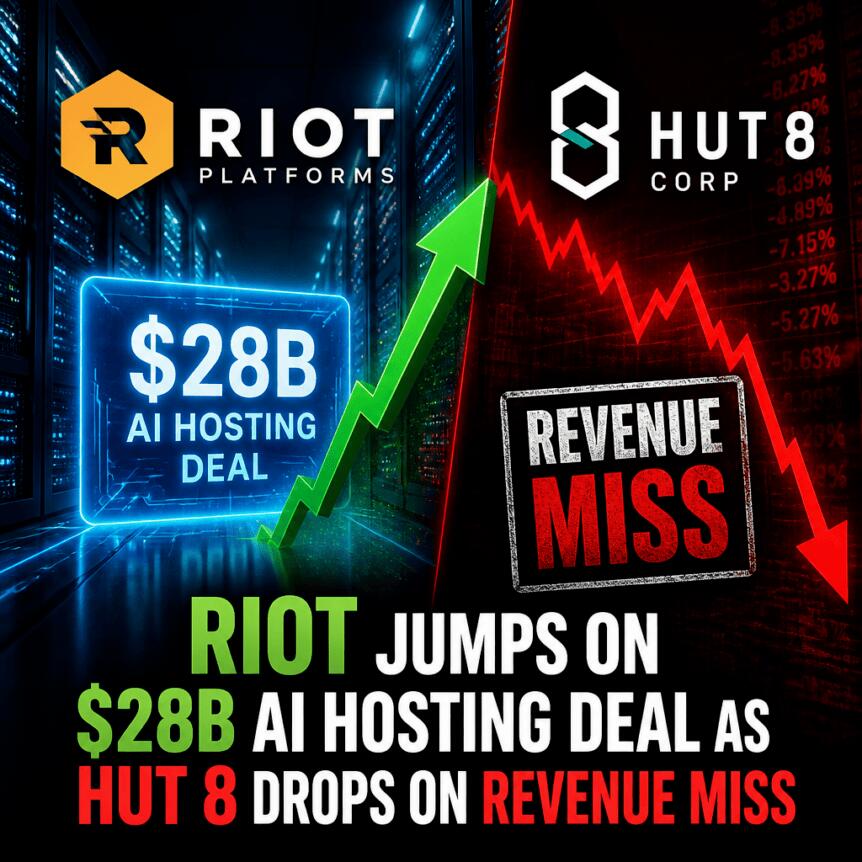
Bitcoin miner Riot Platforms jumped more than 13% on Wednesday after unveiling what it described as its biggest step yet in building artificial intelligence infrastructure: a 15-year, $28 billion AI data center lease at its Corsicana, Texas site. The company framed the deal as a shift away from relying primarily on Bitcoin mining cash flow toward long-term contracted infrastructure revenue.
Riot’s plan also raises a familiar question for the sector—how quickly miners can translate mining-developed power and land assets into durable AI lease income—at a moment when peers are still working through the transition. Shares of Hut 8, another miner pursuing AI-related infrastructure, fell sharply earlier in the day after it reported weaker quarterly revenue.
Key takeaways
- Riot signed a 15-year AI data center lease worth $28 billion covering 910 megawatts at its Corsicana, Texas facility.
- Riot said the lease model is expected to drive nearly all of its expected cash flow from long-term agreements once currently executed deals are fully deployed.
- Riot estimates total project capital costs at $5.5 billion, with delivery of the first phase expected in September 2027 and rental payments starting within 60 days of delivery.
- Hut 8 shares dropped as the company reported third-quarter revenue that missed expectations during its AI infrastructure transition.
- The contrast highlights a timing risk: lease revenue can lag behind financing and construction milestones even as miners reposition for AI.
Riot’s $28 billion lease marks a major AI pivot
Riot said the 15-year agreement covers 910 megawatts at its Corsicana facility and lifts its total future contracted data center revenue to roughly $38 billion across three leases signed in 2026. The company positioned the deal as a meaningful expansion of its AI strategy, leveraging infrastructure originally developed for Bitcoin mining.
On Wednesday’s earnings call, CEO Jason Les said the company is moving from a cash flow base heavily influenced by Bitcoin price to a model increasingly tied to long-term leases. According to Les, “a year ago” Riot’s cash flow depended on the price of Bitcoin, and with currently executed deals at full deployment, “nearly all” of expected cash flow would be generated by long-term leases with players in the AI ecosystem.
Land, power, and who runs the compute
Riot’s third-quarter earnings materials and regulatory filing provide key operational details. In its earnings release, Riot said it will supply land and power infrastructure originally developed for Bitcoin mining. The AI tenant—identified as Anthropic in Riot’s SEC filing—will own and operate the computing equipment and cover operating expenses.
Riot also estimated total capital costs for the project at $5.5 billion. The company said financing is expected to be primarily debt backed by lease payments, though it also stated that financing has not yet been secured. The first phase is expected to be delivered in September 2027, with rental payments beginning within 60 days of delivery, according to the company’s disclosures.
For investors, the structure matters because it shifts revenue visibility toward lease commitments while separating the miner’s role in power and site development from the tenant’s role in running the compute. At the same time, the timeline means that upside depends on delivery milestones and the ability to secure and execute financing without delays.
Mining revenue still plays a bridge role
Riot’s latest quarter underscored that Bitcoin mining remains part of the near-term financial engine. The company reported third-quarter revenue of $181.4 million, up about 1% year over year, and said it sold 10,599 BTC during the quarter to support its data center expansion plans.
During the Wednesday earnings call, Les also discussed how mining operations at Corsicana could change. He said Bitcoin mining at that site could begin winding down in summer 2027, aligning with the data center delivery schedule that Riot expects to culminate in September 2027 for the first phase.
That sequencing is likely to be a key monitoring point for the market: miners transitioning assets from mining to AI infrastructure need construction and commissioning timelines to line up with the monetization of lease payments, or else face periods where both mining output and revenue are under pressure.
Peer pressure: Hut 8 shares fall on slower revenue during transition
Riot’s upbeat AI deal arrived alongside a more cautious signal from another Bitcoin miner. Shares of Hut 8 dropped more than 22% at one point on Wednesday after it reported weaker-than-expected quarterly revenue linked to its shift toward AI infrastructure.
According to MarketBeat data, Hut 8’s third-quarter revenue fell 15% to $71.1 million, missing analysts’ estimates of $75.8 million. In remarks from Wednesday’s earnings call, CFO Sean Glennan attributed part of the decline to asset sales and lower revenue per Bitcoin mined, while noting that cash administrative expenses increased year over year.
Glennan added that the “legacy revenue base” is no longer expected to be the main growth driver, while larger contracted infrastructure revenues remain tied to delivery milestones. CEO Asher Genoot also pointed to the difficulty and cost of building traditional AI data centers at scale, describing many current facilities as complex and slow to deliver.
In its third-quarter earnings presentation, Hut 8 said it has secured $7.5 billion in project bonds to fully finance two major AI data center developments, though it noted that neither project has begun generating lease revenue yet. That detail helps explain the market reaction: even with funding in place, revenue can remain delayed until construction completes and contracts start paying out.
The divergence between Riot’s announcement-driven rally and Hut 8’s revenue disappointment illustrates a central tension in the miner-to-AI transition. Investors may reward firms that provide clear lease economics and near-term visibility, but they continue to scrutinize whether the revenue ramp will materialize on schedule.
What to watch next in the miner AI transition
With Riot’s first phase targeting September 2027 delivery and Hut 8’s projects still not generating lease income, the sector’s next updates will likely center on financing close, construction progress, and the timing of when power-and-site development turns into recurring lease revenue. For traders and long-term investors alike, milestone delivery and cash flow timing may matter as much as headline contract values.
This article was originally published as Riot Jumps on $28B AI Hosting Deal as Hut 8 Drops on Revenue Miss on Crypto Breaking News – your trusted source for crypto news, Bitcoin news, and blockchain updates.
0
0

 Manage all your crypto, NFT and DeFi from one place
Securely connect the portfolio you’re using to start.
 Where will Bitcoin trade next?
Live Polymarket and Kalshi odds on Bitcoin price targets, compared side by side.
See Bitcoin price odds


