
ElizaOS Token Drops 19% to Record Low After Founder Says It’s Dead

0
0
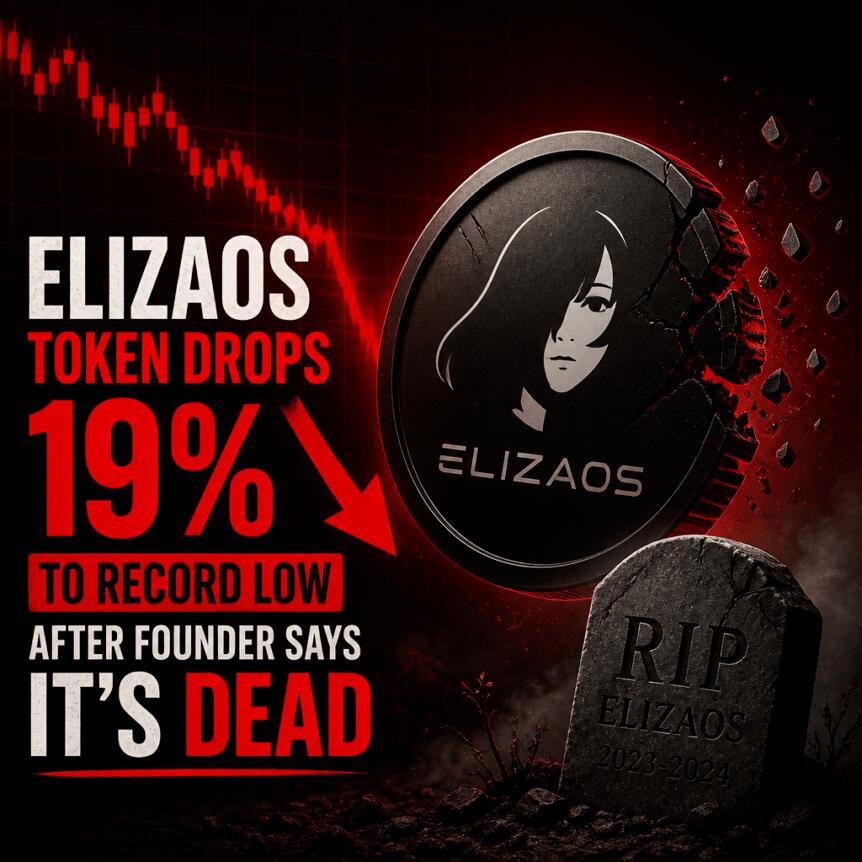
ElizaOS, a token tied to the open-source Eliza AI-agent framework, has plunged to a fresh all-time low after its creator, Shaw Walters, said the asset is effectively “dead” and that the Eliza Foundation is winding down.
CoinGecko data shows ElizaOS trading around $0.000285 at the time of writing, after briefly hitting a record low of $0.000284 on Thursday. The token’s market capitalization was about $2.1 million, following a reported 19% drop over 24 hours.
Key takeaways
- Walters says ElizaOS has no future token support, describing the token as “dead” and stating he no longer owns or backs it.
- The Eliza Foundation is winding down, removing an expected institutional backstop for the token ecosystem.
- A legal dispute is central to the founder’s explanation, with a settlement referenced and parts of the case dismissed in July.
- Eliza’s software work is expected to continue even if the token is abandoned.
- The token’s collapse reverses a major prior run-up, when the project’s earlier version peaked at about $2.5 billion market cap in January 2025.
A sharp reversal after the founder’s “token is dead” message
The latest selloff follows a direct statement from Walters that he views ElizaOS as finished. In a post on X, Walters said, “The token is dead. Completely,” adding that he neither owns nor supports the token. He also indicated that development of the open-source Eliza software would continue independently of both the token and the Eliza Foundation.
For many participants, the announcement marks a rare moment where an AI-agent category token is explicitly disavowed by its founder—rather than merely experiencing a typical liquidity or adoption slowdown. The market reaction was immediate, with ElizaOS falling to a new low on CoinGecko.
It is also a striking reversal compared with the token’s prior peak. CoinGecko shows that before rebranding as ElizaOS, the asset—then known as AI16Z—reached a peak market capitalization of about $2.5 billion in January 2025, underscoring how quickly sentiment can turn when expectations about continuity and ecosystem support collapse.
Legal pressure and “no capital to keep fighting” claims
Walters tied the project’s current state to ongoing legal problems and said the team privately settled with a group of tokenholders represented by Burwick Law. He said the settlement involved giving the represented tokenholders the project’s remaining treasury and funds.
According to Walters, the lawsuit was “ridiculous,” but he argued the project lacked resources to continue defending itself. The dispute, filed in April, named Eliza Labs, Walters, Sebastian Quinn-Watson, and the AI16Z DAO as defendants. The complaint alleged false advertising, deceptive practices, negligent misrepresentation, and unjust enrichment—claims described earlier in reporting by Cointelegraph in connection with the filing.
Court docket information referenced in the article indicates that the named plaintiff’s claims were dismissed with prejudice by stipulation on July 8, while proposed class claims were dismissed without prejudice.
Cointelegraph reported that it reached out to Walters and Burwick Law founder Max Burwick for comment but had not received a response at the time of publication. That leaves an open question for investors: while settlement and dismissals are documented, the broader dispute narrative—particularly whether any additional claims or future litigation could arise—remains less clear from the available details.
What Walters says will (and won’t) happen next
Beyond describing the token as unsupported, Walters said there would be no remaining funds for token buybacks. He also said there would be no foundation and no future supply intervention to support the asset.
Walters further indicated he would not allow another token to be associated with Eliza while he continues building the underlying operating system. In the X post, he wrote that he is “starting over” because he owns the intellectual property, and that he would “never” let a token come close to Eliza again.
For holders, those remarks matter because they point to a fundamental shift in the project’s economic model: instead of token-driven incentives or treasury-backed market measures, the software may proceed as a standalone open-source effort.
ElizaOS itself is described as an open-source framework for building and managing AI agents. The project launched in October 2024 as ai16z with an initial goal of raising $75,000 for what was described as an autonomous investor.
In January 2025, the project rebranded to ElizaOS, according to the article’s account of an earlier development. The change followed concerns raised by Andreessen Horowitz about potential confusion with its “a16z” brand. The token later underwent a migration as well.
All of these steps show how the ecosystem evolved quickly—but the current announcement suggests the latest stage will be different: the token component may be intentionally severed from the broader building effort.
Why this matters for AI-agent token investors
AI-agent tokens have often been marketed around long-term narratives: an ecosystem matures, a product ships, and token utilities follow. In this case, the story is less about technical progress and more about governance, funding, and the legal/branding realities that can decide whether a token survives as an ongoing mechanism.
Walters’ comments also highlight a tension common in crypto projects: even when the underlying software remains open-source and continues, the token can still lose its perceived support structure. With ElizaOS described as having no future foundation intervention, investors are left to reassess what determines value—development alone, market liquidity, and any remaining community coordination—especially when the figure most directly tied to the token’s origin says he will not support it.
Finally, the token’s trajectory—from a reported January 2025 peak market capitalization to a new all-time low—illustrates how quickly the market can reprice perceived credibility and continuity in token-managed ecosystems. The current move may become a reference point for how founders handle legal disputes and whether open-source continuity can compensate for the loss of an active token mandate.
Investors watching ElizaOS next should focus on whether any additional on-chain activity or ecosystem announcements emerge after the winding-down claim—particularly around the settlement outcome, any remaining treasury controls, and how the Eliza software roadmap proceeds without token-linked incentives.
This article was originally published as ElizaOS Token Drops 19% to Record Low After Founder Says It’s Dead on Crypto Breaking News – your trusted source for crypto news, Bitcoin news, and blockchain updates.
0
0
 Manage all your crypto, NFT and DeFi from one place
Securely connect the portfolio you’re using to start.