
Binance Monitoring Tag vs Seed Tag: What Each Label Means for You

0
0
Binance Monitoring Tag vs Seed Tag: What Each Label Means for You
Binance doesn't treat every listed token the same way. A Binance Monitoring Tag flags a token whose price swings and risk run well above the rest of the exchange. A Seed Tag points to a newer project that's still short on track record. Both labels warn of risk, but the worry behind each one differs.
On November 20, 2026, Binance added six tokens to the Monitoring Tag list and removed the Seed Tag from two. This guide on Binance new token safety adds background on listings.
This article explains each label, the review factors and the trading rules. Facts come from Binance announcements and support pages. Gaps are noted.
What Is a Binance Monitoring Tag?
Binance introduced both labels in an announcement dated July 26, 2023. The Binance Monitoring Tag applies to tokens that show notably higher volatility and risk than other listed tokens.
Binance reviews these tokens regularly. A support page states that a tagged token may be delisted if the token no longer meets listing criteria. A primer on crypto exchange listing explains how listings and removals work.
What Is a Seed Tag?
The Seed Tag replaced the former Innovation Zone. Binance applies the label to innovative projects that may carry higher volatility and risk than other listed tokens.
Binance Academy describes Seed Tag assets as early in development. Such projects may lack a finished product or a long track record. The Academy page also says the tag is not a recommendation or endorsement.
Binance Monitoring Tag vs Seed Tag: Key Differences
Feature | Monitoring Tag | Seed Tag |
|---|---|---|
Core meaning | Notably higher volatility and risk | Newer project with possible higher risk |
Delisting link | Token may be delisted if criteria are unmet | No delisting link stated on the same pages |
Quiz and terms | Required every 90 days | Required every 90 days |
Where the tag shows | Trading pages and Markets Overview | Trading pages and Markets Overview |
Origin | New label in July 2023 | Replaced the Innovation Zone |
The Seed Tag signals novelty. The other label signals concern under observation. A token can move between labels or lose both after a review.
How Does Binance Decide Which Label Applies?
Binance says both labels rest on periodic project reviews. The announcement lists nine factors:
Team commitment
Development activity level and quality
Trading volume and liquidity
Network safety against attacks
Network and smart contract stability
Quality of public communication
Responsiveness to due diligence requests
Evidence of unethical or fraudulent conduct or negligence
Contribution to a healthy and sustainable ecosystem
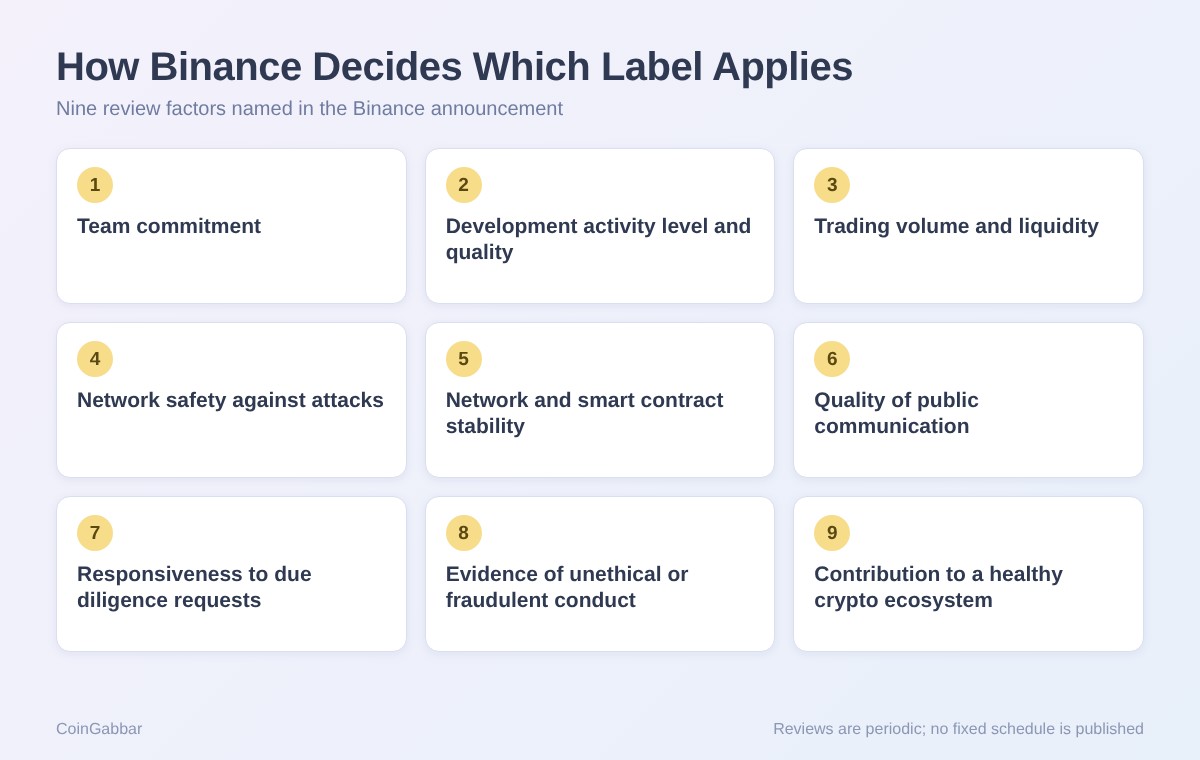
Binance doesn't publish a fixed review schedule or a scoring formula for either label. The announcement says reviews are periodic, so timing stays unclear. The November 2026 notice also names unjustified supply or tokenomics changes among the criteria.
What Rules Apply When Trading Tagged Tokens?
Traders must pass the matching quiz and accept the Terms of Use before trading tagged tokens on Spot or Margin. The quiz must be retaken every 90 days.
Tagged tokens are easy to spot. The label shows on trading pages and on the Markets Overview page, and a risk warning banner sits on every one. Binance says other services tied to these tokens carry on as normal. For a closer look at the platform itself, this Binance exchange review covers the products.
The quiz is there to check that traders understand the risk. Passing says nothing about whether a token is any good. For wider research habits, a guide to crypto market analysis is a useful start.
What Changed in the November 2026 Update?
According to the Binance announcement dated November 20, 2026, the Binance Monitoring Tag now covers six more tokens:
Lorenzo Protocol (BANK)
Initia (INIT)
Mitosis (MITO)
Harmony (ONE)
THENA (THE)
Zilliqa (ZIL)
Binance also removed the Seed Tag from Morpho (MORPHO) and Hyperliquid (HYPE). Binance says the changes are based on recent reviews. The announcement gives no token-by-token reason. Tags update shortly after publication, and no exact time is stated.
How Should Labels Be Read Correctly?
Several common misreadings of the two labels are worth avoiding.
A seed tag removal isn't an endorsement. The Academy page says the Seed Tag is not a recommendation, and removal doesn't turn into one either.
A Binance monitoring tag isn't a delisting. Binance says delisting is possible if a token stops meeting listing criteria. The Binance Academy page says the tag itself is not a delisting announcement.
Labels can change. Binance adds and removes tags after reviews.
Reasons often stay unstated. Press coverage sometimes links a removal to maturity. That link is a media interpretation, not a Binance statement.
A guide to bull and bear cycles shows how volatility shifts across market phases.
Expert Sources: What Binance Risk Labels Do and Do Not Show
The two labels work as a risk-communication tool, and the monitoring tag carries the heavier warning. A Seed Tag says a project is new. A Binance monitoring tag says a token is under closer review. Neither label rates a project's future.
The practical value lies in the rules attached. The quiz, the banner, and the terms add friction before trading. That friction is the main protection Binance builds into the system.
Transparency remains limited. Binance names review factors but publishes no scoring detail. For the full picture, Binance's original 2023 announcement explains both labels, and the November 20, 2026 notice shows the latest changes.
Final Thoughts on Reading Binance Risk Labels
The Binance Monitoring Tag flags higher volatility and risk, with a possible delisting review. The Seed Tag flags newer projects. Both labels bring quiz and banner rules, and both can change after a review.
The November 20, 2026 update shows the Binance Monitoring Tag list is far from frozen. Binance keeps adding and dropping names after each review. A tag is only one clue, so the project, the market, and the risk deserve a closer look too. A guide on why crypto prices drop is one place to start.
Disclaimer: This article is for educational and informational purposes only and should not be considered financial or investment advice. Always conduct your own research before making investment decisions.
0
0
 Manage all your crypto, NFT and DeFi from one place
Securely connect the portfolio you’re using to start.