
Cluster Protocol Tokenomics: The Economic Layer for Decentralized AI

0
0
Cluster Protocol Tokenomics: $CP Utility and Allocation
Cluster is building an AI-focused infrastructure layer that connects AI models, GPU compute, datasets, and autonomous agents within a Web3 ecosystem. Its architecture is designed around a unified AI gateway, tokenized datasets, agent identity, and on-chain settlement.
The project describes its goal as creating open and composable AI infrastructure rather than keeping models, data, and applications inside centralized platforms. Its infrastructure supports AI model training, deployment, AI inference, data monetization, and agentic workflows.
What is Cluster Protocol? - A Decentralized AI Engine
Cluster Protocol is a decentralized AI infrastructure. Its early architecture focuses on Proof of Compute, decentralized GPU resources, privacy-preserving AI, and collaborative model development
Its infrastructure operates on Base, where smart contracts handle payments, dataset ownership and other protocol functions. It provides a single OpenAI-compatible API accessing 500+ models, while also connecting users to tokenized datasets, AI services, GPU compute, and on-chain applications.
Features That Give Cluster Protocol an Edge
1. Unified AI Inference
Cluster provides one API through which developers can access 500+ open-source models across text, image, audio, embeddings and document reranking.
2. Tokenized Data Marketplace
Datasets can be stored on IPFS and represented as ERC-721 NFTs on Base, giving them verifiable on-chain ownership. The platform's stated revenue split sends 85% to the dataset creator, 10% to the protocol treasury, and 5% to the referrer
3. AI Training and Compute
Cluster connects datasets with GPU compute and model fine-tuning, allowing a dataset to move through a broader data → training → model → inference pipeline.
4. AI Agent Infrastructure
The protocol supports ERC-8004 agent identity and x402 payments, allowing autonomous AI agents to identify themselves and make micropayments for services.
5.CodeXero
CodeXero is Cluster's application layer that allows users to create and deploy on-chain applications through natural-language prompts, reducing the technical barrier for Web3 development.
$CP Token Utility - What Powers the Ecosystem?
The Cluster Token ($CP) is designed as the native protocol token on Base. According to Cluster's technical documentation, it can be used for AI inference payments, dataset purchases, compute provisioning, staking, and governance.
Main Utilities:
-
Dataset Purchases: Support transactions within the tokenized data marketplace.
-
Compute: Used within the protocol's computer economy.
-
Staking: Provides an incentive mechanism for ecosystem participation.
-
Governance: Supports participation in protocol decision-making.
Cluster Protocol Tokenomics - Breaking Down 1 Billion CP
Cluster Protocol's tokenomics is built around a total supply of 5 billion tokens. The supply is divided among the community, foundation, team and advisors, strategic investors, liquidity, and seed participants. The token utility also includes different TGE unlocks, cliff periods, and vesting schedules to control how tokens enter circulation over time.
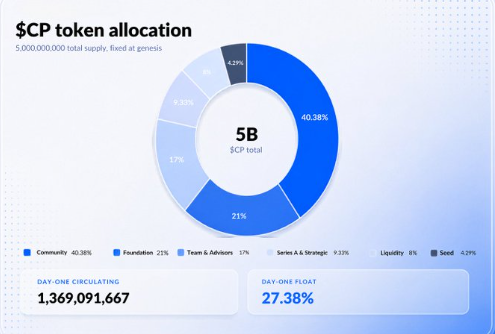
Community: 40.38% Allocation; 2,018,833,333 Tokens
The largest allocation is dedicated to the community, supporting crypto airdrop, rewards, incentives, and broader ecosystem participation. 35% of this allocation is available at launch, while the remaining tokens are released over a 36-month vesting period with no initial cliff.
Foundation: 21% Allocation; 1,050,000,000 Tokens
The Foundation allocation is intended to support treasury management and ongoing protocol operations. Only 25% unlocks at launch, followed by a 3-month cliff and 36-month vesting period, helping maintain long-term funding for the ecosystem.
Team & Advisors: 17% Allocation; 850,000,000 Tokens
This allocation is reserved for the core team and advisors who contribute to the development and growth of Cluster Protocol. There is no token unlock at launch, followed by an 18-month cliff and 24-month vesting period, encouraging long-term commitment.
Series A & Strategic: 9.33% Allocation, 466,666,667 Tokens
These tokens are allocated to strategic investors and Series A participants, providing growth capital for the project's expansion. They have no launch unlock, followed by a 12-month cliff and a 24-month vesting period.
Liquidity: 8% Allocation; 400,000,000 Tokens
The liquidity allocation is designed to support DEX and CEX market-making, helping establish smoother trading and market liquidity. Unlike most other categories, 100% of these tokens are unlocked at launch, with no cliff or additional vesting period.
Seed: 4.29% Allocation, 214,500,000 Tokens
The Seed allocation is reserved for early backers and investors who supported the project during its earlier stages. These tokens have no launch unlock, followed by a 12-month cliff and a 24-month vesting period.
What Stands Out?
Cluster Protocol's tokenomics combines a large community allocation with staggered vesting for insiders and investors, while keeping a dedicated pool available for the crypto liquidity market. This structure is designed to balance community incentives, operational funding, long-term contributor alignment, and market accessibility.
Road Ahead - From AI Infrastructure to an Agent Economy
Rather than presenting only future milestones, Cluster's latest June 2026 overview says several major components are already live, including its 500+ model zero-settlement inference gateway, tokenized dataset marketplace, CodeXero, Python SDK, x402 payment rails, and ERC-8004 agent identity.
Stage 1: Core AI Infrastructure
Build the unified inference layer, developer tools, model access, and compute infrastructure.
Stage 2: Data & AI Economy
Expand tokenized datasets asset, data ownership, fine-tuning, and the connection between datasets and AI services.
Stage 3: Autonomous Agents
Enable AI agents with identity, payments, and orchestration through technologies such as ERC-8004 and x402.
Stage 4: Production-First Internet Capital Markets
Cluster is also positioning tools such as CodeXero around a model where users can build software, deploy it on-chain, and turn it into an economically coordinated asset, rather than simply launching tokens first.
What Makes Cluster Protocol Interesting?
Its concept is trying to create a closed-loop AI economy:
Dataset -> AI Training -> Model -> Inference -> Payment -> Creator/Network -> Rewards
For example, a creator can tokenize a dataset, a developer can use it for model training, the resulting model can be deployed through the inference layer, and subsequent usage can generate economic activity across the ecosystem.
This makes data ownership and monetization an important part of the project's broader AI infrastructure thesis.
Conclusion
Cluster Protocol is developing a Web3-native AI infrastructure stack combining AI inference, tokenized data, compute, autonomous agents, and blockchain settlement. Its $CP token is designed to support payments, AI staking, compute, dataset purchases, and governance, while its token allocation emphasizes ecosystem incentives and community participation. The project's most distinctive idea is perhaps the creation of a connected data-to-AI-to-payment economy, where contributors can participate in the value generated by AI infrastructure.
Disclaimer
This content is for informational purposes only and is not financial or investment advice. Cryptocurrency tokens involve significant risks, including volatility, liquidity risks, and changes to tokenomics or project plans. Token supply and information can change before or after launch, so always verify the latest official information before making financial decisions.
0
0
 Manage all your crypto, NFT and DeFi from one place
Securely connect the portfolio you’re using to start.