
Japan’s corporate pension fund eyes 1% allocation to crypto, Nikkei reports

0
0
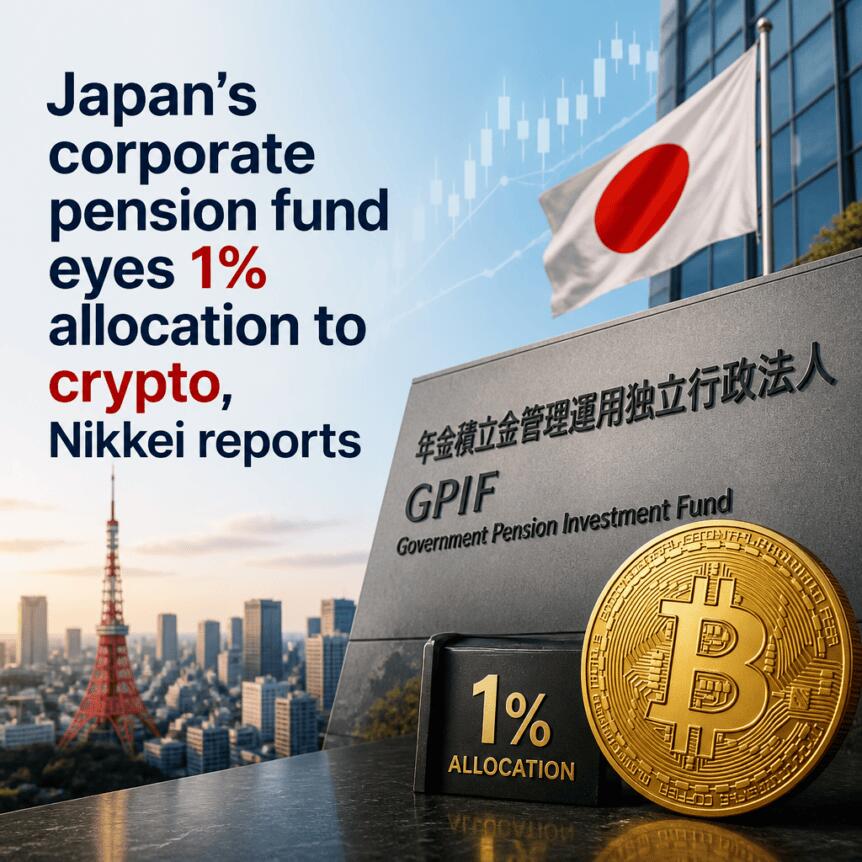
A Japanese corporate pension fund that serves roughly 1,200 small and medium-sized businesses plans to add cryptocurrency exposure to its portfolio starting fiscal year 2026, according to Nikkei. The proposal calls for allocating about 1% of the fund’s assets to crypto through a passive investment vehicle managed by a “major” hedge fund holding multiple crypto assets.
Nikkei reports the Nationwide Business Corporate Pension Fund oversees approximately 21.3 billion yen (around $130 million). CoinPost, in a separate report, said the pension fund is incorporating the allocation as part of its diversification effort, with a planned allocation split of 80% to yen, 15% to US dollars, and 5% to other currencies.
Key takeaways
- The Nationwide Business Corporate Pension Fund plans to dedicate roughly 1% of assets to cryptocurrency in fiscal year 2026.
- According to reports, the investment will be made via a passive fund managed by a hedge fund holding a basket of crypto assets.
- The move adds crypto exposure inside Japan’s more conservative institutional money pool, suggesting gradual mainstreaming.
- It comes as Japanese lawmakers advance legislation that would bring crypto assets under rules closer to those for traditional financial products.
- Investors should watch how the pension allocation is implemented, including whether it aligns with broader ETF and tax policy changes.
A cautious allocation inside Japan’s pension system
Crypto adoption among mainstream institutions typically proceeds in measured steps—especially in jurisdictions where pensions and other conservative vehicles are heavily regulated. In this case, the 1% target is small relative to the fund’s overall size, but the decision is significant because it places digital assets on the radar of an entity designed to meet long-term obligations for participating companies.
As described by Nikkei, the fund would not pick individual coins directly. Instead, it would use a passive fund managed by a hedge fund described as a “major” player, with holdings spanning multiple crypto assets. That structure could matter for implementation: passive vehicles can be easier to administer within institutional investment frameworks than bespoke strategies, even if underlying market exposure remains volatile.
CoinPost’s coverage, meanwhile, frames the decision as part of broader portfolio diversification rather than a standalone bet on crypto. With yen still projected to account for 80% of the fund’s exposure, the planned allocation suggests the pension fund is treating cryptocurrency as an incremental diversifier rather than a core allocation—at least for now.
Policy momentum: crypto moves closer to traditional market rules
The pension allocation aligns with a wider push in Japan to integrate digital assets more firmly into the country’s regulated financial ecosystem. On June 11, Japan’s House of Representatives passed legislation that would bring crypto assets under the Financial Instruments and Exchange Act, as coverage discussed by Cointelegraph noted. Under the proposal, crypto would fall under rules more closely aligned with those applied to conventional financial products.
The legislation is expected to move to the House of Councillors. If approved, it could open a pathway for crypto exchange-traded funds, while also strengthening the case for reforms that would lower the tax rate applied to digital-asset gains. The draft framework referenced in coverage includes a potential shift toward a 20% flat tax on gains from the current maximum rate of 55%.
For institutional investors, regulatory proximity can be as important as performance. When crypto assets sit outside the same legal and compliance environment as other financial products, long-term allocation decisions become harder—particularly for entities with strict governance and oversight requirements. A framework under the Financial Instruments and Exchange Act may reduce friction and help pension administrators justify allocations and risk controls.
Broader institutional access: experiments in retail and yield
Beyond pensions, Japan has seen other efforts aimed at making crypto exposure more accessible to investors in ways that fit established financial channels. Earlier this year, SBI Shinsei Bank began testing a deposit-linked rewards program that offers vouchers redeemable for Bitcoin, Ether, or XRP. The bank reportedly planned a permanent launch in autumn, highlighting a trend toward bundling crypto access with mainstream banking products.
In parallel, Metaplanet—described as Japan’s largest publicly listed Bitcoin holder—took steps to expand its financial toolkit. On June 12, Metaplanet agreed to acquire Siiibo Securities for 2.1 billion yen. The company said the deal would support the development and distribution of Bitcoin-linked yield products through a newly formed securities arm.
Together, these moves point to a gradual shift: crypto is no longer only an exchange and custody story. It’s increasingly being packaged into products and structures that resemble traditional finance—whether through rewards programs, yield-linked instruments, or, in this case, pension allocations.
What to watch next for pension-linked crypto
While the pension fund’s planned 1% allocation is modest, it could set an example for other conservative institutions if the implementation is smooth and governance concerns are addressed. The critical details investors will want to understand as fiscal year 2026 approaches include how the passive crypto fund is selected, what risk management and rebalancing policies apply, and whether the pension’s approach harmonizes with the evolving regulatory path in Japan.
More broadly, readers should monitor whether the legislation currently advancing through Japan’s political process translates into practical market infrastructure—such as regulated products that institutions can more easily deploy within their existing compliance frameworks.
This article was originally published as Japan’s corporate pension fund eyes 1% allocation to crypto, Nikkei reports on Crypto Breaking News – your trusted source for crypto news, Bitcoin news, and blockchain updates.
0
0
 Gerencie todo seu criptograma, NFT e DeFi de um só lugar
Conecte com segurança o portfólio que você está usando para começar.