
AI Bubble Warning: Why Gensler Predicts Recession Before 2028 Election

0
0

AI Bubble Fears Grow as Gary Gensler Warns of Recession Before 2028
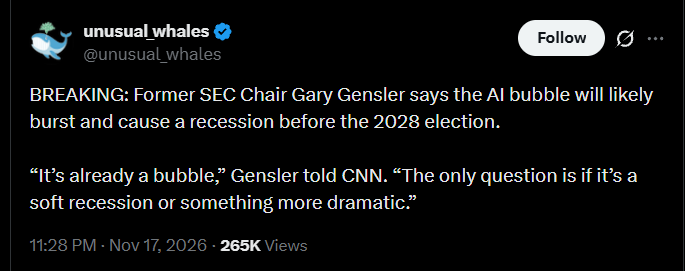
The AI bubble debate has moved from social media into the mainstream. Former SEC Chair Gary Gensler told CNN on November 17, 2026, that the AI bubble could burst and cause a recession before the 2028 US presidential election.
Worries about heavy spending, rising debt, and tech valuations are growing. A new Bank of America survey adds weight to those fears. The key question is whether an AI market correction could slow the wider economy.
AI Bubble at a Glance
-
Gensler warns of a possible recession before November 2028.
-
Big Tech spends an estimated $800 billion a year on AI infrastructure.
-
34% of fund managers name an AI bubble as the top tail risk.
-
31% fear an AI credit crisis.
-
Tech overweight positions fell to 12% from 37%.
Why Is Gary Gensler Warning About an AI Bubble?
Gensler, now an MIT professor, told CNN the AI bubble already exists. He noted that Big Tech spending is five times higher than it was three years ago. Money is flowing in faster than companies can earn profits, he said.
He compared today with the railroad boom, the electricity boom of the 1920s and the 1990s internet era, which all ended in retrenchment.
He expects a downturn as significant as the dot-com crash, but not as harsh as 2008. “The only question is if it’s a soft recession or something more dramatic,” he said.
Source: Unusual Whales X Post
Bank of America Survey Shows AI Bubble as the Biggest Market Risk
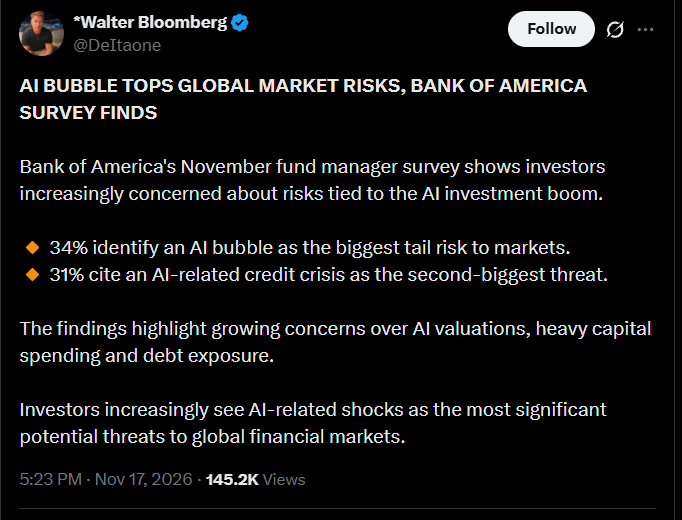
Bank of America’s November survey covered 169 global investors who manage $461 billion. Some 34% named an AI bubble as their biggest tail risk.
Another 31% pointed to an AI credit crisis. A record 38% said companies are overinvesting, and 52% expect at least one hyperscaler to cut spending within six months.
Managers also cut their tech overweight from 37% to 12%, the sharpest monthly drop since June 2006. These numbers show that institutional investors are turning cautious about AI.
Source: Walter Bloomberg
Could AI Infrastructure Spending Trigger a Credit Crisis?
Building data centers, buying chips and adding computing power takes huge sums of borrowed money. Gensler worries about circular financing and off-balance-sheet debt, which can hide how much risk the system carries.
He believes the largest companies will survive. Neocloud providers face more pressure because many rely on heavy debt. He expects “breakage and bankruptcies” among them. If AI demand slows, firms that depend on constant infrastructure spending could struggle to repay lenders.
The Federal Reserve also disclosed that large US banks hold close to $1 trillion in exposure to AI firms.
Source: Walter Bloomberg X Post
AI Bubble Timeline: From Investment Boom to Growing Market Fears
-
1990s: Heavy internet investment ends in the dot-com collapse.
-
2023 to 2026: Big Tech speeds up spending on chips and data centers.
-
November 2026: Bank of America’s survey flags AI valuations and credit risks.
-
November 17, 2026: Gensler warns of an AI-driven recession before 2028.
-
Next six months: 52% of surveyed managers expect a hyperscaler to cut spending.
AI Market Correction: Are Bitcoin, Gold, Silver Under Pressure?
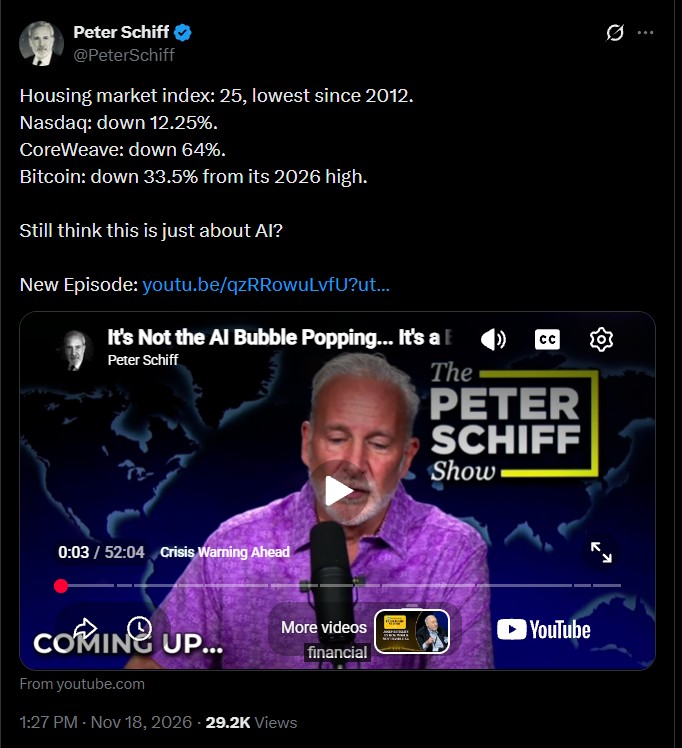
Peter Schiff argues the weakness goes beyond AI stocks. Market commentary also reports sharp drops in precious metals.
| Asset / Indicator | Reported movement |
| Nasdaq | Down 12.25% |
| CoreWeave shares | Down 64% |
| 33.5% below its 2026 high | |
| Down 33% | |
| Silver | Down 61% |
| US Housing Market Index | 25, lowest since 2012 |
Bitcoin’s slide matters because it shows weaker risk appetite across markets. Falling gold and silver also challenge the idea that metals always rise in uncertain times. Still, simultaneous declines do not prove an AI bubble caused every loss. Several figures come from social media posts, and their measurement periods are not fully confirmed.
Source: PeterSchiff X Post
Why Are Fund Managers Looking Beyond US Technology Stocks?
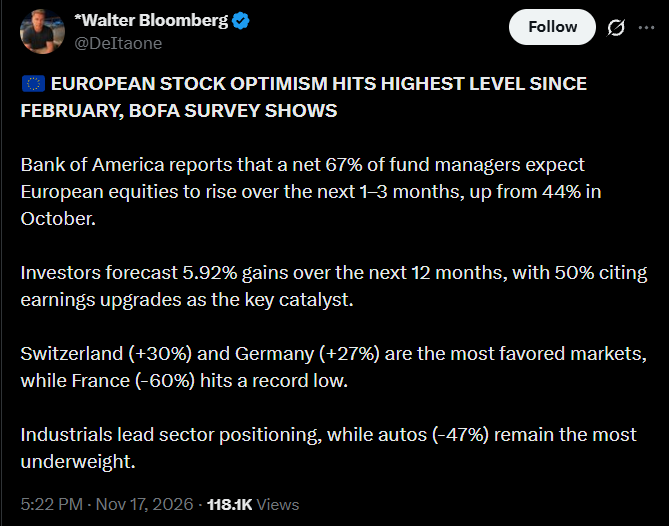
Some 36% of global managers expect international stocks to perform best in 2027. Only 24% favor US stocks. European optimism rose to a net 67% from 44% in October. Switzerland and Germany are the favorite markets, while France hit a record low of net minus 60%.
With US tech valuations under question, investors may want to spread their risk. However, European managers say a US or AI correction is the likeliest trigger for a fall in their own market.
Is an AI Bubble Collapse Inevitable? What Happens Next?
The bearish case rests on Gensler’s view of a repricing before November 2028. Neocloud bankruptcies and unsustainable spending are the main worries if revenue fails to justify investment.
Ed Yardeni offers a different view. He calls the AI bubble “self-correcting” and says it may deflate without a crash. He adds that falling valuations reduce speculation, and chipmaker price-to-earnings ratios now sit below the broader market. The technology itself may keep growing despite market swings.
How Could the Crypto Market Be Affected?
A burst would not hit crypto directly, but the two markets share one driver: risk appetite. Bitcoin is already 33.5% below its 2026 high, according to Peter Schiff’s post. If AI stocks fall further, investors may sell other risky assets to cut losses, and crypto could feel that pressure.
Credit stress is a second channel. Bank of America’s survey shows 31% of managers fear an AI credit crisis, and the Federal Reserve says large US banks hold close to $1 trillion in AI exposure. Tighter lending could reduce the money flowing into speculative markets.
Gold and silver are also falling, so crypto market has not been a clear safe haven or a clear winner. None of the sources prove that an AI bubble caused Bitcoin price decline, and the link remains a possibility, not a fact.
Conclusion
These concerns are spreading beyond tech stocks into credit, crypto, and metals. Spending, debt, profits, and investor positioning will decide what happens next. A market correction remains a risk scenario, not a confirmed prediction.
Disclaimer: This article is for informational and educational purposes only and is not investment advice. Market conditions and asset prices can change rapidly. Cryptocurrency investments carry a high risk, including the loss of your full capital. Always do your own research and consult a licensed financial adviser before making decisions.
0
0
 Manage all your crypto, NFT and DeFi from one place
Securely connect the portfolio you’re using to start.