
Sirius Network Governance: Exploring SRT Roles and Voting Plans

0
0
How Will Sirius Network Governance Manage Treasury, Vesting and Nodes?
Every token project eventually has to answer one question: who gets to change the rules? For Sirius Network governance, the answer is still being written. The project lists a dedicated module for it, but most of the detail is saved for later stages.
This guide covers what the plan includes, what the roadmap says about timing and what is not yet stated. Details come from the official website and the whitepaper.
Key Takeaways
Governance is planned to cover vesting, treasury, staking, nodes, ambassadors and ecosystem projects.
Confirmed SRT is protected by a rule that governance cannot reduce it retroactively.
Governance contracts are set for audit in 2027, an on-chain launch in 2028 and open governance in 2029. Every date is a planning target.
What Is Sirius Network?
Sirius Network is a mobile-first contribution mining project. Its site tagline reads “Mobile Mining. Powered by Participation.” Users join 24-hour cycles in an app and collect points, and no purchase is needed to start.
An account begins with a Sirius ID, not an email or phone number. The points are called SST. Contribution Power weighs them, and Sirius Passport tracks identity across six stages, P0 to P5. The planned token, SRT, is a BEP-20 asset on BNB Smart Chain with a fixed supply of 5,000,000,000.
The whitepaper sums up the idea in one line: “Contribute First, Own Next, Build Together.” Governance belongs to that last part.
Source: official website.
What Is Sirius Network Governance?
Sirius Network governance is the planned system for deciding how the project’s token rules are managed. According to the whitepaper, it is meant to cover vesting, treasury, staking, nodes, ambassadors and ecosystem projects. It is a plan, not a live feature. Voting details have not been published, and the on-chain launch is a 2028 target. Everything below separates what is stated from what is still open.
What Is the Sirius Governance Module?
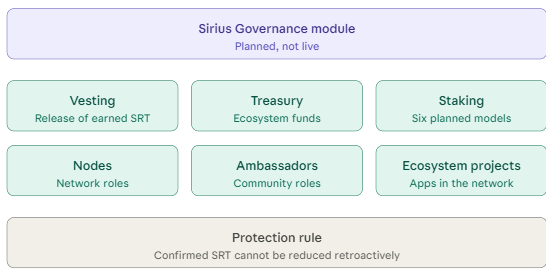
Governance is one of ten planned modules in the whitepaper’s ecosystem matrix. It is planned to cover vesting, treasury, staking, nodes, ambassadors and ecosystem projects. That is a wide scope, and it is still a plan, not a live product.
Area | Plain-word meaning |
Vesting | How earned SRT is released over time |
Treasury | Funds held for the ecosystem |
Staking | The planned SRT staking programs |
Nodes | Network roles such as validators and nodes |
Ambassadors | Community roles |
Ecosystem projects | Applications built in the network |
Where SRT Governance Sits in the Token Plan
SRT governance is one of several planned token functions. The whitepaper lists them in order: missions and services, network roles, application services, digital rights, governance, and real-world asset use cases that follow legal assessment. The website groups SRT uses into four cards: token, vesting, staking and governance.
The architecture also shows where it lives. Contribution records stay off-chain, while token rules run on-chain.
Off-chain | On-chain |
Sirius ID, referrals, Contribution Power, SST, learning and mission records, risk status | SRT issuance and transfers, vesting, staking, reward pools, mission escrow, treasury, governance |
H2: The Rule That Protects Earned Tokens
One limit stands out. The official whitepaper says a governance decision cannot retroactively reduce SRT already confirmed in a contract. In plain words, confirmed SRT is meant to stay confirmed.
Sirius Network vesting adds another layer. Each Ecosystem Season has a fixed community allocation pool, and that pool decides user vesting allocations. SST points do not convert to SRT at a fixed ratio.
The numbers are not final. Details such as lockup periods, cliffs and release timing still have to be published before tokens are formally issued. No vesting schedule is public yet, so figures seen elsewhere deserve caution.
Treasury, Staking, Nodes and Ambassadors
Treasury
Sirius Network treasury sits on the on-chain side of the design. Separately, the tokenomics page sets aside 15% of supply, or 750 million SRT, for the Ecosystem Development Fund. It is meant for Learn, Creator, Game, Merchant, Developer and other applications, and it should not enter circulation all at once.
How treasury management decisions will be made is not detailed yet. The Foundation plan adds that rules for allocation, vesting and incentives are meant to be disclosed openly.
Staking and Nodes
Sirius Network staking is planned in six models, explained in the staking guide. Audited staking is a 2028 target. Sirius Network nodes belong to the network roles listed with SRT functions, next to validators.
Ambassadors
Sirius ambassadors appear in the first roadmap stage, alongside the SST network and Foundation governance.
How Sirius Network Governance Is Planned to Work
The roadmap spreads governance across four years. Smart contracts, audits and SST snapshots come before the SRT ecosystem launches, and every stage is labelled a planning target.
When | Governance-related target |
Q4 2026 | Global SST network, Foundation governance, ambassadors |
2027, Phase I | Governance, vesting, staking and escrow contracts built, tested and audited |
2027, Phase II | Valid users and SST verified, season snapshot data prepared |
2028 | On-chain SRT access, audited staking and governance launch |
2029 | Open ecosystem and global governance |
Token governance in the plan moves in order: Foundation governance first, audited contracts next, open governance last.
The sources reviewed do not describe voting power, proposal steps or approval thresholds. Those details are not yet stated.
What Readers Should Watch
Published voting rules and proposal steps
Vesting numbers, lockups and cliffs, disclosed before issuance
Audit results for the governance and vesting contracts
Roadmap updates on the official site
Sirius Network here means the siriussrt.com project, not the older Sirius Chain. Updates should be read only on the official website and the whitepaper.
Final Thoughts
Sirius Network governance is a plan with a clear scope and a clear limit. The scope covers vesting, treasury, staking, nodes and ambassadors. The limit is that confirmed SRT should not be cut retroactively. Everything else, from voting rules to timing, depends on what the team publishes next.
For updates, follow the official website and read the whitepaper. Related reads: tokenomics, roadmap and ecosystem modules.
Disclaimer: This article is for information only and is not financial advice. Crypto is volatile, and token plans can change. Please do your own research.
0
0
 Manage all your crypto, NFT and DeFi from one place
Securely connect the portfolio you’re using to start.