
CFTC Sues New Mexico Over Prediction Market Regulatory Authority

0
0
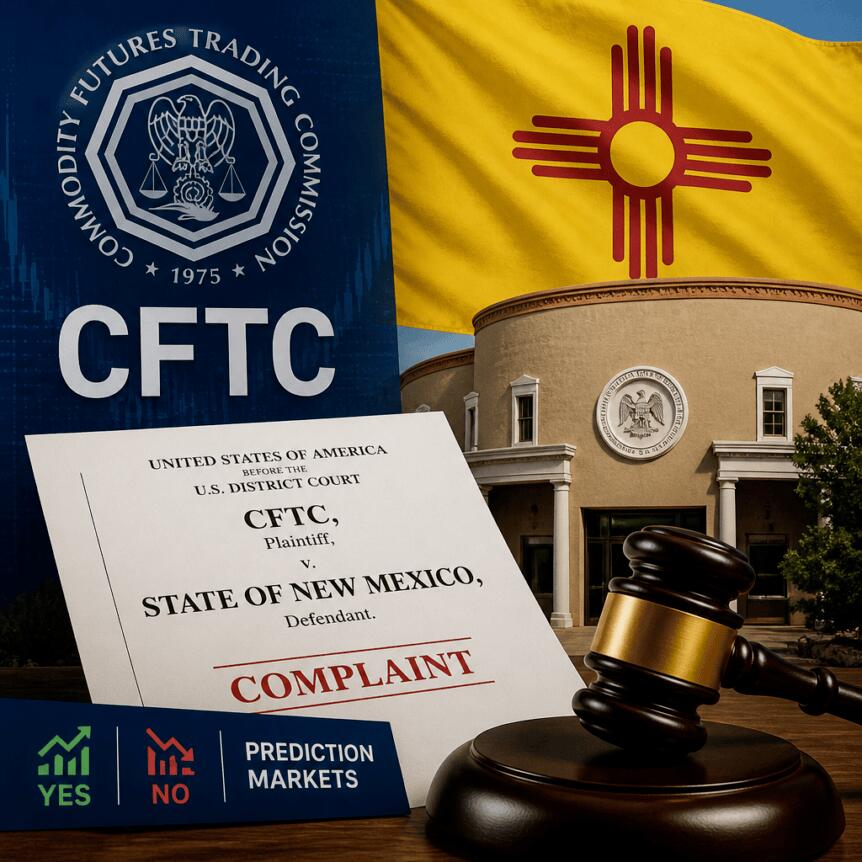
New Mexico has become the latest US state to clash with the Commodity Futures Trading Commission (CFTC) over the regulator’s authority to oversee prediction markets. The CFTC said it filed suit in federal court to stop New Mexico from applying state gaming laws to CFTC-registered contract markets, targeting Governor Michelle Lujan Grisham, state Attorney General Raúl Torrez, and members of the New Mexico Gaming Control Board.
The dispute began after New Mexico sued Kalshi on June 4, alleging the company offered sports betting to residents without the required license and that its sports event contracts operate like traditional sports wagers. The state also argued Kalshi permitted users aged 18 to 20—below New Mexico’s minimum gaming age of 21—to access the platform.
Key takeaways
- The CFTC is asking a federal court to block New Mexico from applying state gaming laws to CFTC-registered contract markets.
- New Mexico’s lawsuit claims Kalshi’s sports event contracts function like sports betting and argues licensing rules and age limits were not followed.
- The CFTC’s position is that event contracts qualify as “swaps” under federal commodities law and fall under the CFTC’s exclusive jurisdiction.
- Gary Gensler, in a separate amicus brief tied to Kalshi litigation, has argued that Congress never intended Dodd-Frank swap definitions to cover sports betting contracts.
CFTC steps in to preserve “exclusive jurisdiction”
In a statement released Friday, the CFTC said it sued New Mexico state officials “to block the state’s efforts to apply state gaming laws against CFTC-registered contract markets.” The regulator framed the case as an attempt by a state to interfere with a federal regulatory scheme established by Congress for commodity derivatives.
According to the CFTC’s lawsuit, event contracts should be treated as “swaps” under US commodities law, placing them within the CFTC’s “exclusive jurisdiction.” The regulator argues that because Kalshi is a Designated Contract Market (DCM), transactions on such platforms fall under federal oversight, not state gambling rules.
The CFTC asked the court to declare that New Mexico laws aimed at restricting transactions on CFTC-regulated DCMs are invalid, and it sought a permanent injunction preventing the state from taking enforcement action against prediction market platforms.
CFTC Chairman Mike Selig said the CFTC would continue to defend its role in overseeing commodity derivatives markets. In the regulator’s view, attempts by states to impose their own gaming frameworks on federally regulated venues undermine “black letter law” and decades of judicial precedent.
The CFTC’s complaint was filed in federal court. The CFTC described its filing in a press release, and court records list the case in a docket for “United States of America v. State of New Mexico.” The docket is available on CourtListener.
New Mexico’s original challenge to Kalshi
New Mexico’s action against Kalshi, filed June 4, argued that the company is effectively offering sports betting without a state license. The state’s complaint, as summarized by the New Mexico Department of Justice, asserts that Kalshi’s sports event contracts are not meaningfully different from traditional sports wagers in how they are used and understood by consumers.
New Mexico also emphasized age eligibility. The state alleged that Kalshi enabled individuals aged between 18 and 20 to participate on the platform, despite New Mexico’s minimum gaming age of 21.
These allegations reflect a broader theme in the emerging prediction market regulatory fights: states are not only questioning whether prediction market products are different from gambling, but also whether they comply with specific state licensing and consumer protection requirements.
A widening map of CFTC-vs-state lawsuits
New Mexico becomes the eighth state the CFTC has sued after state authorities moved against prediction market platforms. The CFTC’s legal actions include earlier cases involving Rhode Island, Wisconsin, Minnesota, New York, and Arizona, Connecticut, and Illinois—according to Cointelegraph’s earlier reporting on those disputes. Cointelegraph covered the Minnesota fight, and earlier reporting detailed New York’s challenge. A broader roundup of earlier state actions also included Arizona, Connecticut, and Illinois.
For investors and platform operators, the growing number of cases increases legal uncertainty around the rules prediction markets must follow across state lines. Even where platforms are registered and approved under federal frameworks, states may pursue enforcement routes through their own gaming laws. The CFTC’s repeated push is that federal jurisdiction should prevent that kind of patchwork regulation.
Gensler questions whether sports bets fit swap law
While the CFTC is arguing that event contracts fall squarely under the federal definition of swaps, former SEC and CFTC chair Gary Gensler has publicly disputed the premise in an amicus brief connected to Kalshi’s litigation with Ohio’s authorities.
In the amicus filing, submitted to the Sixth Circuit on Thursday, Gensler argued that the Dodd-Frank Act—passed after the 2008 financial crisis to establish rules for swaps—was not intended to reach sports betting contracts. He contended that Congress did not include sports betting agreements within the statutory definition of a swap and that sports event contracts do not align with the purpose and language of commodities swap rules, which he said are oriented toward hedging economic risk.
“Sports bets are very rarely, if ever, about hedging,” Gensler argued, according to his statements. The amicus brief is posted on CourtListener in the docket for Kalshi’s case.
Gensler also told CNBC on Thursday that the central question is whether Congress intended to remove state regulation from this category of contracts, suggesting the answer is “categorically ‘No.’”
For markets, this matters because federal outcomes in one case can influence how other states and courts interpret the same statutory framework. The dispute in New Mexico turns on similar legal mechanics—whether state gaming rules can be applied at all to products the CFTC considers federally regulated swaps.
What to watch next
As New Mexico’s federal fight with the CFTC plays out, the key uncertainty is how courts will reconcile state gambling enforcement with the CFTC’s claim of exclusive federal jurisdiction over DCM-cleared event contracts. The more states escalate their legal efforts, the more likely it becomes that appellate decisions addressing whether sports event contracts truly qualify as swaps will shape the regulatory map for prediction markets nationwide.
This article was originally published as CFTC Sues New Mexico Over Prediction Market Regulatory Authority on Crypto Breaking News – your trusted source for crypto news, Bitcoin news, and blockchain updates.
0
0

 Manage all your crypto, NFT and DeFi from one place
Securely connect the portfolio you’re using to start.


