
Remittix Whitepaper 2.0: Understanding the New PayFi Ecosystem

0
0
How Does Remittix Whitepaper 2.0 Define Its Roadmap and Products?
Remittix Whitepaper 2.0 is the newly published document that explains the full Remittix ecosystem in one place. It covers the PayFi payment model, the wallet, trading, yield, the RTX token and the roadmap ahead. This guide goes through the official text section by section, so readers can tell what is confirmed, what is planned and what is still unannounced.
Key Takeaways
The new whitepaper presents Remittix as a full ecosystem, not a single payments tool. PayFi, Wallet, Markets and Earn are built as connected layers around RTX.
The core idea has not changed. A sender pays in crypto, and the recipient receives normal money in a bank account.
RTX has a fixed supply of 1.5 billion tokens, but the whitepaper says the complete utility framework has not been released yet.
What Is Remittix?
Remittix is a PayFi project. It is built to connect digital assets with the traditional banking system.
The problem is easy to picture. Crypto moves across the world in minutes. Turning that crypto into usable fiat money often needs several platforms, exchanges, wallets and banking steps. That gap hurts businesses, consumers and crypto-native organisations alike.
Remittix wants to close it. The sender starts with a digital asset. The recipient receives fiat through supported banking and local payment infrastructure. The recipient does not need to own crypto, manage a wallet or understand blockchain.
Source: official website
Remittix New Whitepaper Explained: Why It Was Released
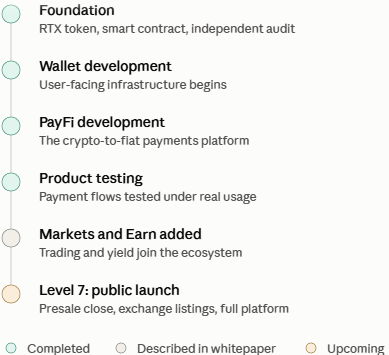
The short answer is that Remittix has grown beyond its original concept. It began with the RTX token, smart contract and core infrastructure, then expanded into the Remittix Wallet and PayFi platform. Testing helped refine its crypto-to-fiat payment model, while the broader vision now connects digital assets, blockchain networks, compliance and traditional payment rails across a wider ecosystem.
The graphic below shows the journey described in the document.
What Is New in Remittix Whitepaper 2.0?
Earlier focus | Now in the whitepaper |
Token and smart contract | Token, audit, wallet, PayFi and tested payments |
One crypto-to-fiat service | Four connected products |
A proposed use case | Infrastructure that has been built and tested |
Payments only | Hold, transfer, trade, earn and spend |
A single idea | A full document with roadmap, risk and security sections |
The announcement lists what the new document covers: the complete PayFi model, how crypto-funded bank payments work, the wallet and connected ecosystem, perpetual futures, supported digital-asset yield, payment routing, settlement and conversion, and the wider vision for global crypto-to-fiat payments. It is aimed at holders, testers, contributors and anyone meeting Remittix for the first time.
The Structural Problem: Why Crypto-to-Fiat Is Still Hard
The Remittix Whitepaper 2.0 spends a full chapter on the problem, starting with The Structural Problem. It breaks the problem into five parts:
Fragmented cross-border payments
International payments run through banks, correspondent institutions, processors, foreign-exchange providers and local settlement systems. The network works, but customers can face intermediary fees, foreign-exchange costs, banking cut-off times, jurisdictional restrictions, delays, limited visibility and several intermediaries in a single transfer.
Why blockchain alone is not enough
Blockchains can move value across borders without the correspondent banking chain. That makes them a strong transport layer. But a token arriving on a blockchain is not the same as usable money in a bank account. Employees, contractors, landlords, tax offices and suppliers usually want fiat. The missing piece is infrastructure that translates one into the other.
The stablecoin angle
Cross Border Payments and Digital Assets points to stablecoins as an important bridge. They let dollar or euro value move across networks with a steady unit of account, and their use has grown from trading into payments, treasury management and settlement. Still, the recipient needs the right currency through the right payment channel, and that final stage is what PayFi targets. The same chapter group includes The Global Payments Opportunity, The Remittance Market and Business Payments.
The Remittix Solution: What PayFi Actually Is
The Remittix Solution describes the project as a financial technology layer connecting digital assets, blockchain infrastructure and conventional payment systems. Its goal is simple: value begins in crypto and finishes in fiat.
The PayFi Model defines PayFi as infrastructure that connects blockchain-based assets with real-world payment and settlement systems. Underneath, many technologies and specialist providers may be involved. On top, the user sees one unified experience.
A few design choices stand out:
One transaction, two financial systems. The sender stays in the crypto world and the recipient stays in the banking world. See One Transaction, Two Financial Systems.
Specialist infrastructure beneath a unified interface. Remittix does not rebuild every rail itself. It integrates third-party providers for payment processing, fiat settlement, compliance and decentralised market execution. See Specialist Infrastructure Beneath a Unified Interface.
Local settlement, not recipient adoption. The recipient is never asked to adopt crypto. See Local Settlement Rather Than Crypto Recipient Adoption.
Compliance by design. Identity checks, enhanced due diligence, anti-money-laundering controls and sanctions screening are performed by authorised third-party infrastructure providers under their own regulatory duties. See Compliance by Design.
This modular setup is meant to support more assets, blockchain networks, fiat currencies and payment corridors without Remittix running every underlying rail directly.
The graphic below follows the complete payment flow from The Complete Payment Flow.
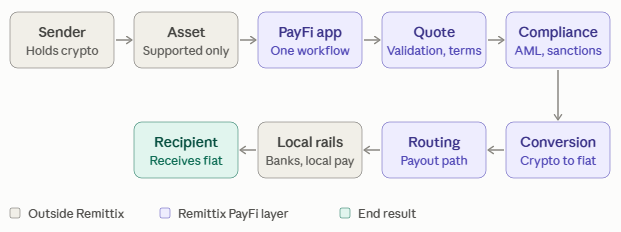
The flow reads left to right on the top row, then right to left on the bottom. PayFi does not replace blockchain or banking. It connects them.
How each stage fits together
The Remittix Whitepaper 2.0 gives every stage its own page in How a Remittix Payment Works:
Stage | Section |
Starting a payment | Payment Creation |
Showing terms before paying | Quote and Payment Terms |
Screening | Compliance |
Paying in crypto | Digital Asset Funding |
Turning crypto into fiat | Conversion |
Choosing the payout path | Payment Routing |
Paying out | Fiat Settlement |
Following the payment | Payment Tracking and Exceptions |
The product itself is introduced in Introducing Remittix PayFi, with sections on Payment Infrastructure, Digital Asset Support, Fiat Settlement and A Unified Payment Experience.
Who Can Use Remittix? Individual and Business Use Cases
Individuals | Businesses |
Cross-border transfers: a crypto holder pays someone who prefers local fiat | Contractor payments: businesses holding digital assets pay contractors who need fiat |
Family payments: crypto as the source, family receives bank money | Supplier payments: treasury assets converted and routed toward supplier invoices |
Freelancer payments: pay a freelancer whose preferred method is fiat | International operations: digital assets as the source, supported local currencies as the result |
Crypto liquidity: move value into the traditional system without juggling several platforms | Treasury conversion: move holdings into traditional payment infrastructure when expenses need fiat |
Businesses are an especially natural fit. Many crypto-native companies hold digital-asset treasuries while their real-world bills are still in fiat. The details sit in Individual Use Cases and Business Use Cases.
Source: RTX use cases
Why PayFi, and Why Now?
Why PayFi, Why Now lays out the timing argument across four ideas:
Blockchain as a Value Layer: digital assets carry value globally, while banks still do the final settlement.
Stablecoins and Payment Infrastructure: stablecoins now work as payment tools, not only trading tools.
Better Local Payment Infrastructure
The official RTX whitepaper 2.0 also places Remittix against other players in Competitive Landscape. It looks at Cryptocurrency Exchanges, Traditional Remittance Providers, Crypto On Ramps and Off Ramps and Stablecoin and Payment Infrastructure Providers, then explains its own position in Positioning Remittix.
The Remittix Ecosystem: Four Connected Products
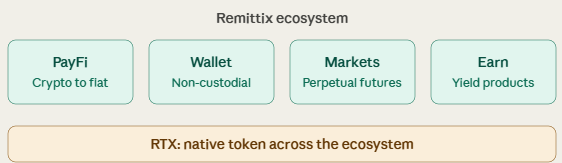
PayFi is the base, but the document describes a wider PayFi ecosystem. The Remittix Ecosystem names four products and says they work as connected layers, not isolated apps. The graphic below shows how they sit around RTX.
Remittix PayFi
PayFi is the core payments layer. It connects crypto liquidity with fiat settlement and enables crypto-funded payments to supported bank accounts and payment destinations. See PayFi inside the ecosystem chapter.
Remittix Wallet
The wallet is non-custodial, which means users keep control of their own digital assets. It also acts as an access point to the wider ecosystem.
Remittix Markets
Markets brings perpetual futures into the ecosystem, built on established decentralised trading infrastructure. Perpetual Futures explains the product: a derivative contract that gives exposure to an asset's price without owning the asset. Unlike traditional futures, there is no fixed expiry.
Source: official documentation
Trading carries real risk, so the whitepaper gives it separate sections: Trading Infrastructure, Leverage and Margin, Funding, Liquidations and The Role of Markets Within Remittix. Anyone planning to trade should read all of them first.
Remittix Earn
Earn is a digital-asset yield platform for supported assets, including stablecoins and other cryptocurrencies such as USDT, USDC and ETH. Yield and APY is careful on one point. The displayed APY is the rate under that product's terms. Rates can change with market conditions, product structure and the source of yield, and an advertised maximum is not a guaranteed return for every asset or user. More context is in The Purpose of Earn, Supported Assets, Product Structure and Risk and The Role of Earn Within Remittix.
One connected environment
Together, the products are meant to let users hold, transfer, trade, earn and eventually use digital assets inside the traditional economy. See One Connected Environment and The Direction of the Ecosystem.
RTX Token Utility, Staking and Allocation
RTX is the native token of the ecosystem. The RTX Token chapter covers its Role Within the Ecosystem and its Fixed Maximum Supply of 1.5 billion. The technical details sit in the Token Specification.
Staking is not the same as Earn
According to Staking, RTX staking remains part of the token model. Eligible holders commit RTX under the available terms and receive rewards. Rates, lock periods and participation conditions are set out in the current staking documentation at the time of use.
The whitepaper keeps staking separate from Earn. RTX staking is a token-specific ecosystem mechanism. Earn is a broader yield product that can involve USDT, USDC, ETH and other supported cryptocurrencies. Keeping them apart makes the economic purpose of each product clearer.
What is confirmed about RTX utility, and what is not
RTX Utility is open about the current state. RTX is meant to be the native economic layer across the ecosystem, with staking already part of the model and extra utility across PayFi, Markets and Earn arriving in stages. But the complete Remittix token utility framework has not been released. The document limits itself to confirmed functions and does not assign speculative roles to RTX. New utility will be added as it is formally announced.
Allocation
According to the published token allocation data, the 1.5 billion supply is split like this. The full breakdown sits under Token Allocation.
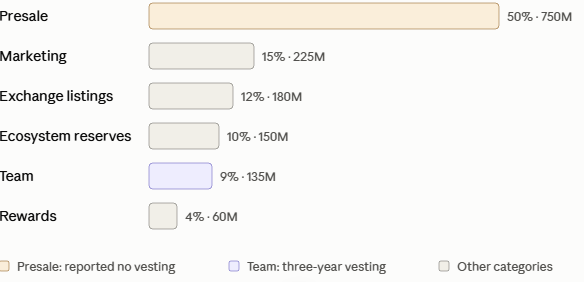
The presale bucket is by far the largest. Public reports on the token documentation say presale tokens carry no vesting and become claimable from the dashboard five days after launch, while the 135 million team tokens vest over three years. Unsold presale tokens are reported to be burned instead of being added to supply later. Readers should confirm the exact wording in Presale Allocation, Team Allocation and Vesting and Long Term Supply, because vesting shapes how much supply can trade early.
The remaining buckets have their own pages: Marketing, Exchange, Ecosystem Reserves and Rewards. For supply questions, see Team Vesting, Circulating Supply and Future Token Mechanics.
Security: Audit, Architecture and Personal Habits
The audit
The RTX contract has been independently reviewed by CertiK, with the report available at skynet.certik.com/projects/remittix-labs. The whitepaper's CertiK Review adds a caution. An audit reduces certain technical risks but does not remove all risks of blockchain technology, digital assets or the wider ecosystem.
Protecting wallet access
Protecting Wallet Access is short but important. Remittix administrators, support staff and community moderators will never require a user to disclose a private key or recovery phrase. Those credentials control the assets in a wallet and must stay private. Users should be especially careful with unsolicited direct messages about:
Token claiming
Wallet validation
Account recovery
Staking
Investment opportunities
Private token sales
Urgent security warnings
Fraud often depends on urgency, pushing people to connect wallets, sign transactions or share sensitive information. Other safety pages worth bookmarking are Official Information and Security, Official RTX Contract, Official Channels and Transaction Verification.
Development Progress and Roadmap
The Roadmap runs in seven levels:
Level | Focus |
Level 1 | Foundation |
Level 2 | Early growth and wallet development |
Level 3 | Product expansion |
Level 4 | PayFi completion and ecosystem expansion |
Level 5 | Markets, Earn and launch preparation |
Level 6 | Full RTX utility and ecosystem integration |
Level 7 | RTX and public ecosystem launch |
What Level 7 contains
Level 7 is marked as upcoming. It includes:
Closing the RTX presale when the hard cap is reached or on the confirmed closing date
Launching RTX trading on Uniswap and locking the initial liquidity pool
Launching RTX on confirmed centralised exchanges
Completing the full public launch of the crypto-to-fiat platform
Continuing exchange expansion, product development and global user growth
Public coverage reports 24 November 2026 as the RTX launch date. The whitepaper itself says Level 7 is not the end of development. It is the point where the ecosystem can focus on scale, product expansion and international adoption. For what comes after, see Beyond Level 7.
The Long-Term Vision
The executive summary states the end goal plainly. The objective is broader than simplifying crypto withdrawals. Remittix is working toward a setup where the asset held by the sender and the currency needed by the recipient no longer have to match. A user may hold crypto, the recipient may need euros or dollars, and Remittix provides the infrastructure between the two.
This idea is developed in A Broader Financial Ecosystem, The Long Term Objective and Long Term Vision.
Risk Factors and Legal Notes
A fair reading of any whitepaper includes its risk chapter. Risk Factors covers:
Area | Sections |
Market | Digital Asset Market Risk, Liquidity Risk |
Token | RTX Token Risk, Stablecoin Risk |
Technical | Smart Contract Risk, Blockchain Network Risk |
Payments | Third Party Infrastructure Risk, Payment and Settlement Risk, Conversion and Foreign Exchange Risk |
Products | Remittix Markets Risk, Remittix Earn Risk, Custody Risk |
Other | Regulatory Risk, Development and Execution Risk |
The Legal Disclaimer chapter adds No Guarantee of Return, Forward Looking Statements, Product Availability, Regulated Financial Activity, Blockchain Transactions and Taxation.
Final Thoughts
Remittix Whitepaper 2.0 shows a project that has moved from an idea to tested payment infrastructure, with a wider ecosystem built around it. It is also direct about its limits. RTX utility is not fully released, Level 7 is still upcoming, and the risk section is long.
For readers, the best approach is simple. Go through the official sources, check the latest version of the document, confirm availability for your region and keep your wallet details private. Everything else is a personal decision.
Disclaimer:This article is for information only and is not financial advice. Crypto assets carry risk, and project details may change.
0
0
 Manage all your crypto, NFT and DeFi from one place
Securely connect the portfolio you’re using to start.