
South Korea Proposes Fourth Crypto Tax Deferral, Aims for 2029 Start

0
0
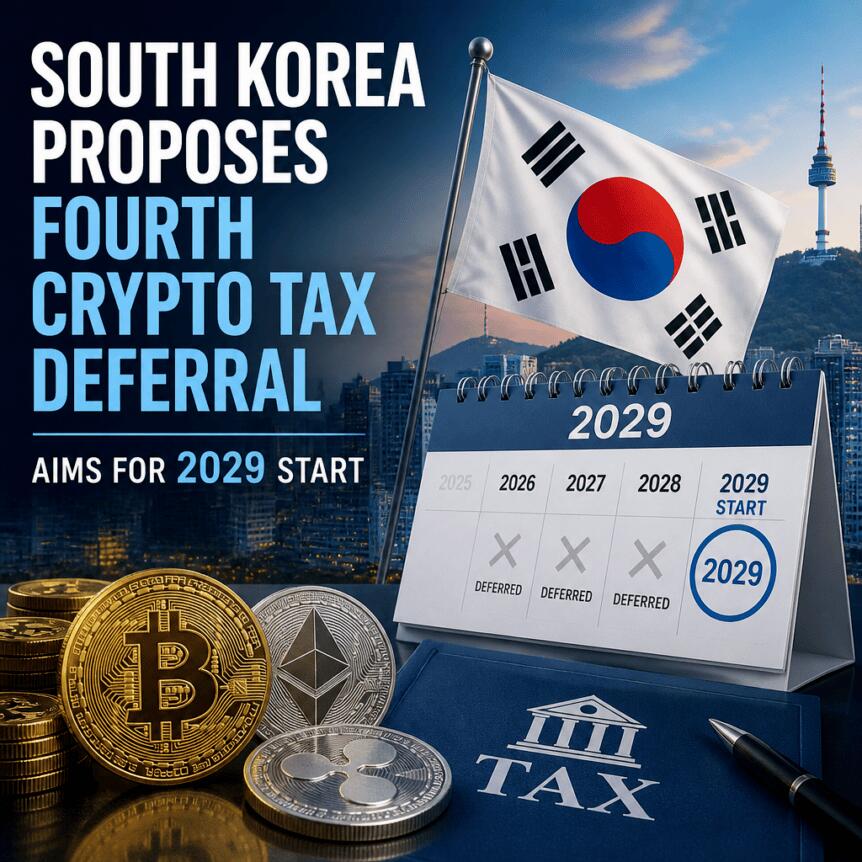
South Korea’s government is moving to delay its planned cryptocurrency gains tax by two more years, pushing the levy’s start date to 2029—its fourth postponement of the measure.
Finance Minister Lee Hyoung-il announced the proposal on Thursday, saying the ministry will consult lawmakers about shifting the current January 2027 implementation deadline. If approved, the tax would be applied on annual crypto gains above 2.5 million won (about $1,860), with a headline rate of 22% composed of a 20% income tax and a 2% local tax.
Key takeaways
- South Korea’s crypto gains tax could be delayed to 2029, extending a schedule that has already been pushed back three times.
- The government points to the start of US information exchanges under the Crypto-Asset Reporting Framework (CARF) as a reason to align timing.
- Officials say delaying the tax would help avoid putting local traders at a disadvantage versus overseas markets before cross-border reporting begins.
- The proposal includes a three-year loss carryforward mechanism to help investors offset future gains with prior crypto losses.
- South Korea’s earlier stance supporting a 2027 rollout appears to have changed, following growing industry pressure to clarify tax rules and prepare systems.
Why 2029 is the new target
The Finance Ministry’s rationale centers on international reporting. Officials cited 2029 as the point when information exchange with the United States is expected to begin under the Crypto-Asset Reporting Framework (CARF). They argued that applying the tax before these exchanges are underway could disadvantage South Korea’s domestic market relative to markets abroad that may benefit from fuller cross-border compliance and reporting.
The ministry also linked the timing to broader policy work, noting that it wants to account for changes under planned digital asset legislation. In practice, that means the government is treating the crypto tax rollout as part of a wider regulatory transition rather than an isolated revenue measure.
How the tax would work if enacted
Under the measure described by the minister, the levy would apply to annual crypto gains above the 2.5 million won threshold. The government’s stated rate—22% total—would break down into a 20% income tax plus a 2% local tax.
Alongside the delay, officials said they intend to introduce a three-year loss carryforward provision. The concept is straightforward: investors would be able to offset crypto losses against taxable profits earned over the following three years, reducing the risk that taxpayers face a higher net tax burden in years where gains occur despite prior losses.
Operationally, the ministry plans to submit amendments to improve the tax system during South Korea’s regular parliamentary session in 2027. More detailed tax guidelines are expected in the first half of 2028, suggesting that even if lawmakers approve the delay, practical rules for reporting and compliance would still take time to finalize.
From 2022 to 2029: the pattern of postponements
The proposal marks another step in a prolonged rollout history. The crypto gains tax was initially scheduled for January 2022, then postponed to 2023, 2025, and most recently 2027. With a new target date of 2029, the policy would be set to begin only after a cumulative seven-year shift from the original plan.
Importantly, the government is not merely reiterating a prior delay. The proposal reverses an earlier position: a Finance Ministry official previously indicated, in May, that implementation would proceed in 2027, according to earlier coverage reported by Cointelegraph.
Industry pressure and unresolved tax mechanics
South Korea’s move comes after renewed discussions between finance officials and major crypto exchanges, amid mounting calls to further postpone the tax. Industry representatives have cited unresolved details about how different transaction types should be treated for tax purposes, as well as insufficient time to build or update the infrastructure needed to comply with reporting requirements.
That backdrop helps explain the ministry’s change in posture. Even as the government has continued refining the tax framework, exchanges have raised concerns that unclear rules could create compliance burdens, inconsistent reporting, or operational risk for market participants.
The government’s new approach—tying timing to CARF-related information exchange and to upcoming digital asset legislation—also indicates an attempt to synchronize taxation with the evolving regulatory and reporting environment, rather than forcing immediate implementation before key cross-border systems are in place.
For traders and long-term investors, the key watchpoints now are parliamentary progress on the 2029 date, and the specifics of the tax guidance expected in the first half of 2028—especially how the system will handle loss carryforwards and the tax treatment of different crypto transaction types. The uncertainty may not disappear immediately, but the direction is clear: South Korea is signaling that it wants tax enforcement to arrive alongside clearer rules and better international reporting alignment.
This article was originally published as South Korea Proposes Fourth Crypto Tax Deferral, Aims for 2029 Start on Crypto Breaking News – your trusted source for crypto news, Bitcoin news, and blockchain updates.
0
0
 Manage all your crypto, NFT and DeFi from one place
Securely connect the portfolio you’re using to start.