
Orochi Network: Proof Network Utility Versus 79% Token Rally

0
0

Why Is Orochi Network ON Getting Attention in Crypto
Orochi Network and its ON token are drawing attention in crypto news today, with a 79% rally figure repeated across headlines and India crypto news coverage. The central question is whether real network demand or quick trading explains the move.
A single verified timeframe for a 79% gain could not be confirmed. Market figures below are dated November 16, 2026, and come from live market data. One related number matters: ON trades about 79% below its all-time high of $0.4477, set on August 7, 2026. That is a decline, not a rally.
What Is Orochi Network (ON)?
Orochi Network is a Verifiable Data Infrastructure (VDI) project that uses cryptography to verify off-chain data. Its ecosystem includes zkDatabase, and ON is the native token used for staking, storage, sequencer rewards, and fees, according to the official token documentation.
Orochi Network technology combines three tools. Zero-Knowledge Proofs (ZKP) let someone prove a fact without revealing the data behind it. Fully Homomorphic Encryption (FHE) allows computing on encrypted data. Trusted Execution Environments (TEE) run sensitive tasks inside protected hardware.
How Does Orochi's Proof Network Work?
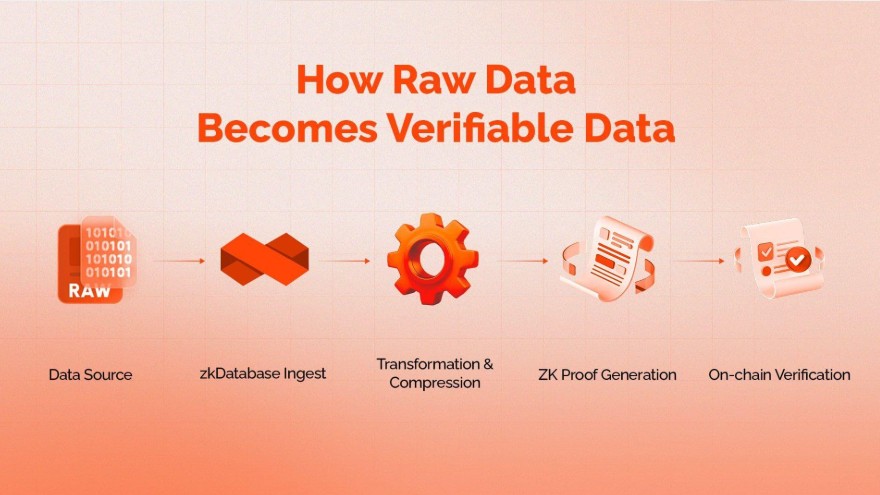
The Orochi Network ecosystem treats data as a pipeline. Raw data enters zkDatabase, a distributed NoSQL database, gets compressed, receives a zero-knowledge proof, and is verified on-chain. Each step leaves a cryptographic record, so outcomes can be checked without trusting one operator.
Project material claims Ethereum verification costs can fall from about $25 to $0.002 per kilobyte. That remains a project figure and was not independently confirmed.
A limit applies. Orochi's own explanation of verifiable data describes the layer as a supplement to oracles and auditors, not a replacement. A proof shows that data was handled correctly, not that the original input was true.
How Raw Data Becomes Verifiable Data: Five Stages
The project's process graphic splits the journey into five stages:
Data Source: Raw records come from databases, applications, or other off-chain systems.
zkDatabase Ingest: the records enter the Orochi zkDatabase for structured storage.
Transformation and Compression: the data is reshaped and reduced so proofs stay efficient.
ZK Proof Generation: provers create a cryptographic proof that the processing was done correctly.
On-chain Verification: A smart contract checks the proof and confirms the result.
What Is the Real Utility of the ON Token?
ON token utility covers four jobs in the official documentation.
Validator incentives: validators stake ON to join network consensus and earn rewards, so ON token staking forms the base security layer.
Distributed storage: users pay ON to use distributed storage services.
ZK sequencer rewards: sequencers earn ON for processing transactions and supporting privacy.
Transaction fees: ON pays for network transactions and interactions.
Through ONProver, users can contribute browser-based computing power to generate proofs. The documentation says contributors earn rewards, though the reward formula is not detailed.
What Do the ON Tokenomics and Token Allocation Look Like?
The allocation chart uses a maximum supply of 1 billion ON. Total supply is listed at 700 million ON, and circulating supply is reported near 196 million, although another provider shows about 144 million. Definitions differ by source.
Allocation | Tokens | Share |
Network Incentives | 300 million | 30% |
Ecosystem Reserve | 215.5 million | 21.55% |
Foundation | 150 million | 15% |
Marketing and Liquidity | 116.5 million | 11.65% |
Team | 100 million | 10% |
Investors | 80 million | 8% |
Airdrop | 38 million | 3.8% |
Total | 1,000 million | 100% |
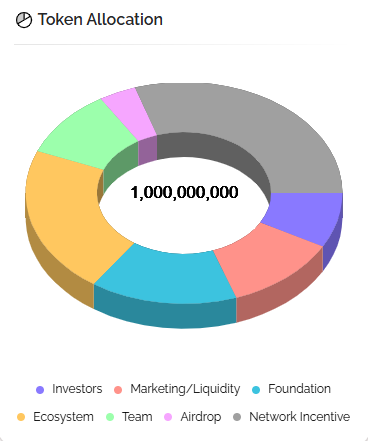
Network incentives hold the largest share, tying much of the supply to validator, prover, and sequencer rewards. Investor and team shares usually follow a vesting schedule, a set timeline for releasing tokens. Vesting dates were not published in the sources reviewed, so future unlocks remain unconfirmed.
On November 16, 2026, market cap was near $18.14 million, while fully diluted valuation (FDV) was near $92.45 million. Market cap counts circulating tokens only, whereas FDV assumes the full 1 billion supply.
Why Did Orochi ON See a 79% Price Movement?
Reports point to several triggers: a short squeeze (forced buying by traders betting on a fall), renewed interest in zkDatabase and proof of reserves, and cross-chain access.
Chainlink's CCIP token directory lists ON on BNB Chain and a wrapped version, wON, on Ethereum. Provider figures conflict, and gains differ by timeframe and trading pair. Earlier reports cited single-session jumps between roughly 73% and 84%, so the 79% label may describe one such session.
Wallet concentration may have amplified the move, since reported on-chain data shows a small group of wallets holding most of the supply. Thin liquidity can exaggerate swings in both directions. Confirmed triggers should stay separate from guesses about whale behavior.
Which Orochi Network Products Could Drive Adoption?
zkDatabase: a verifiable database infrastructure for secure and provable data.
zkDA Layer: data availability infrastructure.
Orocle: a decentralized off-chain data oracle.
Orand: a verifiable randomness generator.
zkMemory: a memory prover for zero-knowledge virtual machines.
Can Orochi Network Support Real-World Use Cases?
Real-world asset tokenization is the clearest target. RWA crypto projects bring bonds, credit, and property onto blockchains, and tokenized RWA products depend on accurate off-chain records. RWA data infrastructure can make reporting steps checkable, but it cannot confirm that an underlying asset exists.
Stablecoin proof of reserves is a second use case, and on-chain credit and decentralized finance (DeFi) compliance checks form a third. Each needs trustworthy inputs.
How Does Orochi Network Compare With Other ZK Projects?
Chainlink focuses on oracles and cross-chain messaging, while Orochi Network focuses on verifiable data storage and processing. Roles overlap in places, and no evidence reviewed shows that one approach is better.
What Are the Biggest Risks for the ON Token?
Unconfirmed token unlock dates, differing supply figures, selling pressure, and price swings top the list. Adoption may also lag, speculation about rival zero-knowledge projects exists, and product delivery remains an open question. Cross-chain bridges and wrapped tokens such as wON add technical risk.
What Should Investors Watch Next?
Active validators, active provers, verified proofs, developer integrations, ON staking participation, storage demand, and trading liquidity offer the clearest evidence. Public figures for most of these were not found in the sources reviewed. Readers should also verify token contract addresses on official pages before interacting.
Conclusion: Is Orochi ON More Than a Price Rally?
Orochi Network offers a clear idea: make off-chain data provable, with ON tied to staking, storage, sequencing, and fees. The 79% figure remains unverified as a rally, and supply definitions need careful reading.
Network participation, verified proofs, and real token demand will matter more than any short-term move.
Disclaimer
Crypto assets are highly volatile and high risk. This article is for information only and is not financial advice. Readers should research independently and consult a licensed financial advisor before making any decisions.
0
0
 Manage all your crypto, NFT and DeFi from one place
Securely connect the portfolio you’re using to start.