
Chainlink Crypto News: Four Integrations Expand DeFi and Compliance

0
0

Chainlink Crypto News: Four Integrations Expand DeFi Reach
Chainlink has shared four fresh integrations, and together they cover some of the biggest themes in crypto right now: moving tokens across chains, getting fast and verifiable prices, automating workflows, and keeping exchanges compliant.
In this Chainlink crypto news update, we break down each partnership in simple words, explain the tools involved, and look at how LINK is trading today.
Source: Chainlink’s official X post
Key Takeaways
-
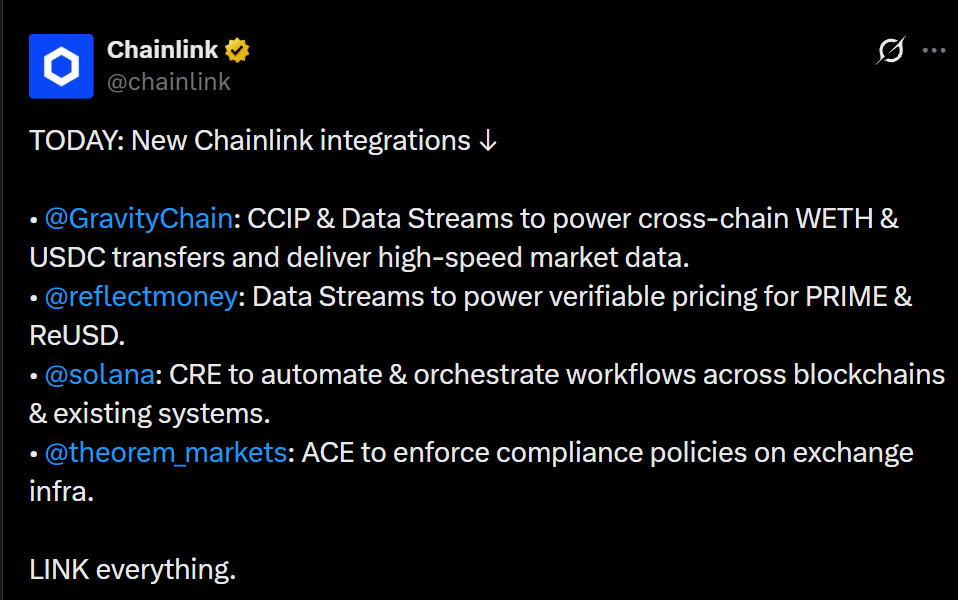
Gravity Chain will use CCIP and Data Streams for cross-chain WETH and USDC transfers and fast market data.
-
Reflect Money will use Data Streams for verifiable pricing of PRIME and ReUSD.
-
Solana is adopting CRE to automate workflows across blockchains and existing systems.
-
Theorem Markets will use ACE to enforce compliance policies on exchange infrastructure.
What Chainlink Announced: The Four Integrations at a Glance
According to the official post, these are the new integrations:
| Partner | Chainlink Tool | Planned Use |
| Gravity Chain | CCIP and Data Streams | Cross-chain WETH and USDC transfers, plus high-speed market data |
| Reflect Money | Data Streams | Verifiable pricing for PRIME and ReUSD |
| Solana | CRE | Automating and orchestrating workflows across blockchains and existing systems |
| Theorem Markets | ACE | Enforcing compliance policies on exchange infrastructure |
This Chainlink crypto news matters because each partner picked a different part of the same toolkit, which shows the platform covers several needs at once.
Each tool solves a different problem, so the sections below explain them one by one.
Gravity Chain: Cross-Chain Transfers and Fast Data
Gravity Chain is picking up two tools at once. The first is CCIP, Chainlink’s Cross-Chain Interoperability Protocol, which lets assets and messages move between blockchains.
The official CCIP release notes explain that WETH transfers work through a lock and unlock method: tokens are locked on the source blockchain, and the same amount is released on the destination blockchain. For stablecoins, the official USDC tutorial shows that CCIP handles native USDC transfers by using Circle’s Cross-Chain Transfer Protocol.
The release notes also record that CCIP became generally available on the mainnet and testnet on April 24, 2024, so this is not a brand-new product.
The second tool is Data Streams, which supplies the fast market information mentioned in the post.
Reflect Money: Verifiable Pricing for PRIME and ReUSD
Reflect Money will use Data Streams to power pricing for PRIME and ReUSD.
The official Data Streams page describes it as a pull-based oracle that delivers low-latency market information offchain, which applications can then verify onchain.
In plain words, an app asks for the latest price only when it needs one, and the price can be checked for accuracy.
The same page says this design supports sub-second resolution and can be more efficient than push-based oracles, which publish updates onchain all the time, even when nobody needs them.
The page lists perpetual futures and options among the use cases, and developers can reach the service through SDKs and APIs.
For users, verifiable pricing matters because fair prices decide how products are valued and traded.
Solana and Theorem Markets: Workflow Automation Meets Compliance
Two other partners are using newer products. Solana is adopting CRE, short for Chainlink Runtime Environment.
The CRE documentation calls it an orchestration layer for institutional-grade smart contracts that are data-connected, compliance-ready, privacy-preserving, and able to work across blockchains and existing systems.
Developers build workflows with an SDK in Go or TypeScript, and those workflows run on a decentralized oracle network.
The docs also define a capability as a small decentralized service, such as reading from or writing to a blockchain, or fetching information over HTTP.
Theorem Markets is choosing ACE, the Automated Compliance Engine. The ACE overview describes it as a compliance layer for EVM smart contracts, with onchain contracts that enforce rules and a platform to manage them. Chainlink’s technical blog on ACE lists three services: a policy manager, an identity manager, and a monitoring and reporting manager.
The ACE docs page also labels the product as "Beta," so readers should expect changes over time.
Chainlink’s ACE page adds that ACE and CCIP can be combined to support compliance in cross-chain transactions involving digital assets, which shows how these tools can work together.
LINK Price Today: Market Reaction
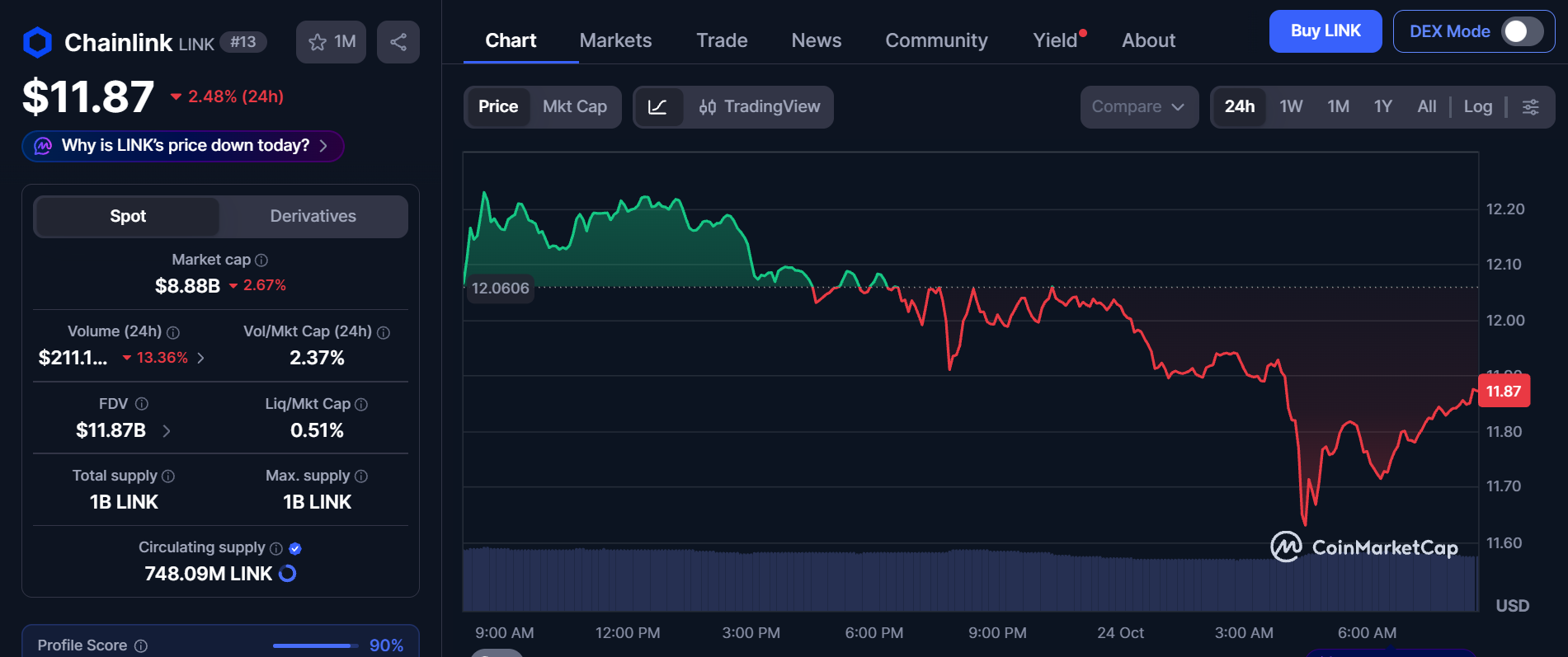
Here is how LINK looks on CoinMarketCap at the time of writing:
| Metric | Value |
| Price | $11.87 (-2.48% in 24h) |
| Market cap | $8.88B (-2.67%) |
| 24h volume | about $211M (-13.36%) |
| Volume / market cap | 2.37% |
| Liquidity / market cap | 0.51% |
Source: CoinMarketCap live data
On the 24-hour chart, LINK opened near $12.06 and touched roughly $12.20 early on. It then slipped to around $11.63 in the early hours of October 24 before recovering to $11.87.
Chainlink crypto news like this does not always move the price right away, and no direct link can be drawn between the announcement and today’s dip.
Lower volume also suggests that traders were less active. The market cap of $8.88 billion fell 2.67%, a little more than the 2.48% drop in price.
One useful point from the numbers: about 748 million of the 1 billion LINK supply is already in circulation, which is why the fully diluted valuation sits above the current market cap.
Conclusion
These four integrations show how widely the network’s tools are spreading, from cross-chain transfers and price feeds to workflow automation and compliance.
For readers following Chainlink crypto news, the main thing to watch is how each partner moves from announcement to live use.
Always check the official Chainlink X account and the documentation pages linked above for confirmed launch details and timelines.
Disclaimer
This article is for educational and informational purposes only and is not financial or investment advice. Crypto assets are high risk, their prices can be very volatile, and you can lose some or all of your money. Always do your own research and consider speaking with a licensed financial advisor before making investment decisions.
0
0


 Manage all your crypto, NFT and DeFi from one place
Securely connect the portfolio you’re using to start.


