
How to Stake Gram: A Step-by-Step Guide for New GRAM Holders

0
0

Many people opened Telegram lately and found a coin they never planned to hold. Most of those Gram balances sit idle. If you want yours to earn, learning how to stake Gram takes a few steps and no coding.
Staking means locking coins to help secure a network in return for rewards. Every figure below has a named source and a date.
What Should You Know Before You Stake Gram Today?
Gram (GRAM) is the new name of Toncoin (TON). The ticker changed on 15 June 2026, with no swap or migration needed.
Easiest route: You deposit GRAM and get a receipt token, such as tsTON.
Yield: floating, never fixed. A tracker showed 11.7% to 16.4% on 15 November 2026.
Exit: about a minute with an instant option, or up to 36 hours.
Before depositing, ask whether the pool is audited and what happens if it runs low on liquid GRAM.
How Does Gram Staking Work on the TON Network?
Gram runs on a proof-of-stake network, and that design shapes how to stake Gram safely. Validators are the nodes that confirm blocks, and they lock a large deposit to do it. The TON documentation puts the technical minimum at 300,000 GRAM and the practical one near 1,000,000.
Few people hold that much, so the same page tells small holders to use a third-party service. Liquid staking spreads your deposit across validators and hands you a token while rewards build.
Background is in our guide to Toncoin and the Telegram blockchain. The name change is covered in why Toncoin became Gram.
How to Stake Gram With a Liquid Staking Pool Step by Step?
These steps follow Tonkeeper's guide. Help pages often still say TON, so expect both names.
Install a TON wallet and write the recovery phrase on paper.
Send GRAM to it, plus at least 1.1 coins spare for the fee.
Tap Stake and choose Tonstakers .
Tap Deposit, enter the amount, and confirm.
Look for the receipt token. Its value rises as rewards build.
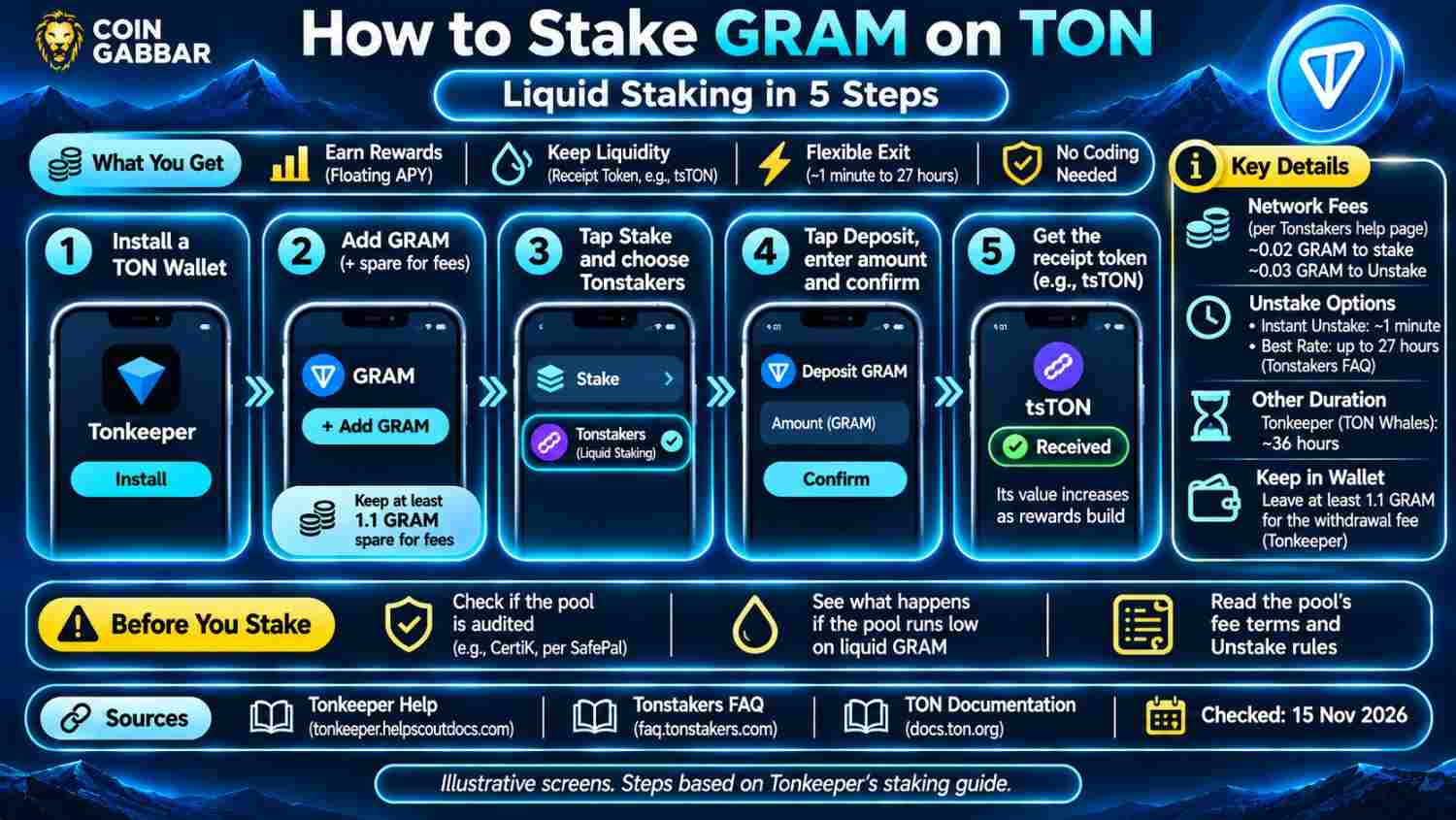
That covers how to stake Gram for most beginners. Tonstakers lists network fees of about 0.02 coins to stake and 0.03 to unstake.
Its Instant Unstake option takes about a minute, while Best Rate waits for the validation round and can take up to 27 hours. Tonkeeper quotes about 36 hours for TON Whales. Keep 1.1 spare coins for the withdrawal fee.
Which Gram Staking Pool Pays What in November 2026?
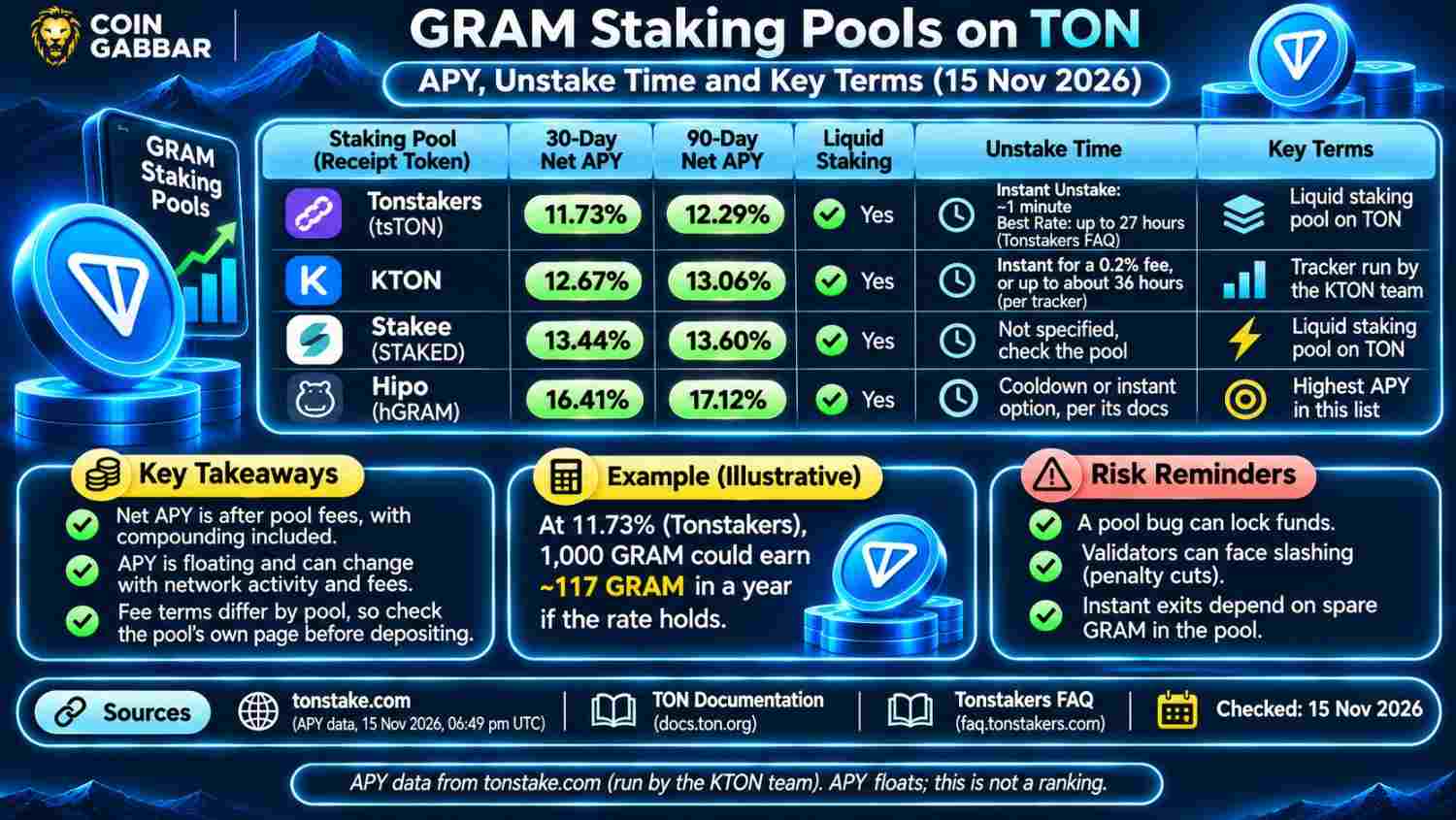
Net APY is the yearly rate after pool fees, with compounding included.
Pool (token) | 30-day APY | 90-day APY |
Tonstakers (tsTON) | 11.73% | 12.29% |
KTON | 12.67% | 13.06% |
Stakee (STAKED) | 13.44% | 13.60% |
tonstakersGRAM) | 16.41% | 17.12% |
Source: tonstake.com, as of 15 November 2026. The tracker is run by the KTON team, which it discloses. Rows are not a ranking.
Fee terms differ by pool, so read each pool's own page before depositing. At the 11.73% tonstakers rate, 1,000 GRAM would earn about 117 GRAM in a year if the rate held. CoinGabbar calculation, illustrative only.
How to Stake Gram on an Exchange or a Hardware Wallet?
On an exchange, how to stake Gram is simple, but the platform holds your keys and can pause service, as our list of exchanges shows. Crypto.com disabled TON staking on 23 June 2026 during the rebrand, then converted staked coins to GRAM at 1:1.
For how to stake Gram offline, a hardware wallet keeps keys away from the internet. SafePal's 12 August 2026 guide describes pairing the device, opening GRAM staking in the app, and confirming on the device. It says the feature isn't offered in the US or UK.
Telegram's own wallet is different. Pavel Durov said on 9 November 2026 that 714,844 new self-custodial wallets appeared in 48 hours. His announcement concerned wallets activating when someone receives Gram.
How Is Gram Staking Income Taxed for Holders?
The Income Tax Department says income from transferring a virtual digital asset is taxed at a flat 30% plus surcharge and cess. Only the cost of acquisition is deductible, and losses can't be set off.
A 1% TDS under Section 194S applies to payments for a transfer above set limits. It is withholding, not an extra tax.
Keep a record of each reward's date and price, and ask a chartered accountant.
What Risks Come With Staking Gram on TON Today?
The risks come before the yield. A pool bug can lock funds, and TON's documentation also mentions slashing, a penalty cut from a validator's stake. SafePal says Tonstakers is audited by CertiK. An audit lowers risk but never removes it.
Instant exits depend on spare GRAM in the pool. Using the receipt token in other DeFi apps adds another layer.
Yields also depend on network activity and fee income, and both can shrink, so the rate you see today may not last.
Expert Opinion: Is Staking Gram Worth the Risk Right Now?
CoinGabbar analysis suggests liquid staking is the practical path for small holders. A spread from 11.73% to 16.41% hints at different fee models or risk levels.
A small test deposit and an unstaked reserve are a sensible start when deciding how to stake Gram. This analysis considers pool yields, fee disclosures, unstaking terms, audit statements, and the tax position.
Disclaimer: This article is for information only. It is not financial, tax or investment advice. Staking returns are not promised or assured, yields and prices can fall, and a smart contract can fail. Confirm details in your wallet before you act.
0
0
 Manage all your crypto, NFT and DeFi from one place
Securely connect the portfolio you’re using to start.