
Binance misses November LUNC burn, testing Terra Classic's exchange reliance

0
0
So far, the anticipated Luna Classic (LUNC) burn planned for November 1 by Binance has not materialized. This is the end of a monthly trend that began in March. While the missing tokens do not affect the token supply significantly, it raises the larger problem of the fact that Terra Classic still relies on one centralized exchange.
A monthly ritual that didn’t come
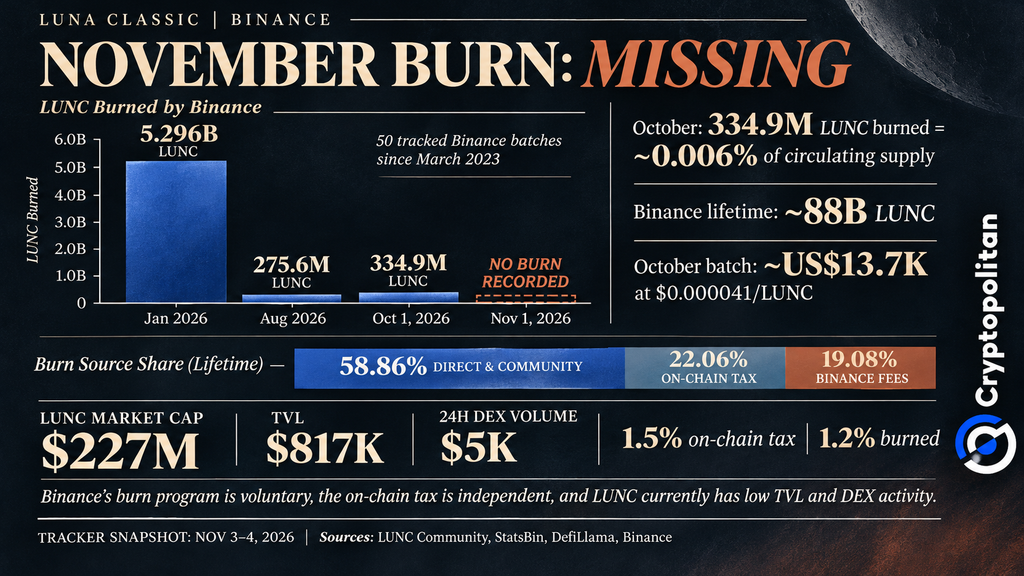
On November 3, Decrypt released a report about the missing burn. This is supported by the LUNC Community records that showed 50 batches from Binance. The last one, which was on October 1, saw the removal of around 335 million tokens.
However, the missed burn does not imply that Binance has ceased its burn activities. Binance’s existing LUNC burn policy gives up to the fifth of every month to compute the trading fees. According to one of the contributors to Terra Classic, there may be changes in wallet security that caused the delay. Binance has not yet confirmed the reason for the delay.
The uncertainty is important to a community that sees Binance’s monthly burns as a sign of continued support. “It is an important sign of support and a vital part of the overall burn campaign,” Terra Classic contributor Dawid Skinder told Decrypt.
Why the dollar impact is tiny
The October burn performed by Binance eliminated 334.88 million LUNC, which accounted for just 0.006% of the approximate 5.5 trillion tokens in circulation. The value of the burned tokens at the LUNC’s price of $0.000041 on November 3 was around $13,700. The market cap of the token was about $227 million.
The impact also depends on how much Binance burns each month. Its records show a sharp difference between January 2026, when it burned 5.296 billion tokens, and August, when the figure fell to 275.6 million.
These numbers show why missing one monthly burn would barely affect LUNC’s supply. But for holders who see regular burns as a sign of Binance’s commitment, the delay could do more damage to confidence than to the token’s supply.
Exchange goodwill versus on-chain rules
Trading fees collected from LUNC spot and margin markets are capped at half the amount by Binance. Although the program is voluntary, it shortly made the exchange a notable supporter of Terra Classic. So far, Binance says it has burned around 88 billion LUNC.
Terra Classic also has its own burn mechanism. In August, proposal 12223 raised the on-chain transaction tax to 1.5%. Of that, 1.2 percentage points go toward burning tokens. The remaining 0.3 points are split equally between the community and oracle pools.
According to the burn tracker, direct and community efforts account for 58.86% of historical burns. Transaction taxes contribute another 22.06%, while Binance accounts for 19.08%.
These figures show that Terra Classic can continue burning tokens without Binance. What the community risks losing is the confidence that comes with the exchange’s regular support.
The hack hanging over the delay
The missed burn comes at a difficult time for Binance. The exchange is still recovering from an October 29 $6.3 billion theft, which the FBI attributed to North Korea. Reuters reported that Binance used company funds to cover 95% of the stolen assets.
Cryptopolitan reported that the attackers used a fake job interview and exploited an internal AI tool.
The timing has caused some to wonder if the security breach has led to the delayed burn. An unconfirmed explanation regarding wallet-security has only added to the speculation. But there have been no indications from Binance that there is a connection between the two.
The bigger threats to LUNC’s revival
Beyond the missing burn, Terra Classic faces a more pressing problem: attracting users and rebuilding activity on its network.
On November 3, DefiLlama showed just $817,000 in total value locked and around $5,000 in daily decentralized-exchange trading volume. These figures point to limited activity despite the community’s efforts to reduce LUNC’s supply.
Cryptopolitan has previously clarified that the price trends of LUNC have been mainly driven by community sentiment and Binance trading as opposed to the utility of the LUNA network.
While regular burns can sustain interest from investors, burning tokens alone will not be enough for Terra Classic to bounce back. The network needs enhanced liquidity and a broader user base to ensure that its recovery is sustainable. Until this happens, the dependence on Binance remains a worry, no matter if any further burns take place.
If you're reading this, you’re already ahead. Stay there with our newsletter.
0
0


 Manage all your crypto, NFT and DeFi from one place
Securely connect the portfolio you’re using to start.


