
DeFi Economics: Who Really Controls the Money and the Risk?

0
0

DeFi Economics: Who Really Controls the Money and the Risk?
Code runs the contracts, yet people still hold the keys, the votes, and the early token stacks. So who really controls the money?
DeFi economics looks different when you follow the losses. A 2025 study of 1,141 crypto crime events found that protocol teams were often the victims and sometimes the culprits. Our guide to what decentralized finance is covers the basics.
This guide uses three research papers to show where control sits, where profits gather, and what the crime record says.
Key takeaways
Protocol teams were the target in 52% of recorded crime events. That caused 83% of the recorded losses.
In 41% of incidents, the team itself was the culprit, mostly through rug pulls.
In January 2022, the top 10 validators held 14% of stakes across the ten largest proof-of-stake chains.
Three exchanges handled about 70% of decentralized exchange volume.
Is DeFi Really Decentralized or Just Rebranded Control?
Decentralized finance runs on smart contracts, code that executes on a blockchain. No bank sits in the middle. That is the promise.
MIT Sloan’s Antoinette Schoar and Igor Makarov of the London School of Economics test it in a Brookings paper. They find that rents can still build up. A rent is profit earned from a position that rivals struggle to copy.
Their view is that rents gather where scale and network effects limit competition. They also find that most crypto projects keep ownership concentrated, since developers and early investors hold large stakes.
Who Holds the Power: Validators, Exchanges, or Developers?
Control shapes DeFi economics at several layers. Validators are the computers that confirm blocks. In January 2022, the top 10 held over 25% of capacity on typical proof-of-stake chains. The top 50 held over 50%.
Many run on several chains. Across the ten largest, the top 10, 50, and 100 validators held 14%, 32%, and 41% of stakes.
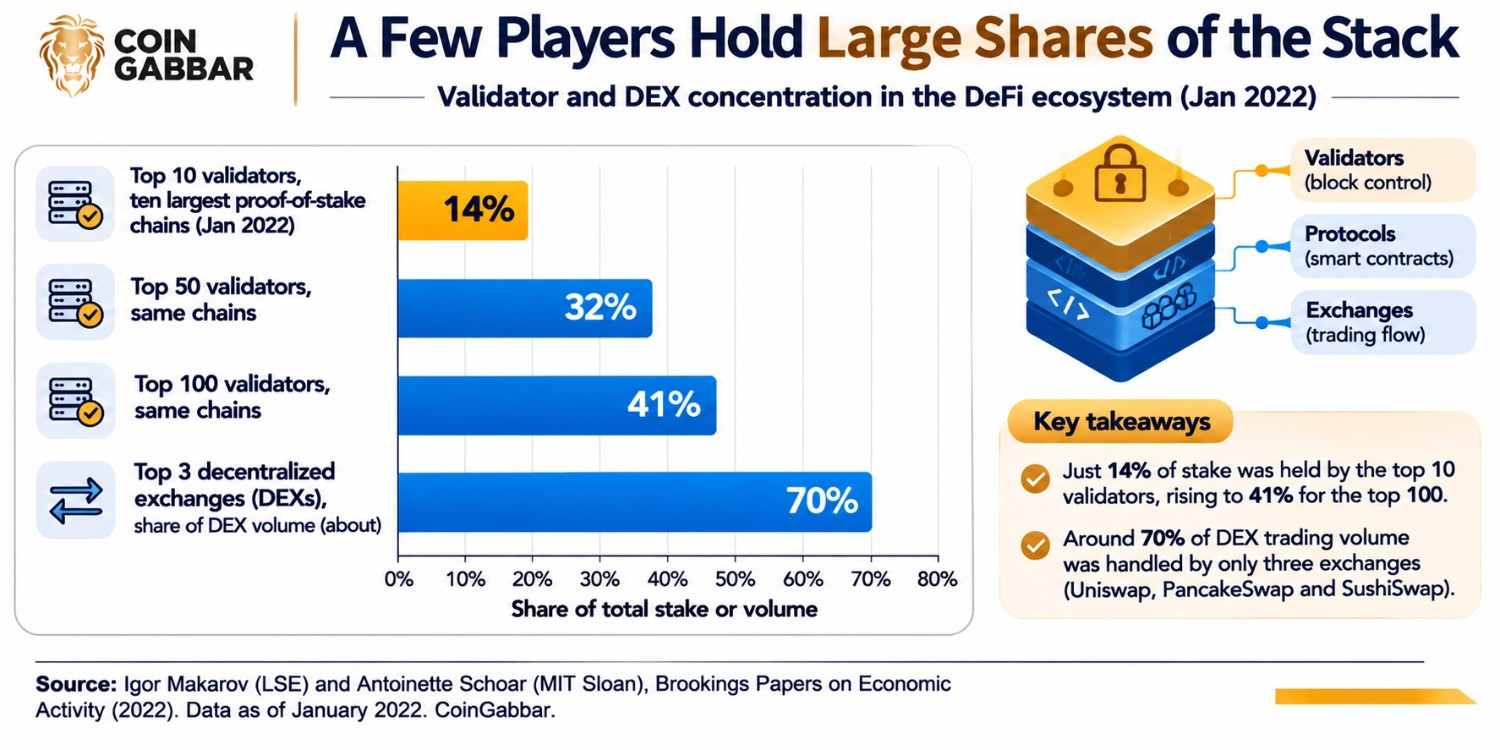
Trading looks similar. Uniswap, PancakeSwap, and SushiSwap made up about 70% of volume on decentralized exchanges.
Voting is a softer form of control. A Journal of Corporate Finance survey covers a study of 2,377 DAOs, groups run by token votes. It found that voter turnout, not ownership concentration, drove results.
How Do Validators Take a Cut of Every Single Trade?
Validators choose which trades enter a block. That gives them a short window of power over order.
Maximal extractable value, or MEV, is the extra revenue they earn by reordering or inserting trades. It is a quiet part of DeFi economics.
The same survey cites work finding that validators capture nearly all arbitrage profit. User losses topped 130,000 Ether. Private relays cut some of the waste, but not all of it.
What Does the Crime Data Say About Where Money Is Lost?
The Journal of Cybersecurity study covers 2017 to 2022. Its authors counted 1,141 incidents: 1,036 in DeFi and 105 in centralized finance, or CeFi. The data is open on Zenodo.
Yearly events grew from 16 to 430. Damage swung from $493.6 million in 2017 to $8 billion in 2018, $11.4 billion in 2021 and $6.4 billion in 2022.
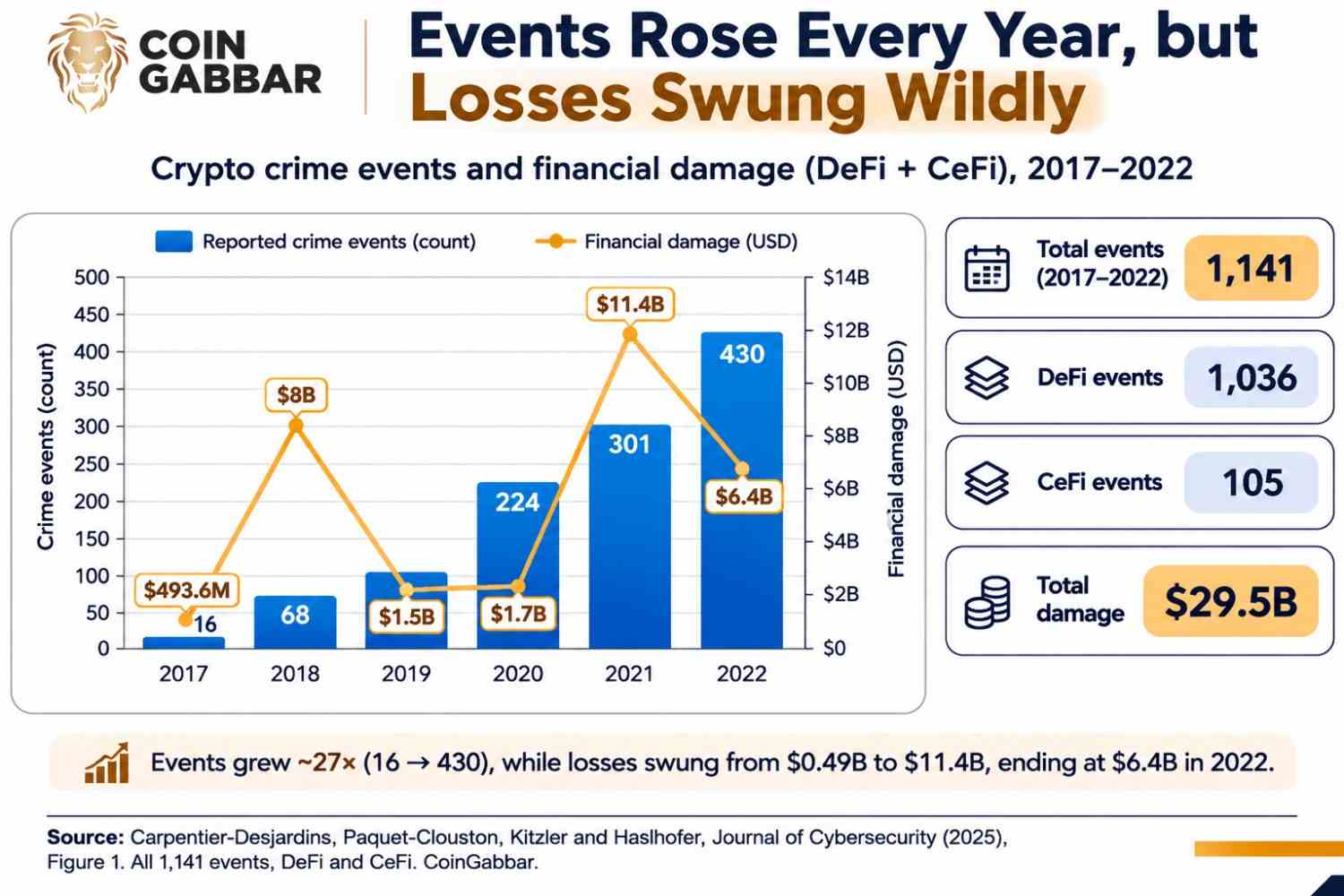
Here is the surprise. The 105 CeFi events cost $19.5 billion, against $10 billion for 1,036 DeFi events. By our division, that is about $186 million per CeFi event and $9.7 million per DeFi event.
Why Are Protocol Teams Both the Victims and the Culprits?
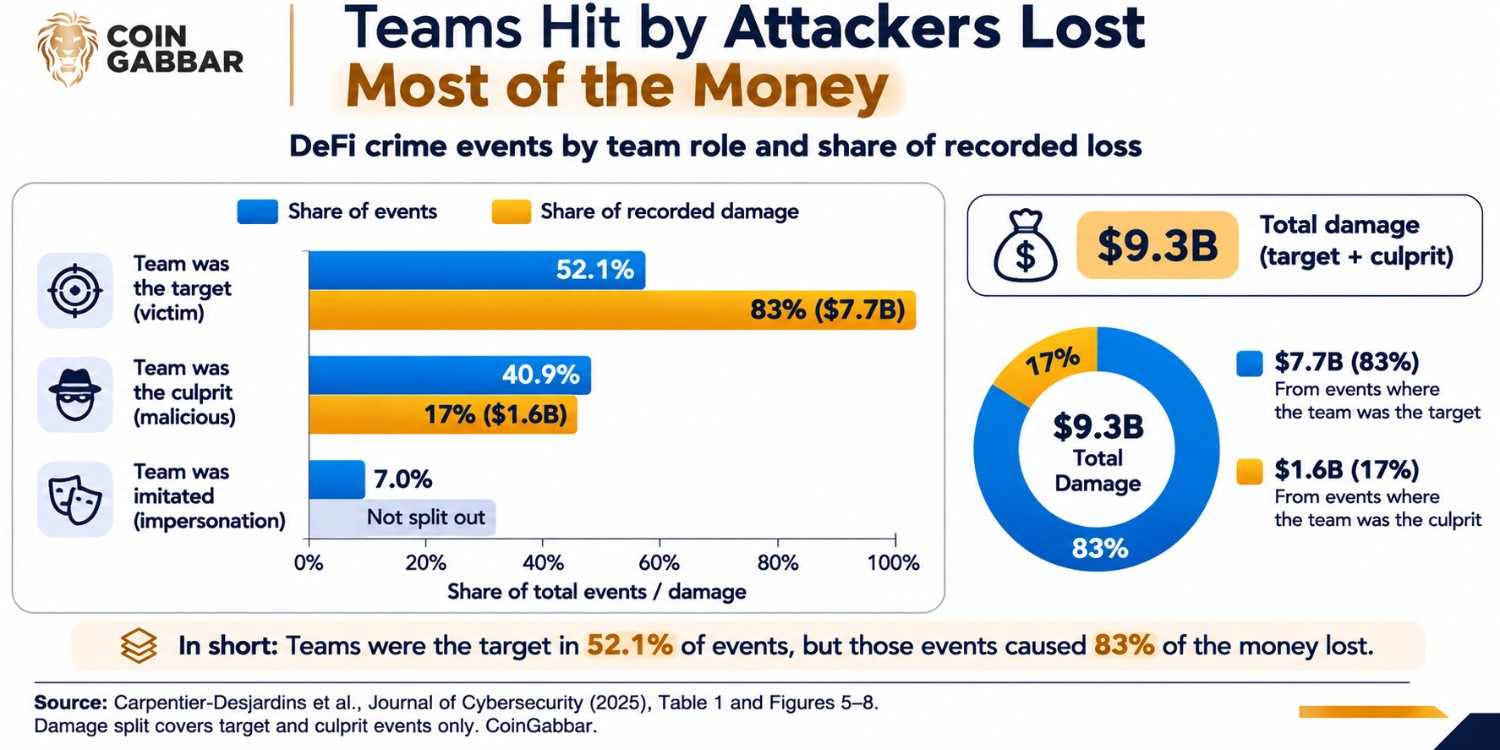
The study sorts events by the team’s role. In 52.1% of events, the team was the target. Those cost $7.7 billion of the $9.3 billion recorded, or 83%.
In 40.9%, the team was the culprit. Those cost $1.6 billion, or 17%. In 7.0%, the team was imitated to trick users, as in phishing.
So the same sector holds both the biggest losers and many bad actors. The authors say protocols are the first victims, yet malicious projects are common too.
Which Attack Methods Show Up Most in the Data?
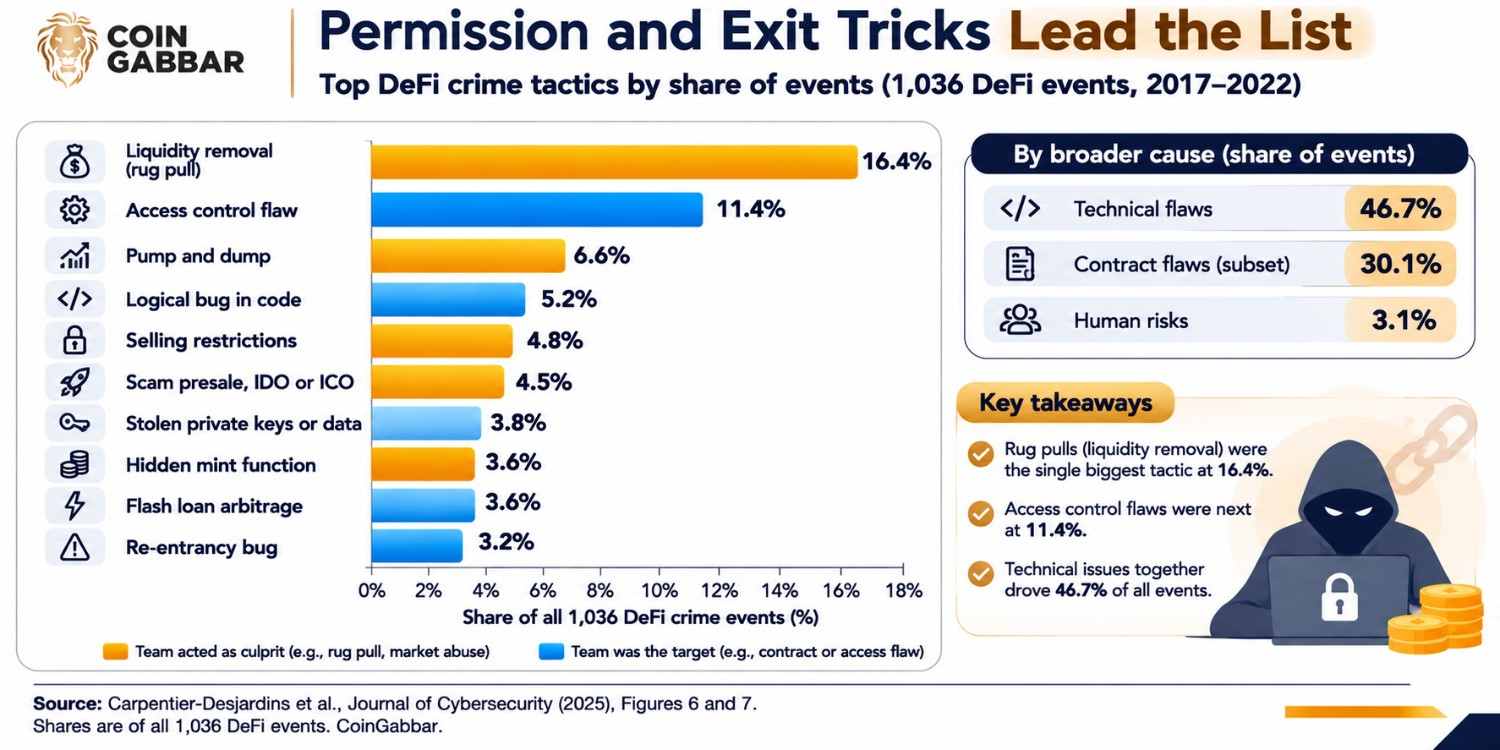
Technical flaws drove 46.7% of events. Contract flaws made up 30.1%. The top specific tactic was an access control flaw, at 11.4%. In plain terms, someone could call a powerful function without proper permission.
Among culprit teams, rug pulls were 36.0% of all events. A rug pull is when builders drain funds and vanish. Liquidity removal alone was 16.4%.
Human risks added 3.1%. Notice the pattern. The biggest items are about who holds permission, not clever math. That is our reading, not the authors’ claim.
Which Layer of the Stack Loses the Most Money?
The study maps events onto five layers. Protocols lost $2.6 billion across 298 events. Interfaces, such as bridges and oracles, lost $2.5 billion across only 34.
Assets lost $1.8 billion across 375 incidents. The base ledger lost $1.5 billion across 24. Compositions, which combine protocols, lost $925 million across 107.
By our division, an interface event cost about $73.5 million on average, against $4.8 million at the asset layer. Schoar and Makarov also warn that one data source can be a single point of failure.
What Can Readers Check Before Trusting a Protocol?
Sound DeFi economics for users starts with one question. Who can change the contract? Look for admin keys, upgrade rights, and who holds the token supply.
Check whether liquidity is locked and whether an audit exists. Our guide to smart contract audits shows what to read, and our list of rug pull warning signs shows what to avoid.
An audit cannot prove safety. Test with small sums first.
What Do Key Control and Crime Terms Mean for Readers?
Rent: profit from a position rivals cannot easily copy.
Rug pull: builders drain funds and disappear.
Access control flaw: a bug that lets the wrong party use a powerful function.
MEV: extra revenue from reordering trades in a block.
DAO: a group that runs a project through token votes.
Expert Opinion: Is DeFi Open Code With Closed Control Points?
CoinGabbar analysis suggests DeFi economics is less about code and more about who holds permission. The basis is simple. Protocol teams were the target in 52% of events and the culprit in 41%, while validator and exchange shares are concentrated.
The data covers 2017 to 2022 and uses reported events, so it likely undercounts. This view is not a forecast.
Disclaimer: This article is for information only and is not financial, legal, or tax advice. Returns are never promised or assured. Crypto assets are volatile. protocols can be hacked or abandoned, and rules may change, so all the money put in can be lost. Readers should consult a qualified adviser before investing.
0
0

 Manage all your crypto, NFT and DeFi from one place
Securely connect the portfolio you’re using to start.


