
Midterm Elections 2026: What Is at Stake for Bitcoin and Crypto

0
0

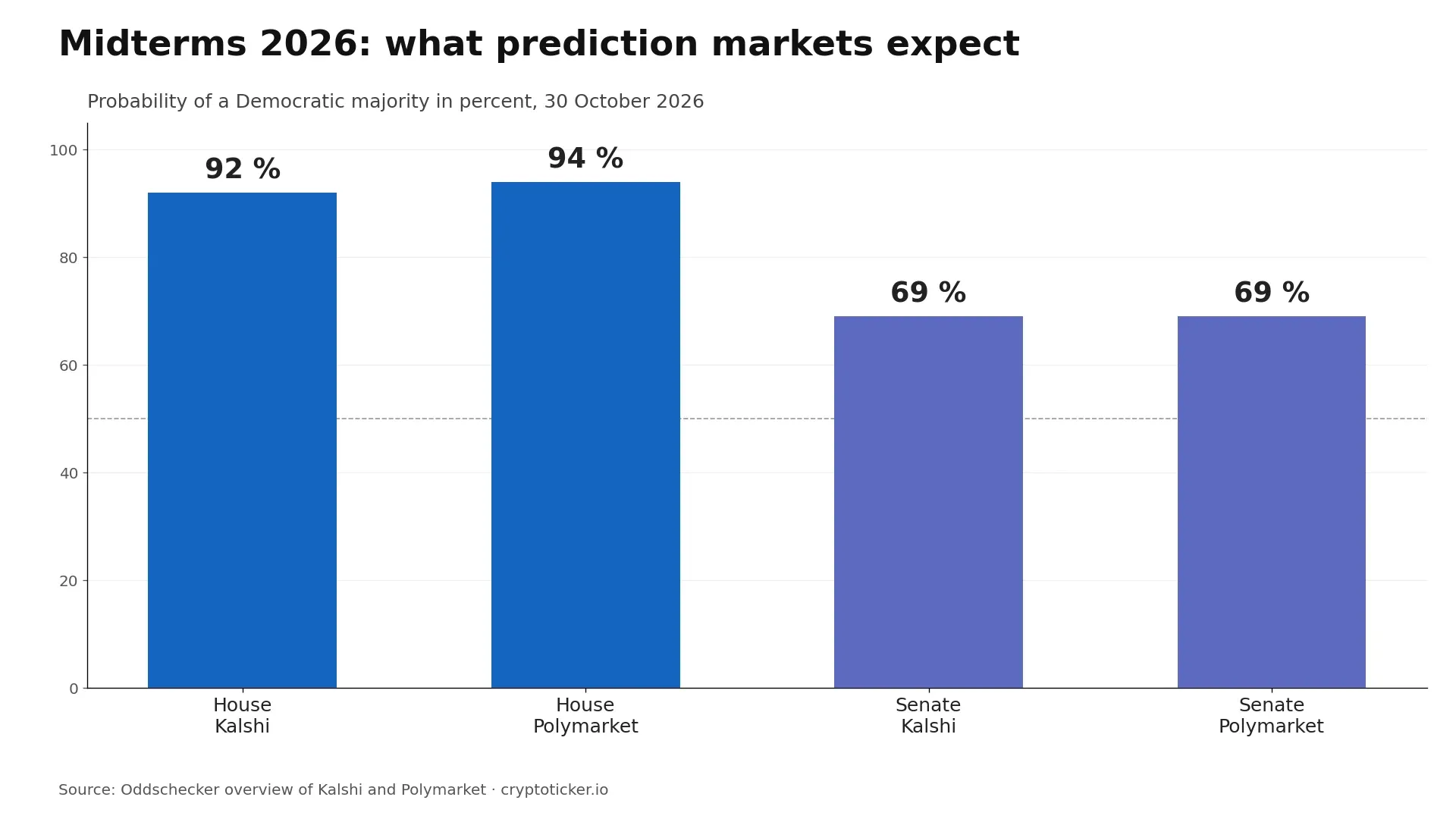
On Tuesday, 3 November 2026, Americans elect all 435 members of the House of Representatives and 35 of the 100 senators. For Bitcoin and crypto, the midterm elections decide who writes the next crypto law: the market structure bill CLARITY failed in the Senate in September and will probably have to start again in the new Congress in January. Prediction markets on 30 October gave the Democrats a 92 to 94 percent chance of winning the House and 69 percent for the Senate, according to an overview by Oddschecker of Kalshi and Polymarket. The election falls into a week of shocks: the Binance hack, the worst day on Wall Street since June and expected rate hikes by the Fed. Here is what is at stake for crypto investors.
Midterm elections 2026 and crypto: the key facts
- Date: Tuesday, 3 November 2026; results in close races can take days.
- Prediction markets: Democrats 92 to 94 % for the House, 69 % for the Senate (Kalshi and Polymarket, 30 October).
- Crypto law: the CLARITY Act passed the House in July 2025 by 294 to 134 votes, but failed in the Senate on 15 September 2026 by 49 to 50.
- Crypto money: the super PAC Fairshake and its affiliates back 32 House candidates and entered September with about $120 million in cash.
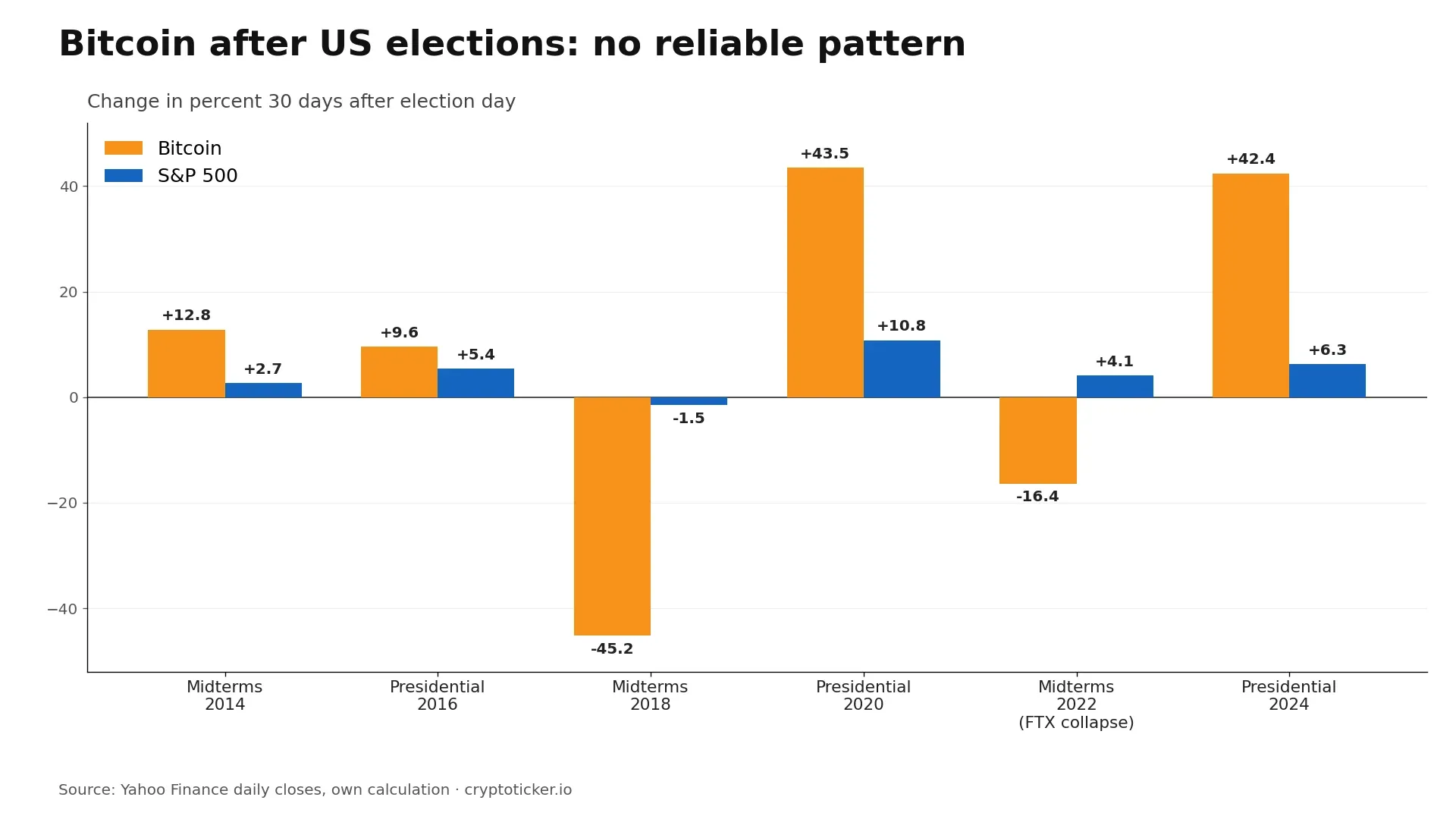
- History: after the last three midterms Bitcoin moved between −45 and +13 percent within 30 days; crypto-specific events weighed more than the vote.
- Backdrop: Binance hack on 29 October, Nasdaq −2.86 % on 30 October, December rate hike priced at around 80 percent.
The week before the vote is covered in our analyses of the stock market crash and of the question whether the Binance hack and the crash are connected.
Midterm elections 2026: what prediction markets expect
Prediction markets are not polls: they show where traders put their money. On 30 October they saw a clear shift of power in the House and a likely, but less certain, Democratic Senate. The amounts are large: more than $1.4 billion has been traded on midterm markets, CNN reported in late October. That is itself a crypto story, because Polymarket settles its bets in the stablecoin USDC.
| Market | Democrats win | Republicans win |
|---|---|---|
| House, Kalshi | 92 % | 8 % |
| House, Polymarket | 94 % | 6 % |
| Senate, Kalshi | 69 % | 31 % |
| Senate, Polymarket | 69 % | 31 % |
Odds as of 30 October 2026, rounded. Odds can move quickly in the last days before an election.
Why the midterms matter for crypto regulation
The most important crypto law of this Congress is stuck. The CLARITY Act would divide oversight of digital assets between the SEC and the CFTC and require exchanges to register at federal level. It passed the House on 17 July 2025 with 294 to 134 votes, including many Democrats. In the Senate, the motion to open debate failed on 15 September 2026 by 49 to 50 votes; 60 would have been needed. If the Senate does not act in the lame-duck session before 3 January 2027, the bill expires and the new Congress has to start again. All details are in our explainer CLARITY Act explained.
What changes with a new majority:
- Democratic House: committee chairs change. Maxine Waters, today the senior Democrat on the House Financial Services Committee and a sharp critic of the pardon of Binance founder CZ, would be in line to chair it again. Investigations into the crypto business of the Trump family and the CZ pardon would gain subpoena power.
- Democratic Senate: the Banking Committee and its agenda would be led by Democrats; a market structure law would need a new compromise, probably with stricter rules on officials' crypto holdings.
- Republican majority in both chambers: the CLARITY text could return almost unchanged, but would still need 60 votes in the Senate.
Without a law, the agencies keep moving: the SEC has proposed its own rules for crypto assets, and the CFTC proposed a framework for exchanges on 5 October and has cited the Binance hack to promote federal oversight of offshore exchanges, as Decrypt reports. Stablecoins are already regulated by the GENIUS Act of July 2025, regardless of the election.
Crypto money in the midterms: Fairshake and its candidates
The crypto industry is one of the biggest spenders of this election. Fairshake and its two affiliated super PACs back 32 House candidates, 19 Republicans and 13 Democrats, and entered September with about $120.4 million in cash, CNBC reported. The strategy is bipartisan: Fairshake supports candidates of both parties who back clear crypto rules. After the failure of CLARITY in the Senate, the money is meant to secure majorities for the next attempt.
How Bitcoin reacted to past US elections
There is no reliable election pattern for Bitcoin. We compared the Bitcoin price and the S&P 500 30 days after the last six US elections, measured from the close before election day:
| Election | Bitcoin after 30 days | S&P 500 after 30 days | What dominated |
|---|---|---|---|
| Midterms 2014 | +12.8 % | +2.7 % | early bear market after Mt. Gox |
| Presidential 2016 | +9.6 % | +5.4 % | start of the 2017 bull run |
| Midterms 2018 | −45.2 % | −1.5 % | crypto winter, Bitcoin Cash split |
| Presidential 2020 | +43.5 % | +10.8 % | pandemic money printing |
| Midterms 2022 | −16.4 % | +4.1 % | FTX collapse in election week |
| Presidential 2024 | +42.4 % | +6.3 % | Trump's crypto agenda |
The striking parallel is 2022: in the week of the midterms, the exchange FTX collapsed, and Bitcoin fell 16 percent within a month while stocks rose. In 2026 the midterms again follow an exchange crisis, the Binance hack, but with one important difference: Binance has promised to cover all losses and is not insolvent according to everything known. The results of a vote rarely move Bitcoin as much as the state of its own market.
What the midterms could mean for Bitcoin
Our view: in the short term, rates and the aftermath of the Binance hack matter more for Bitcoin than the election. The Fed is expected to hike in December, and the October jobs report on Friday, 6 November, will shape that expectation. In the medium term, the midterms decide whether the US gets a crypto law in 2027 or remains regulated by agency rules. A divided Congress, which prediction markets currently consider likely, would mean slower legislation and more power for the SEC and CFTC. For investors, uncertainty is not a reason to panic, but a reason to keep coins on regulated platforms or in their own wallets.
Election week at a glance
- Sunday, 1 November: Binance aims to reopen withdrawals; proof of reserves promised by Monday.
- Monday, 2 November: Apple and Palantir report.
- Tuesday, 3 November: midterm elections, polls close from midnight UTC; AMD reports.
- Wednesday, 4 November: first results, Arm and Qualcomm report.
- Friday, 6 November: October jobs report.
Regulated platforms that already work under clear rules are compared in our overview of regulated crypto exchanges. This article is not investment advice.
0
0

 Manage all your crypto, NFT and DeFi from one place
Securely connect the portfolio you’re using to start.
 Where will Bitcoin trade next?
Live Polymarket and Kalshi odds on Bitcoin price targets, compared side by side.
See Bitcoin price odds


