
Trump-Linked Tokens Drop as Democrats Win US Midterms

0
0
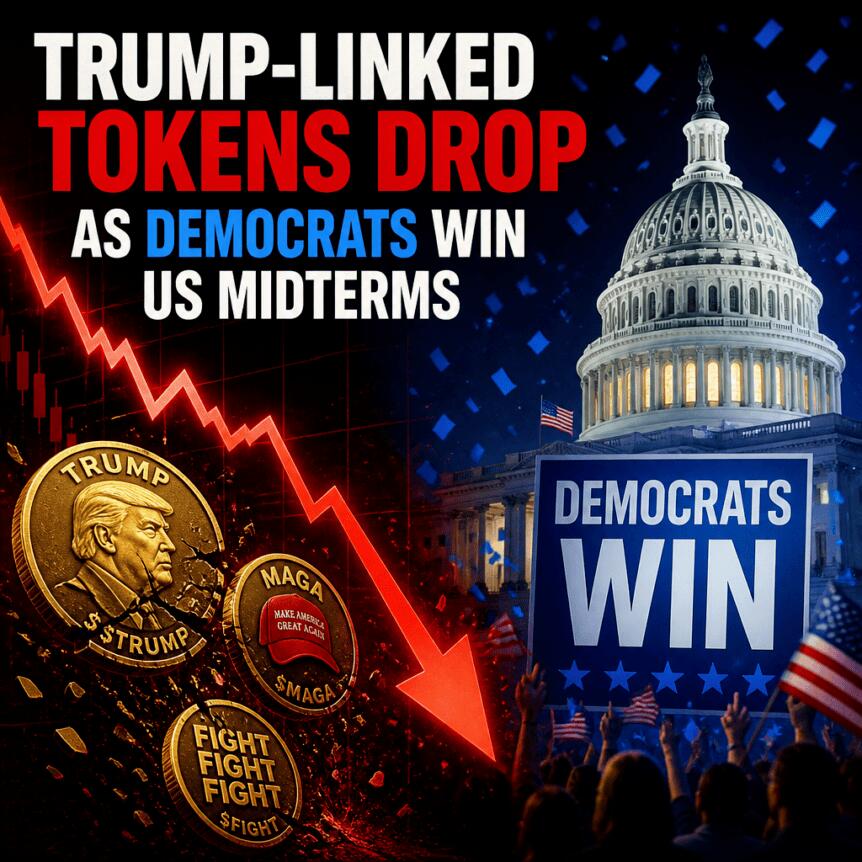
Crypto-linked tokens tied to US political figures slid sharply on Wednesday after results from the US midterm elections shifted expectations in Washington—an undercurrent that stood in contrast to a broad market rebound.
According to CoinMarketCap data around 5:32 p.m. UTC, “Official Trump” (TRUMP) fell 17% over 24 hours to about $1.33, while World Liberty Financial (WLFI)—the governance token for the Trump family-backed DeFi project launched in 2024—dropped more than 7% to roughly $0.047. The moves came after the Democratic Party secured surprise wins, including in Texas, and ultimately won control of both the House and the Senate from Republicans.
Key takeaways
- Trump- and Trump-family-linked tokens underperformed as Democrats gained control of both chambers of Congress.
- Bitcoin and Ether rose on the day, highlighting a divergence between mainstream crypto assets and politicized memecoins.
- Analysts suggest investor demand for political tokens may rely too heavily on political expectations rather than fundamentals.
- The election outcome adds another layer of uncertainty around US digital asset legislation, including the stalled CLARITY Act.
Political tokens fall even as the broader market rises
While TRUMP and WLFI declined, the wider crypto market was moving higher. CoinMarketCap data showed Bitcoin increasing more than 4% over 24 hours to around $80,500, and Ether climbing about 6% to roughly $2,433. Other large-cap coins also posted gains, including BNB (+3%), XRP (+2.6%), and Solana (+2.5%). Overall market capitalization rose about 3.4% to $2.69 trillion.
The political-token drag extended beyond the two biggest laggards. MELANIA, a memecoin associated with Melania Trump, fell nearly 13% over 24 hours to about $0.066, while a token named after Vice President JD Vance (VANCE) dropped nearly 12%. The report noted that VANCE has no confirmed official connection to the vice president.
On the sector level, political memecoins softened alongside these individual declines. The group’s combined market capitalization fell more than 16% to $477 million, while trading volume jumped about 123% to $437 million, per CoinMarketCap data—suggesting heightened activity as traders reassessed exposure.
Why investors appear to be treating these tokens differently
One notable feature of Wednesday’s trading was the mismatch between a recovering market and persistent weakness in politically branded assets. Benjamin Sarquis Peillard, founder and CEO of Cap (a DeFi platform focused on stablecoin yields), told Cointelegraph that politically linked tokens can behave differently from established cryptocurrencies.
Peillard argued that assets like Bitcoin tend to react to liquidity conditions, institutional flows, and broader macroeconomic factors. By contrast, politically linked tokens may be more sensitive to changes in expectations around US politics.
He also cautioned that even if the overall market improves, politically themed tokens may still face selling pressure if investors begin reevaluating their risk—particularly if sentiment had been driven primarily by political narratives rather than usage or durable demand. In his view, the more important longer-term question is what can sustain interest beyond a token’s association with a political figure.
Congress control and the knock-on effects for crypto policy
The midterm results are also likely to affect the regulatory outlook for digital assets, not just trader sentiment. The article highlighted uncertainty around the future of US crypto legislation, including the Digital Asset Market Clarity Act—commonly referred to as the CLARITY Act—which has been stalled.
According to the source, the CLARITY Act failed to advance in the Senate earlier this year after it fell short of the 60 votes required. Democrats had been pushing for tighter ethical provisions and safeguards designed to address conflicts of interest tied to Trump’s crypto-related ventures, and four Republicans opposed advancing the bill.
Peillard said the midterm outcome creates an additional layer of regulatory uncertainty—particularly around how quickly any digital asset legislation might move and what direction it may take. For tokens whose investor demand is partly tethered to perceived political alignment, that uncertainty can translate into more immediate price pressure.
For the industry overall, his emphasis was on a broader goal: whether Congress can deliver a durable regulatory framework that offers clarity regardless of which party controls either chamber.
What to watch next
For traders and investors, Wednesday’s divergence underscores a key open question: whether political memecoins can attract sustained demand tied to fundamentals rather than election-driven expectations. The next signal to monitor will be how quickly lawmakers and regulators react to shifting congressional control—and whether any legislative progress, including on the CLARITY Act, meaningfully changes the perceived policy trajectory for the sector.
This article was originally published as Trump-Linked Tokens Drop as Democrats Win US Midterms on Crypto Breaking News – your trusted source for crypto news, Bitcoin news, and blockchain updates.
0
0


 Manage all your crypto, NFT and DeFi from one place
Securely connect the portfolio you’re using to start.