
Moscow Exchange Set to Start Bitcoin, Ether, and USDT Trading in December

0
0
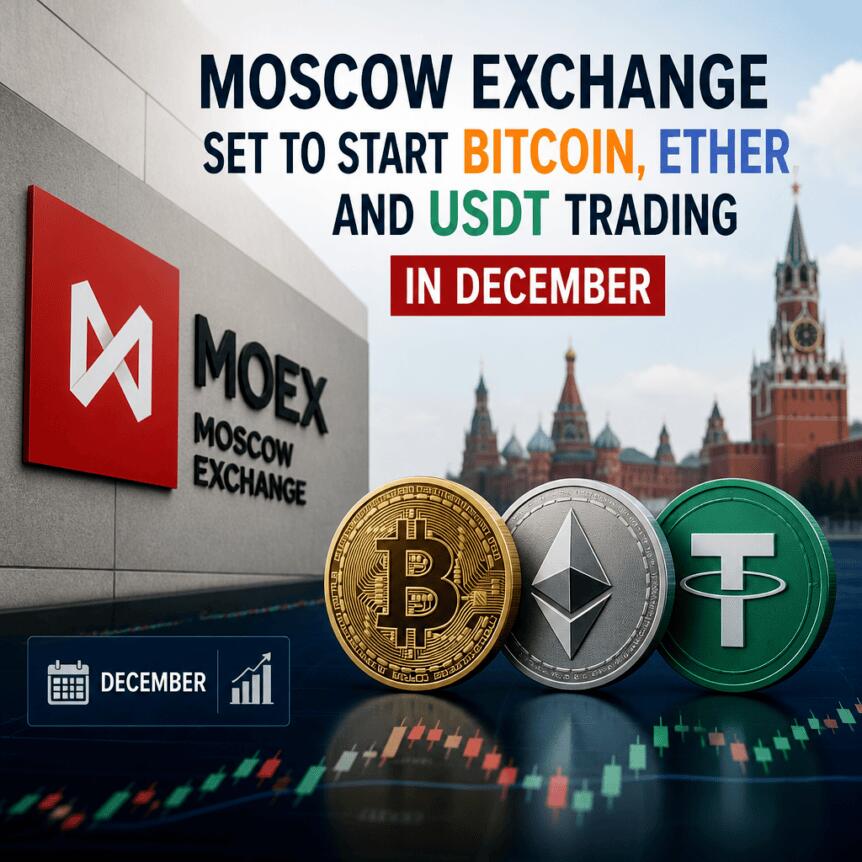
Moscow Exchange (MOEX) says it will start trading Bitcoin (BTC), Ether (ETH) and Tether’s USDT on Dec. 1, positioning the move as the first organized digital-asset market in Russia.
MOEX said on Monday that pilot trades will begin as participants come onto the platform. Transactions will run on the exchange’s existing stock-market infrastructure and be cleared through the National Clearing Center (NCC), with trading hours set for 6:50 a.m. to 11:50 p.m. Moscow time.
Key takeaways
- MOEX plans a Dec. 1 launch of spot trading for Bitcoin, Ether and USDT, initially using its established market and clearing infrastructure.
- Clearing will be handled via the National Clearing Center (NCC), with the venue offering same-day and next-day settlement plus swap transactions.
- Access for non-qualified investors will require passing a test and will be capped at 300,000 rubles per broker per year (about $3,700).
- The launch follows the Sept. 1 start of Russia’s regulated crypto trading framework, while keeping the broader ban on using crypto to pay for goods and services.
- MOEX has been under U.S. sanctions since June 2024 and is also sanctioned by the UK and EU, raising questions about liquidity and trading competitiveness.
How MOEX’s planned crypto market would work
MOEX’s proposal centers on adding digital currency trading to its existing operational stack rather than creating a standalone venue. The exchange said it will use its stock-market infrastructure, while settlement and clearing will be managed through the National Clearing Center.
According to MOEX, the initial offering will include settlement models for both same-day and next-day trades. The exchange also plans to offer swap transactions as part of the early product set. Trading will be available from early morning through late evening Moscow time, providing a broad window for market participants.
Limits for retail participants and a “test” requirement
A key element of the launch is how MOEX intends to onboard retail users. The exchange said non-qualified investors will need to pass a test before they can purchase crypto.
MOEX also set a purchasing ceiling: non-qualified investors will be limited to buying up to 300,000 rubles annually per broker, which the exchange described as roughly $3,700. The structure suggests MOEX is aiming to fit crypto trading into a controlled brokerage-access model rather than opening the market broadly from day one.
Regulation changes—and what is still prohibited
MOEX’s timetable comes after Russia’s crypto law framework moved into force. The exchange’s announcement follows the Russian crypto law whose main provisions took effect Sept. 1, according to coverage referenced by Cointelegraph earlier.
The law allows regulated crypto trading, but it continues to prohibit cryptocurrency payments for goods and services in Russia. That distinction matters for demand: an exchange can grow volumes through trading activity, but restrictions on everyday payments reduce the range of real-world use cases that can drive broader participation.
Sanctions risks cloud expectations for liquidity
Beyond domestic regulation, MOEX faces significant constraints tied to sanctions. The exchange and its clearing arrangements have been under U.S. sanctions since June 2024, and the UK and EU have also designated MOEX as part of their respective sanction regimes. MOEX’s trading ambitions therefore arrive under the shadow of compliance challenges and potential access limits to counterparties.
In an interview, Sergey Mendeleev—founder of Russian cross-border payments platform Exved—told Cointelegraph he doubts the proposed market will attract meaningful demand. He argued that neither the global nor the local market would “notice anything at all,” and questioned who would choose to trade on a sanctioned venue.
Mendeleev also warned that the trading conditions may not be attractive. He compared the concept to precious metals accounts offered by Russian lender Sberbank, where customers trade account balances without taking physical possession. In his view, the MOEX-style structure could produce unfavorable execution—particularly if spreads are wide.
He specifically pointed to the risk of “absolutely outrageous spreads,” describing the spread as the difference between buy and sell prices. For ordinary non-qualified investors, he said, the economics could be unattractive and unprofitable.
Potential use beyond trading—and the competition problem
Even so, Mendeleev suggested there is one area where an organized market could matter: cross-border payments. He said it would be beneficial if importers and exporters could buy and sell crypto directly with each other, potentially supporting trade settlement needs.
However, he questioned whether MOEX adding another intermediary would improve competitiveness. In a market where traders negotiate over small price differences—he referenced spreads on the order of 0.05%—an exchange model that introduces additional steps could struggle to compete with faster, more flexible price discovery.
He expressed a hope that MOEX’s effort could still be a “genuine breakthrough for foreign trade,” but his broader message was cautious: sanctions and execution economics could limit adoption even after the regulatory framework becomes operational.
What to watch after the Dec. 1 rollout
As MOEX prepares to begin pilot trades ahead of Dec. 1, investors and market observers will likely focus on whether liquidity actually builds—especially among participants able to operate under sanctions—and whether trading spreads remain tight enough for retail buyers constrained by the test and annual limits. The next critical signal will be how quickly market volumes materialize once settlement and swap offerings go live.
This article was originally published as Moscow Exchange Set to Start Bitcoin, Ether, and USDT Trading in December on Crypto Breaking News – your trusted source for crypto news, Bitcoin news, and blockchain updates.
0
0


 Manage all your crypto, NFT and DeFi from one place
Securely connect the portfolio you’re using to start.
 Where will Bitcoin trade next?
Live Polymarket and Kalshi odds on Bitcoin price targets, compared side by side.
See Bitcoin price odds


