
Stanford Study Finds 5-Minute Bitcoin Prediction Markets Susceptible to Manipulation

0
0
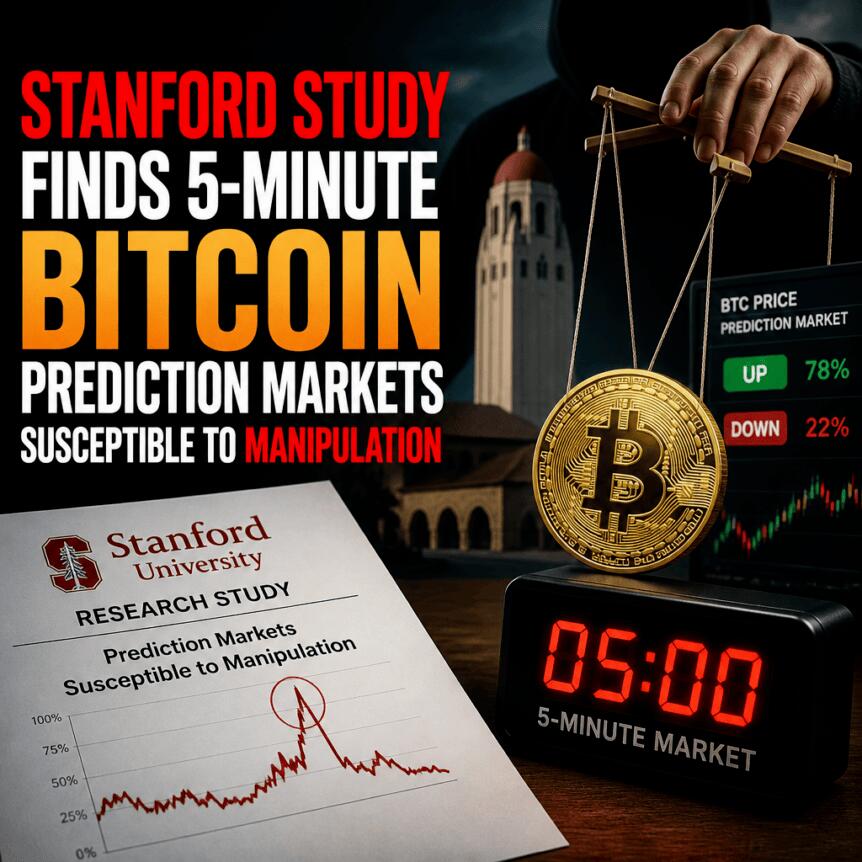
Prediction markets are attracting mainstream attention—and they’re also raising new questions about how their mechanics can shape market behavior. A new research paper from Stanford University and Singapore Management University argues that Polymarket’s short-horizon Bitcoin contracts can create incentives for sophisticated traders to manipulate spot prices around settlement, at a potential cost to retail participants.
The study focuses on Polymarket wagers that settle after five minutes based on Bitcoin’s price relative to a fixed threshold. Because settlement depends on Chainlink price feeds tied to the end-of-window spot price, the authors say traders can profit by influencing the spot market immediately before the contract resolves.
Key takeaways
- Settlement based on a five-minute spot price can encourage end-of-window price manipulation.
- Researchers observed larger order-flow spikes shortly before settlement and quick price reversals after.
- The paper estimates about $1.28 million may have shifted from ordinary traders to manipulators during the sample period.
- Extending the contract window from five minutes to 15 minutes significantly reduced the effect.
- The findings highlight why contract design matters, not just whether prediction markets exist.
How five-minute Bitcoin contracts can change incentives
The paper analyzes Polymarket contracts where traders bet whether Bitcoin’s price will finish above or below a predetermined level after five minutes. Settlement is determined using Chainlink price feeds that reflect the Bitcoin price at the end of each trading window.
According to the researchers, this structure can produce a specific incentive: if the settlement price effectively “locks in” at the end of a short period, participants have a reason to influence market conditions right before that moment. In short-horizon settings, even small price moves can determine outcomes, making it easier for sophisticated traders to attempt to steer the spot price toward a preferred settlement level.
What the researchers found in Polymarket activity
To test the claim, the authors compared trading activity before and after Polymarket introduced these five-minute Bitcoin contracts in July 2024. They report sharp increases in Bitcoin spot-market order flow just before settlement, followed by rapid price reversals.
The paper interprets this pattern as consistent with settlement-price manipulation: order-flow concentrates near the settlement boundary, and spot prices then unwind quickly after resolution—suggesting the pre-settlement movement may not persist beyond the contract’s settlement point.
Quantitatively, the study estimates the behavior transferred approximately $1.28 million from ordinary traders to manipulators during the sampled period. The researchers also argue that the mechanism is sensitive to the timing of settlement: when contract durations were extended from five minutes to 15 minutes, the manipulation effect was largely eliminated.
Manipulation isn’t “inherent”—settlement design may be the lever
A central point of the paper is that its results do not imply prediction markets are intrinsically vulnerable to manipulation. Instead, the authors argue that design choices—particularly how settlement prices are produced—can materially affect the risk.
Beyond lengthening contract windows, the researchers point to alternative settlement methods that could reduce incentives to tamper with the precise end-of-window price. They specifically mention approaches such as using time-weighted average prices (TWAP) rather than a single end-point spot price, which would make it harder to profit from last-moment spot moves.
For market participants, the practical takeaway is straightforward: the shorter the window and the more settlement hinges on an exact spot read at a specific timestamp, the greater the potential payoff to short-term steering. Conversely, smoother pricing references and longer resolution horizons can dampen that incentive structure.
Broader implications as prediction markets expand
The paper’s relevance may extend beyond crypto-native venues. It notes that traditional trading venues have proposed “event contracts” tied to asset prices—signaling that settlement mechanics will matter even as prediction markets move into more regulated environments.
That expansion is already happening alongside intense legal scrutiny in the United States. Cointelegraph previously reported that several US states have challenged prediction-market companies including Kalshi and Polymarket, while the Commodity Futures Trading Commission has argued that federally regulated event contracts fall under its “exclusive jurisdiction” rather than state gambling laws. The dispute is now moving through federal courts, with observers noting that conflicting appellate decisions could ultimately lead to a role for the US Supreme Court in determining whether states or the CFTC have primary authority.
At the same time, activity continues to grow. Prediction markets recorded record trading volumes in June, fueled by the expanded 2026 FIFA World Cup. According to DefiLlama data cited in the original reporting, Kalshi processed about $9.4 billion in trading volume during June, while Polymarket International handled roughly $4.3 billion.
World Cup winner markets have since generated more than $5.4 billion in combined trading volume, with Polymarket processing about $4.25 billion and Kalshi about $1.2 billion, based on data from the platforms at the time of writing.
As market interest accelerates—especially in short-duration contracts—the paper’s message becomes more urgent: regulators and designers may need to focus on settlement architecture, not just on categorizing whether prediction markets should be permitted.
For traders and builders, the next thing to watch is whether venues adjust contract durations, adopt averaging-based settlement (like TWAP), or otherwise change pricing feeds to reduce manipulation incentives—particularly as more prediction markets emerge with quickly resolving, price-linked settlement rules.
This article was originally published as Stanford Study Finds 5-Minute Bitcoin Prediction Markets Susceptible to Manipulation on Crypto Breaking News – your trusted source for crypto news, Bitcoin news, and blockchain updates.
0
0

 Manage all your crypto, NFT and DeFi from one place
Securely connect the portfolio you’re using to start.
 Where will Bitcoin trade next?
Live Polymarket and Kalshi odds on Bitcoin price targets, compared side by side.
See Bitcoin price odds


