
Dogecoin loses 8.6 percent in seven days, Bitcoin only 2: why DOGE falls more than four times as hard

0
0
Dogecoin trades at $0.0801 on Thursday midday, down 8.6 percent over seven days. Bitcoin gave up 2.0 percent in the same period. That distance is the real finding of the day: Dogecoin is falling more than four times as hard as the market's largest asset, and it is doing so at a point the price already visited four weeks ago.
Dogecoin at $0.0801: the numbers at Thursday midday
As of 15 October the price stands at $0.080056. Over 24 hours that is 5.0 percent lower, over seven days 8.6 percent, over 30 days 3.0 percent. On a one-year view there is a loss of 61.1 percent. Spot turnover over the past 24 hours is $1.07 billion and market capitalisation $12.52 billion. That is rank twelve in the overall market. All figures come from CoinGecko and were read off at Thursday midday.
CoinGecko reports the day's low from tick data at $0.078426. On hourly values, which allow lows to be compared cleanly across weeks, the lowest hourly print of the day is $0.078951, reached in the early morning. The two numbers do not contradict each other; they measure at different resolutions. For the comparison with September, the second one counts.
Seven days down 8.6 percent, Bitcoin down 2 percent
The weekly comparison places the move. Over seven days Ethereum loses 7.3 percent, XRP 6.6 percent, Shiba Inu 7.8 percent, Litecoin 9.3 percent, Solana 10.2 percent and Cardano 11.5 percent. At 8.6 percent, Dogecoin sits in the middle of that group. The only striking figure is the distance to Bitcoin, which at 2.0 percent is almost unmoved and over 30 days is even 5.5 percent up.
That yields a plain reading which needs no speculation. What is under way bears the marks of a rotation out of the smaller assets into the largest. Managing a portfolio by weights shows it in Dogecoin's share of the overall market, which has fallen this week, while Bitcoin's share has risen.
What the term rotation means here
Rotation describes capital shifting between segments of the same market without money leaving that market. It is recognisable when one segment falls while another holds or rises, with turnover overall normal. That is precisely the picture this week's numbers show.
Since yesterday: $0.0845 has become $0.0801
On 14 October the price stood at $0.0845 in our look at the large-address share, as set out in Wednesday's edition on the Dogecoin price and the share held by large addresses. Since then 5.2 percent has been given up. The level named there as the next test has now been reached and was briefly breached during the day.
What matters here is keeping the time frames apart. This year's February low was $0.0887, measured on 6 February. That line has been history since June, a month that brought hourly prints down to $0.0731. The line where something is being decided today is younger and sits lower.
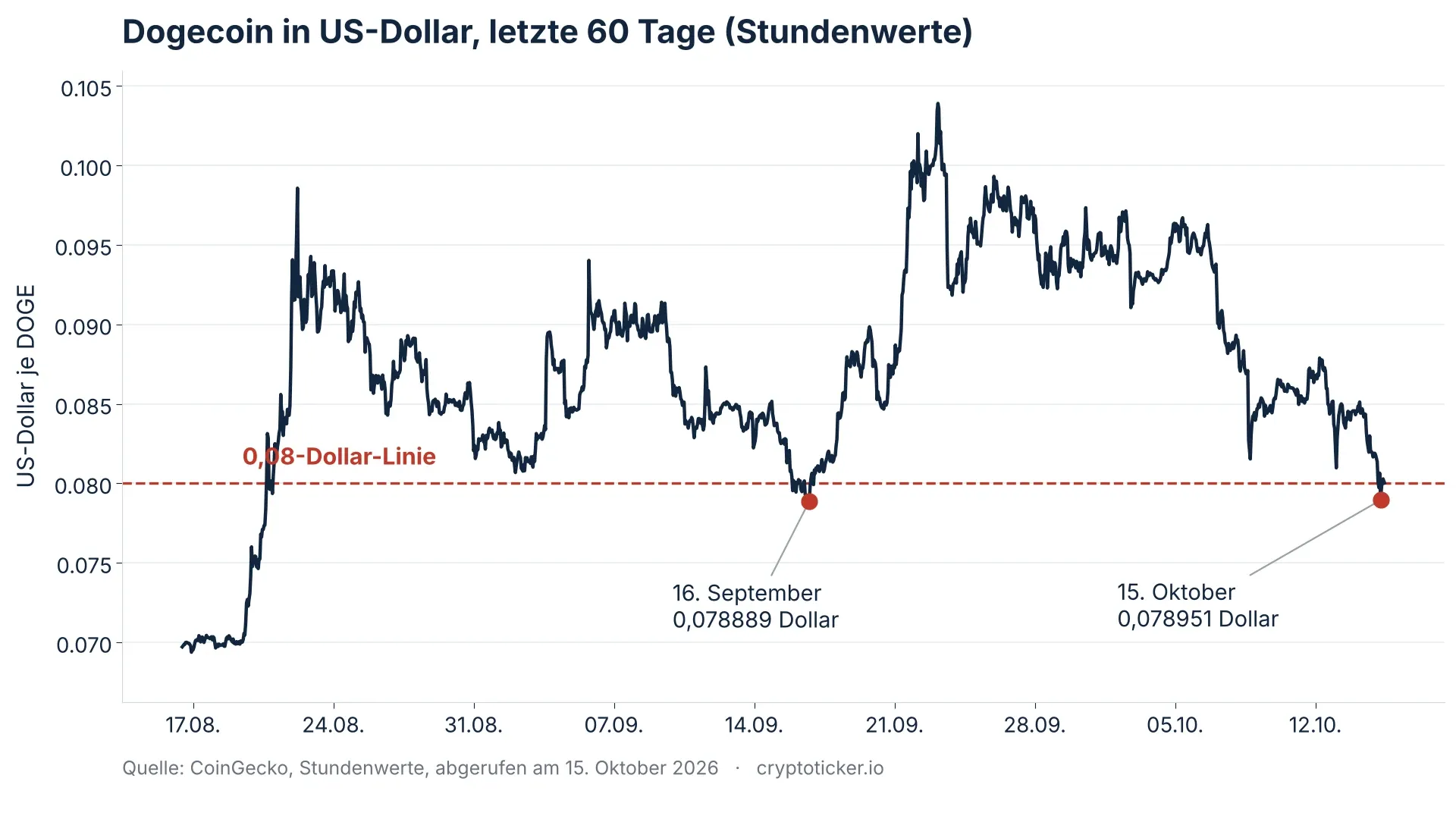
The $0.08 line and the September low at $0.078889
On 16 September the lowest hourly print fell to $0.078889. On 15 October it was $0.078951. Between the two values lie $0.000062, less than a tenth of a percent. Two attempts 28 days apart therefore ended at practically the same point.
Alongside that stands September as a month with a lowest daily value of $0.080051 and October with $0.080024. On a daily basis the round $0.08 line has held twice; on an hourly basis it was briefly breached both times. In practice a level is rarely an exact line. Usually it is a zone a few tenths of a percent wide.
To the upside the next well-founded level is the October high of $0.097149 from 2 October. To the downside the year's low sits at $0.06902, reached on 7 August. The current price is 89.1 percent away from the all-time high of $0.7316.
The last test on 16 September and the recovery to $0.1039
The comparable case is four weeks back and can be recalculated to the hour. After the low of 16 September the price turned up and reached $0.103908 on 23 September. That is 31.7 percent above the low, achieved in seven days. After that it went down again in stages: $0.097149 on 2 October, $0.088349 on 8 October, $0.0801 today.
For investors that means two things. The line held at the last test, and it brought no trend reversal. The recovery ended 32 percent higher and then retraced in full. Taking September as a template means taking both halves of the template.
Where Dogecoin is traded and at what cost differs markedly from venue to venue. A look at the crypto exchange comparison shows the ranges on trading fee, spread and withdrawal, which weigh more heavily on a price with four decimal places than they do on Bitcoin.
Mining supply: 13.64 million new DOGE a day
A second way into the subject lies not in the chart but in the blockchain itself. Dogecoin has no cap on total supply. Each block creates 10,000 new DOGE, as the project site at dogecoin.com describes it. Over the past 24 hours, 1,364 blocks were found according to Blockchair.
That works out to 13.64 million new DOGE in a day and around 4.98 billion a year. At the current price the daily amount corresponds to a value of roughly $1.09 million. Circulating supply lies between 156.3 billion units at CoinGecko and 172.0 billion at Blockchair, depending on the count. Annual expansion thus comes to just under three percent.
Why that number does not explain today
$1.09 million in new supply faces $1.07 billion in spot turnover. New supply therefore accounts for roughly one part in a thousand of daily turnover. As an explanation for a weekly loss of 8.6 percent it does not serve. It works as a permanent drag over years, not as the trigger of a single trading day. Anyone seeking to understand the annual balance of minus 61.1 percent finds one building block here. For today it contributes nothing.
The blockchain, incidentally, shows no congestion. 23,015 transactions in 24 hours, 17 items in the mempool, an average fee of $0.028. Panic-driven movement on the blockchain looks different.

Holding period and the exemption limit: 31 December under section 23 of the German Income Tax Act
Here lies the concrete check an investor in Germany can carry out today, and it has little to do with the chart. Crypto falls under private disposal transactions. The governing rule is section 23 of the German Income Tax Act. It sets the period between acquisition and disposal at "not more than one year", and it sets the exemption limit: gains stay tax-free if the total gain from private disposal transactions in the calendar year comes to less than 1,000 euros.
What the annual balance of minus 61.1 percent has to do with it
Anyone who bought Dogecoin within the past twelve months is, at today's price, sitting on a loss on paper. Losses from private disposal transactions realised within the one-year period can be offset against gains in the same category in the same year, for instance gains from other coins or from gold. The calendar year ends on 31 December, and a disposal takes effect only in the year in which it occurs.
Two points belong with that. First, with every month a part of the holding runs out of the one-year period, and what lies outside the period has no tax effect, in gain or in loss. Second, the order of acquisitions is decisive, which is why a clean record per purchase matters more than any view on the price. Which tools keep that record and track the deadlines per lot is shown in the overview of tax software and portfolio trackers.
This account is no substitute for tax advice. What is named here is the deadline, the section and the exemption limit, so that the question to check is on the table before the turn of the year.
Buying route and custody: fees, spread and your own keys
At a price of $0.08 the buying route decides a noticeable part of the outcome. On the cost side at entry we have already broken down the ranges between instant buy and order book, as set out in our look at the buying route for Dogecoin. The finding there still holds: the convenient route costs the larger mark-up.
For custody the usual trade-off applies. On the exchange the holding stays quickly tradable and sits with a third party. On your own hardware it sits with you, with full responsibility for securing the recovery words. Which devices support Dogecoin and what they cost is set out in the hardware wallet comparison. For amounts earmarked for a sale within the one-year period anyway, moving to your own hardware is rarely the first job.
Our assessment: the line is holding so far, the annual balance is not
In this newsroom's view the situation is less dramatic than the daily loss of 5.0 percent suggests, and at the same time less reassuring than the line holding makes it look. Three documented points support that. First, the zone around $0.0789 has stopped the price twice within 28 days, at $0.078889 on 16 September and at $0.078951 on 15 October. Second, the blockchain is unremarkable: 17 items in the mempool and an average fee of $0.028 show no selling pressure backing up in the network. Third, the weekly loss sits in the middle of the larger altcoins, not at the bottom of them.
Against that stands the longer view. On a one-year basis there is a 61.1 percent loss, over 30 days 3.0 percent, while Bitcoin gained 5.5 percent in the same month. The recovery after the September low ended at $0.103908 and retraced in full. A line that holds twice is a floor and not yet a turn. A turn can only be proven once an attempt ends above the October high of $0.097149. This assessment evaluates the situation and is not a buy or sell recommendation.
Dogecoin: below $0.078889 the path to the August low opens
Three steps order the coming weeks, each of them checkable.
- Watch the zone around $0.0789. If it holds a third time, the picture of the past four weeks stays intact. If a daily close lands clearly below it, the year's low of $0.06902 from 7 August is the next figure the market can refer to. To be ready to trade on that, know the costs of your venue and check them against the exchange comparison.
- Write down the one-year deadline for each purchase lot. Purchase date, quantity, price, and from that the date on which the one-year period under section 23 of the German Income Tax Act ends. Until 31 December this list decides which losses can still be offset. The tools for it are in the overview of tax software.
- Match the place of custody to the investment horizon. Holdings that will sit longer than the one-year period belong on your own hardware rather than at a trading venue. The devices and their costs are in the hardware wallet comparison.
(As of October 15, 2026. This article is not investment advice. Prices and fee structures change; check the terms with the provider before you buy. Crypto investments can lead to a total loss.)
0
0


 Manage all your crypto, NFT and DeFi from one place
Securely connect the portfolio you’re using to start.
 Where will Bitcoin trade next?
Live Polymarket and Kalshi odds on Bitcoin price targets, compared side by side.
See Bitcoin price odds


