
Phina Chain Protocol Layers: Understanding the Network Design

0
0

How Do Phina Chain Protocol Layers Manage Blockchain Operations?
Every blockchain has a design under the hood. Most readers look at the token or the app first, but the design decides how fast a network runs, how safe it stays and how easily it can grow.
The Phina Chain protocol layers are the best starting point for anyone trying to understand how this project is built. This Phina architecture overview explains each layer in plain words, using the project’s whitepaper and documentation as its sources.
Key Takeaways
The network splits its work into three layers: execution, storage and consensus.
The execution layer has one EVM-equivalent main core and several specialized cores built for specific jobs.
Validators stake PHN under a CometBFT-based Proof of Stake system, which the whitepaper says gives fast finality.
What Is Phina Network?
Phina Network describes itself as a foundation for a decentralized internet. Its GitBook says the mission is to give people tools to control their digital assets and identity.
The whitepaper goes further. It describes Phina Chain Network as a purpose-built blockchain that creates a programmable market for intellectual property, knowledge and creativity.
The native token is PHN. It pays network fees, secures the chain through staking and is used in on-chain governance votes. The official website, lists PHN as a BEP-20 token on BNB Smart Chain and tells readers to verify any contract address on BscScan.
Source: official website.
Why Separation of Concerns Matters in Blockchain Design
Separation of concerns blockchain design means every part of the system has one job. The whitepaper says the protocol follows this principle, and it calls the consensus design modular. It also says new cores can be added later. That makes Phina Chain a modular blockchain in practice: one part can change without a rebuild of the rest.
Three jobs sit at the center:
Execution runs transactions and smart contracts.
Storage keeps data organized and provable.
Consensus decides which blocks are added and in what order.
Phina Chain Three-Layer Architecture at a Glance
Layer | Main job | Key detail from the whitepaper |
Execution | Runs transactions and smart contracts | One main core plus specialized cores |
Storage | Organizes data and builds cryptographic commitments | One interface for on-chain and off-chain storage |
Consensus | Agrees on blocks and secures the network | CometBFT with Proof of Stake |
The Phina Execution Layer
The Phina execution layer is where every transaction and smart contract runs. The whitepaper calls it the computational foundation of the network.
Its main core is the default environment. It offers EVM equivalence, so existing Ethereum applications can move over with less work. The main core handles all transactions and calls a specialized core only when a contract inside that core is used.
Phina Chain Specialized Cores Explained
A specialized core is tuned for one need, such as speed, scalability, safety or privacy. The whitepaper lists three cores for the first release and two possible ones for later.
Core | What it does | Stage |
IP core | Stores intellectual property as a native asset class and runs the Proof of Creativity protocol | First release |
Off-chain synchronization core | Links on-chain contracts to real-world data through oracles | First release |
Cross-chain communication core | Passes messages between blockchains, including IBC | First release |
AI core | Handles AI-related operations on-chain | Possible future core |
ZK core | Verifies zero-knowledge proofs efficiently | Possible future core |
Every core must follow three rules:
Determinism: the same call always gives the same result.
Bounded resource use: gas costs are worked out in advance and in constant time.
Canonical storage: data is saved as key/value pairs in a fixed, ordered format.
The Phina Storage Layer
The Phina storage layer gives the execution layer its storage APIs. It hides the choice of database and builds cryptographic commitments over the data. The official whitepaper says its design takes inspiration from the NAND Flash Translation Layer. In the same spirit, it studies how often data is used and places it across storage tiers.
The network has a real problem to solve here. Intellectual property comes in many sizes, from short text to large datasets. Keeping big files fully on-chain is expensive. Keeping them on IPFS with only a reference on-chain can hurt the user experience.
So the whitepaper proposes one interface that joins on-chain storage with IPFS and Arweave. It says deeper technical detail will come in a follow-up paper.
The Phina Consensus Layer
The Phina consensus layer decides how blocks are formed and who agrees on them. The first release is planned to use CometBFT, an implementation of the Tendermint Byzantine Fault Tolerant engine. The whitepaper lists four properties:
Fault tolerance: security holds even if up to 33% of validators are malicious or offline.
Liveness: the network keeps moving while more than two-thirds of voting power stays active.
Instant finality: transactions become final soon after they enter a block.
ABCI: this interface separates consensus from execution, so consensus can be upgraded later.
The layer uses Proof of Stake. Validators stake PHN, process transactions and earn rewards. Bad behavior can cost them their staked tokens. This is how Phina Chain validators secure the network: honest work pays, and cheating costs money.
How the Phina Chain Protocol Layers Work Together
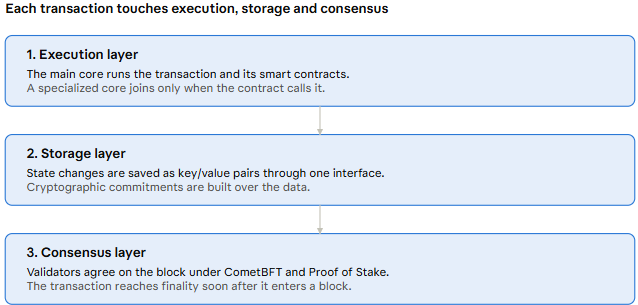
Each transaction touches all three layers. Execution runs it, storage records the data and consensus finalizes the block.
Where the PHN Token Fits
The whitepaper calls PHN a unified utility token for network security and ecosystem functions.
Use of PHN | Where it applies |
Transaction fees (gas) | Execution layer |
Validator staking | Consensus layer |
Licensing and royalty payments | IP core |
Value exchange between AI agents | Role described in the whitepaper |
Governance votes | On-chain governance |
What Is Still Planned
Some parts of this design are plans, not finished features. The AI core and ZK core are described as possible future cores. Deeper storage details are promised in a follow-up paper. The current status of any single feature should be confirmed in the official documentation.
Source: official documentation.
Conclusion
The Phina Chain protocol layers keep each job apart. Execution runs the code, storage holds the data and consensus keeps everyone honest. A multi-core design, one storage interface and a Proof of Stake system sit on top of that split. Readers who understand these three layers will find the rest of the whitepaper much easier to follow.
Disclaimer: This article is for educational purposes only. It is not financial, investment or legal advice. Cryptocurrency carries risk, including the loss of invested capital. The content is based on the Phina Network whitepaper, GitBook and official website as reviewed on November 11, 2026. Some features described here are plans and may change. Readers should verify details through official channels and do their own research before making any decision.
0
0
 Manage all your crypto, NFT and DeFi from one place
Securely connect the portfolio you’re using to start.