
Orbinum Network News: Native Groth16 Checks Speed Up Testnet

0
0

Node Upgrade Brings Faster Transaction Checks
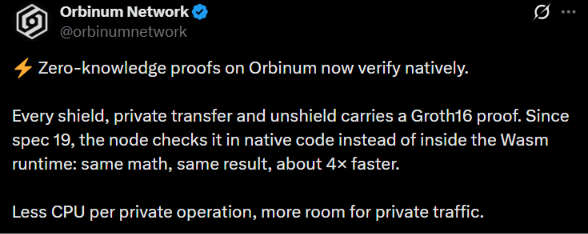
Orbinum Network news today centers on a speed upgrade for private transactions. In a post dated Oct 19, 2026, the project said zero-knowledge proofs now verify natively.
The post carried a testnet tag and linked to the official ZK docs. This crypto news item covers a different layer: the cost of checking shielded activity.
Spec 19 Moves Groth16 Checks Out of Wasm
Every shield, private transfer, and unshield carries a Groth16 proof, according to the project. It is a small data packet that confirms an action is valid without exposing sensitive details.
Before Spec 19, nodes ran this check inside the Wasm (WebAssembly) runtime. Now the node runs it in native code through a host function called bn254_groth16_verify.
The team says the math and the result stay the same. The graphic lists node version 0.4.0 or higher for this change.
Source: Official X Post
Benchmark Figures Shared in the Graphic
The graphic posted with the update lists two timing results. This Orbinum Network news piece relies on those published figures.
Measure | Before | After | Gain |
One proof verified. | 2.43 ms | 0.61 ms | About 4x |
Private transfer validated | 4.6 ms | 1.5 ms | Roughly 3x |
The team states the first gain as about 4x. The transfer gain is calculated from the listed numbers. Readers should treat all figures as project-reported.
Where Checks Happen on the Transaction Path
The graphic and the docs describe four steps:
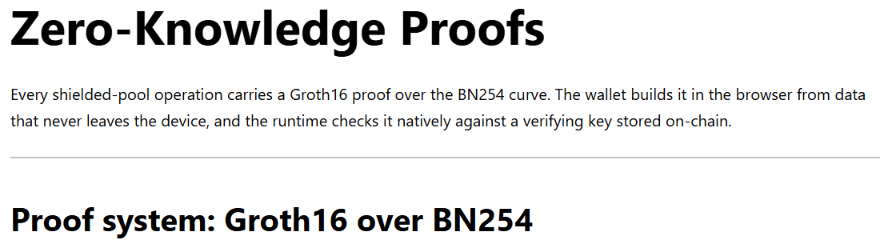
Wallet: builds the Groth16 proof in the browser from data that stays on the device.
Pool admission: transfers and unshields are checked before entering any block.
Block execution: every node checks it again for every block.
Verifier pallet: pallet-zk-verifier loads the verifying key and calls the native host function.
Per the docs, a shield is a signed extrinsic, which is a chain transaction type. Transfers and unshields are sent unsigned, and each carries the proof and encrypted memos.
Only a valid submission lets the pool record spent-note markers, called nullifiers, and add new note commitments.
Source: Official Docs
Why Native Checks Matter for Private Traffic
According to the project, less processor load per private operation leaves more room for private traffic. Transfers and unshields are checked twice, so each saved millisecond applies at both steps.
That is why the latest Orbinum Network news centers on node cost, not new features. The docs page adds that every proof stays 128 bytes.
Checking cost stays constant across three circuits: Transfer, Unshield, and Shield. The same page names BN254 as the curve. One open point remains. According to the docs, the trusted setup has a single contributor today. A multi-party ceremony is planned before mainnet.
Final Takeaway on Native Verification
The update changes speed, not the privacy design. Lower node workload can help testnet capacity, though that gain rests on the project’s own benchmarks. Outside testing would add clarity.
For readers tracking Orbinum Network news, the single-contributor setup is the main item to watch before mainnet. Spec 19 makes each verification about 4x faster, according to the project.
Readers can follow the official X account and docs for release notes and more benchmark data. Further Orbinum Network news depends on what the project publishes next.
YMYL Disclaimer: This article is for educational and informational purposes only. It is not financial advice, a price prediction, or a guarantee of returns. Readers should do their own research before making any decision.
0
0

 Manage all your crypto, NFT and DeFi from one place
Securely connect the portfolio you’re using to start.


