
60 percent instead of 50: Binance raises what Shiba Inu counts for as collateral

0
0

On the record: Binance raised the collateral ratio for Shiba Inu from 50 to 60 percent on October 23, 2026 at 06:00 UTC. Our assessment follows further down: a higher ratio enlarges the credit line, not the depth of the market behind it.
Anyone holding Shiba Inu in a cross-margin account at Binance can borrow more against it since Friday morning than in the week before. $1,000 of posted SHIB now counts as $600 of collateral value instead of $500. The coin itself has not changed: on Saturday evening SHIB traded at $0.00000488, roughly 4.0 percent below the level 24 hours earlier, at a market value of $2.88 billion (market data from CoinGecko, as of October 24, retrieved that evening).
The change is not limited to SHIB. Binance made it for seven assets at once, three of them in the same step as Shiba Inu.
What Binance changed about the collateral ratio on October 23
The switch began on October 23 at 06:00 UTC and was complete within about 30 minutes, according to the exchange. Cross Margin and Portfolio Margin are the products affected. For Polygon Ecosystem Token (POL), Shiba Inu and Stellar (XLM) the ratio rose from 50 to 60 percent. For CoW Protocol (COW), Nexo (NEXO), Ravencoin (RVN) and The Sandbox (SAND) it rose from 10 to 30 percent (Tokenpost, October 21, 2026).
The collateral ratio in this context is the share of market value an exchange recognises when a coin is posted as security. The ratio is neither a price discount nor a fee rate; it is the exchange's own risk markup on its own balance sheet. The more volatile and the more thinly traded an asset is, the lower an exchange sets the ratio, because in a pinch it has to sell quickly and at a discount.
That this is more than an announcement to be taken on trust can be verified by calculation. The ratios are published and machine-readable; Binance documents the endpoint for cross-margin ratios in its developer documentation. Our own query on October 24 at 18:47 UTC returned 0.6000 for SHIB, exactly the 60 percent.
Collateral value in cross margin: 60 percent of $1,000 is $600
The worked example is deliberately small, because the mechanism is linear. Transfer SHIB worth $1,000 into a cross-margin account and before October 23 you had $500 of eligible collateral. Since then it is $600. The $100 difference is extra credit line: money that can be borrowed or moved into other positions without adding fresh capital.
The second half of the mechanism is easily overlooked. Collateral value is tied to the market value of the posted coin, and that moves daily. If SHIB falls ten percent, the eligible collateral falls with it. $600 becomes $540, immediately, not at month end. Anyone who has used up the extra credit line stands closer to a margin call after such a day than before.
That is exactly what happened this week. The daily close stood at $0.000005152 on October 21 according to Kraken price data, at $0.000004940 on October 22 and at $0.000004966 on October 23. On October 24 SHIB traded between $0.00000477 and $0.00000508 during the day. In the week the ratio rose, in other words, the collateral lost value.
The liquidation tiers behind the ratio: 20 percent up to $50,000, 40 above it
The same query returns a second set of numbers that most reports on the switch leave out. Every asset carries tiered liquidation rates that depend on the size of the position. For Shiba Inu, a rate of 20 percent applies up to a value of $50,000; above that threshold it doubles to 40 percent.
For scale, the Bitcoin figures from the same query: 2.5 percent applies up to two million dollars and 5 percent above that. The gap is the real finding of this section. A SHIB holding of $60,000 is charged eight times the rate on the second tier that a Bitcoin holding of the same size is, even though both sit in the same account.
Binance did not touch these tiers on October 23. Reading the higher ratio as the exchange classifying SHIB as less risky overall reads too much into the change: what was raised is how much the coin counts as collateral, not how the exchange unwinds it when things go wrong.
Bitcoin at 95 percent, Dogecoin at 80, Shiba Inu at 60
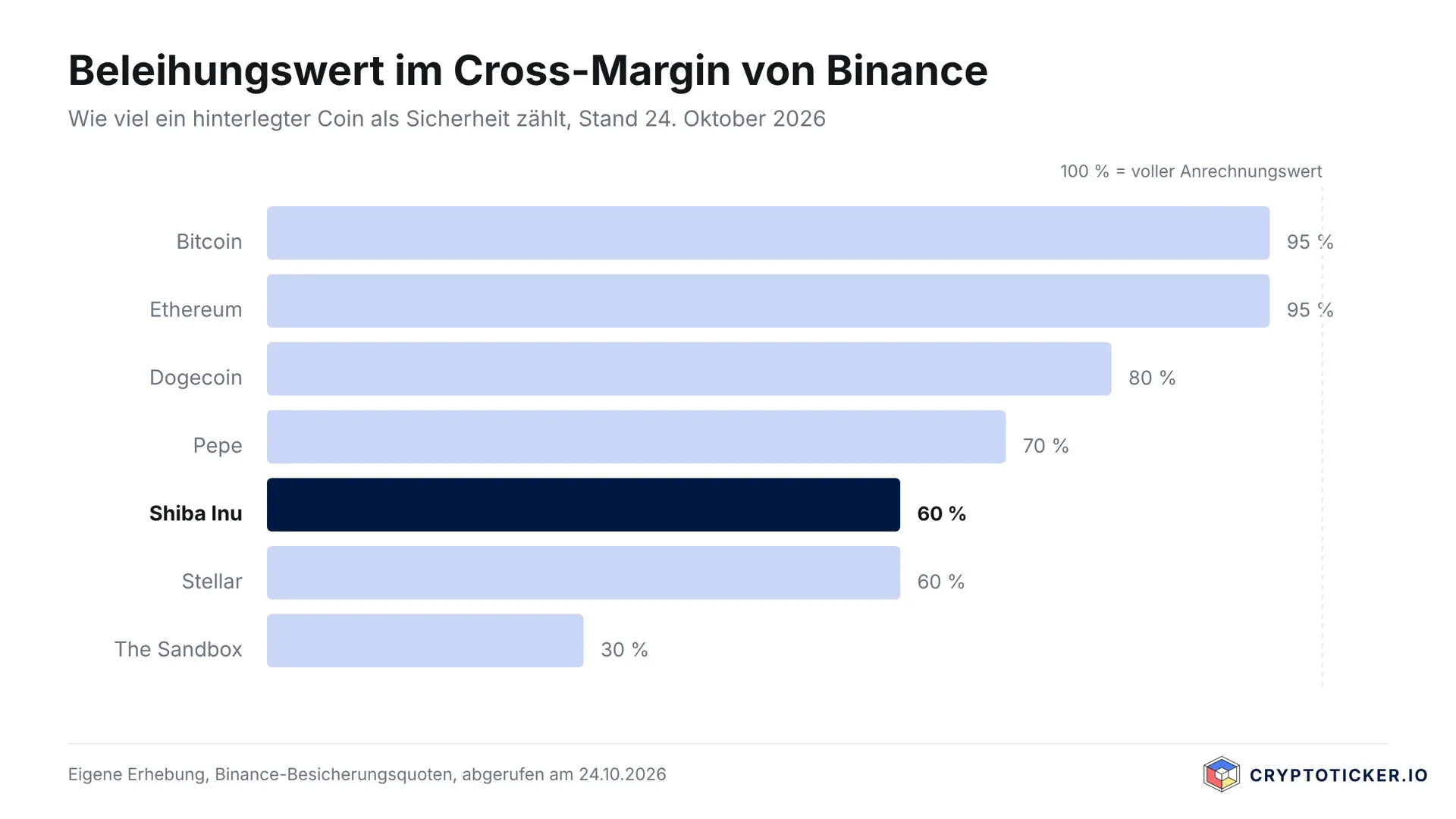
A place in the ranking says more about an exchange's judgement than any single number. Our query of October 24 returned 95 percent each for Bitcoin and Ethereum, 80 for Dogecoin, 70 for Pepe and 60 percent each for Shiba Inu and Stellar. At the bottom of the seven reassessed assets sit COW, NEXO, RVN and SAND at 30 percent.
Shiba Inu therefore trails Dogecoin, the meme coin with the largest market capitalisation, by 20 percentage points, and Pepe by ten. For investors holding several of these assets, that is no footnote: in a cross-margin account the collateral is added together. The same sum in Dogecoin carries a third more credit line than in Shiba Inu.
What the $0.0000050 level has done since October 22
On October 21 we asked in this spot whether the round $0.0000050 level would hold, at the time with a view to the 87.16 trillion SHIB on the exchanges. The answer from the days that followed is clear and sobering: since the October 22 close at $0.000004940, no daily close has been above the level. On October 23 it was 0.7 percent short, on October 24 roughly 2.2 percent short during the day.
What has changed since is the frame, not the direction. The level has turned from support into resistance: the price now approaches it from below. The October 23 daily high stood at $0.000005127, above the level, with the close beneath it. That pattern is the usual one when sellers give up a reclaimed level again.
For the collateral question, that is the connection that matters. The higher ratio applies to a holding that lost roughly three percent of its value in the same week. Part of the extra credit line from those ten percentage points has already been eaten up by the price decline.

Portfolio Margin and uniMMR: where the ratio feeds into the threshold
In the Portfolio Margin product, Binance aggregates all positions and collateral in an account into a single figure, the Unified Maintenance Margin Ratio, or uniMMR. The figure sets the account's value against the minimum collateral required. Fall below the set threshold and liquidation begins.
uniMMR is therefore not a warning light sitting somewhere in the account but the quantity liquidation hangs on. A higher collateral ratio lifts the numerator of that figure, because the posted coins count for more. Put the new room straight into fresh positions and you lift the denominator in the same move, ending up where you started.
To run through the mechanics before using them, the providers' terms are set out in our comparison of lending and credit platforms. Rates for collateralised loans differ markedly between providers, and on small amounts the fee decides the outcome, not the ratio.
What applies to leverage on crypto assets in Europe
For retail investors in Europe, the higher ratio only matters if they are allowed to use the products at all. Margin trading on crypto assets is not freely available in the EU: providers have been subject to authorisation since MiCA came into full application at the end of 2024, and which products an authorised provider may offer retail clients depends on its licence and on national rules.
In practice that means the first question, before any calculation with collateral values, is whether your own account carries the function. That is in the provider's account settings, not in a press release. How widely leverage limits for the same coins differ is something we worked through on October 15 using SHIB futures.
The second point is cost. A credit line is not a balance. Borrowed amounts accrue interest, settled hourly or daily, and on small positions that eats the return quickly. The extra $100 of room from the example above costs money as soon as it is drawn.
Holding period and tax: why posted coins are a separate question
Anyone posting coins as collateral should look at the tax side separately. Germany applies a one-year holding period to private disposals under section 23 of its income tax act: hold for more than a year, then sell, and the gain is free of income tax. Whether and how that period is affected by posting, lending or a forced unwind is a case-by-case question that depends on the specific contract.
There is also a point that follows from the mechanism itself: a liquidation is a sale. The sale happens at the moment of unwinding, not at a moment the investor picks. Hold a position for eleven months and get liquidated in the twelfth and you have missed the period without ever having placed a sell order.
We track where the holding period stands politically on a page of its own: crypto holding period, current status. For your own records, the rule is unchanged: every movement belongs on file with date, quantity and value, kept by the investor.
Our assessment: more credit line on a thin order book
Our read: the increase on its own is a normalisation and not a signal. Three documented numbers support that. First, SHIB at 60 percent remains well below Bitcoin and Ethereum at 95 percent each, so the ranking is unchanged. Second, Binance granted the same step to POL and XLM on the same day, so this is not a single decision about Shiba Inu. Third, the liquidation tiers at 20 and 40 percent were left untouched.
Against that stands the market the step falls into. Daily turnover on October 24 came to roughly $58.7 million, which against a market value of $2.88 billion is 2.0 percent of the market changing hands per day. The price sits 94.3 percent below its October 2021 record. In an order book like that, a wave of unwinding meets little on the other side, and more credit line means, if it comes to it, more material that has to be sold in the same direction.
What follows is not a recommendation in either direction but an arithmetic exercise: the room gained should be measured against the market's daily turnover, not against your own account balance.
Collateral value at Binance: $600 of credit per $1,000 of SHIB
Three things that can be settled today:
- Establish which account type you have. Cross Margin, Portfolio Margin and a plain spot account react differently to the switch. A spot account is not affected at all. Which providers offer which products to European clients is set out in our crypto broker comparison.
- Keep the position clear of the $50,000 threshold. Above it, the liquidation rate for SHIB doubles from 20 to 40 percent. Sit just below it and draw on the new credit line and you may slide into the more expensive tier without noticing.
- Record the movements. Every transfer into a margin account, every interest entry and every unwind belongs on file with date and value. Tools for that are in our comparison of tax tools and portfolio trackers.
(As of October 24, 2026. This article is not investment advice. Prices and fee structures change; check the terms with the provider before you buy.)
0
0

 Manage all your crypto, NFT and DeFi from one place
Securely connect the portfolio you’re using to start.


