
Bitcoin price prediction: the options market prices in 38.3 percent volatility, the price delivers 20.2

0
0

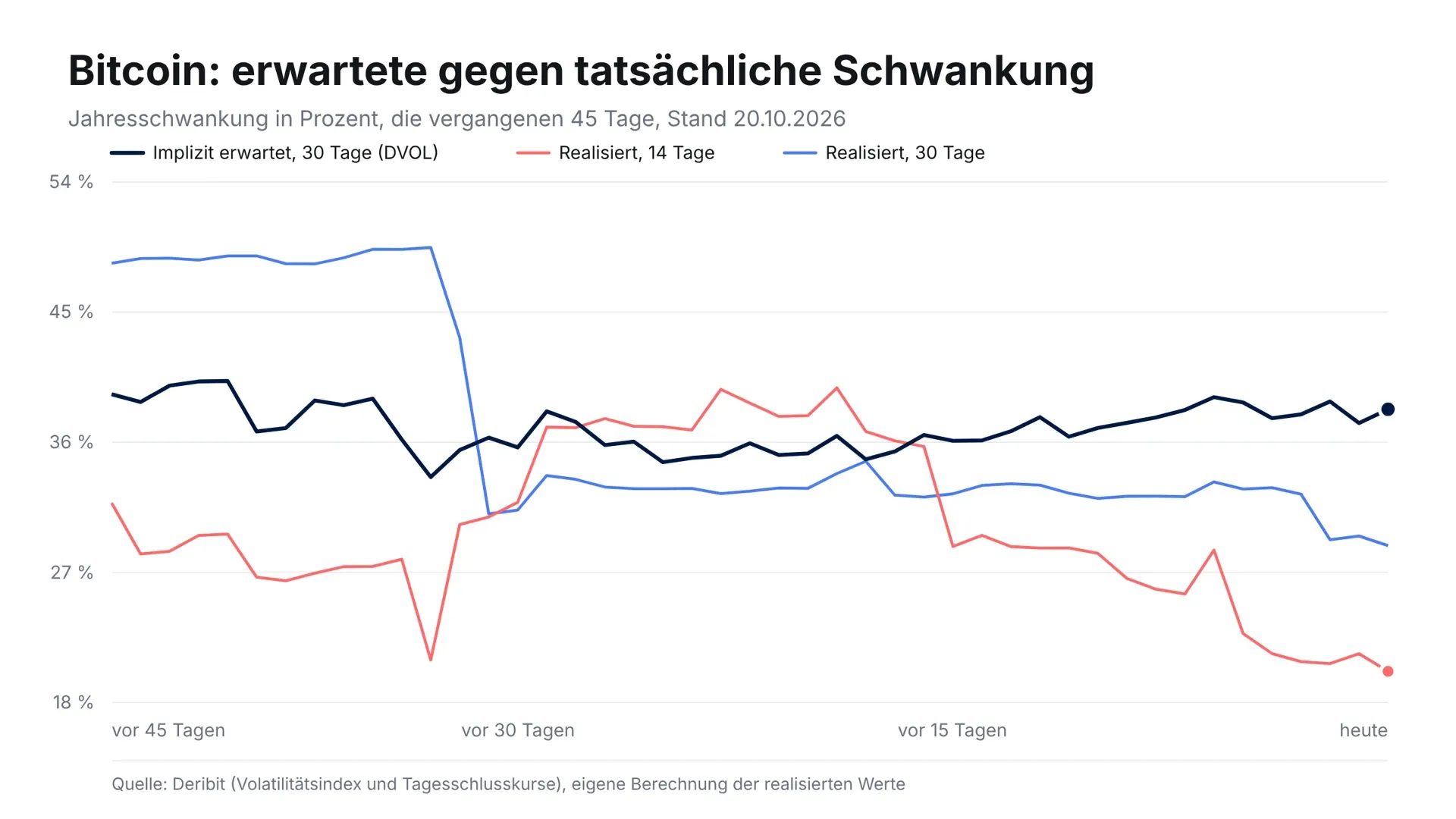
The options market is pricing Bitcoin volatility at 38.3 percent a year. Over the past two weeks the price has delivered 20.2 percent. That gap of just over 18 points is the real news this Tuesday, and it says more about the coming weeks than the price level itself. Bitcoin traded at $81,481 on Tuesday afternoon, about 1.3 percent below Monday's level.
The 38.3 figure comes from the volatility index of the options exchange Deribit, known as DVOL. It measures the volatility traders are paying for through option prices over the next 30 days. We calculated the 20.2 percent ourselves from the same exchange's daily closes over the past 14 days. For where the price can head over a horizon of months, see our Bitcoin price prediction.
What the DVOL volatility index is showing right now
DVOL is Deribit's Bitcoin volatility index. It condenses the prices of all traded options with roughly 30 days left to run into a single number: the expected range of movement, annualised. At 38.3, the market expects Bitcoin to vary by a good 38 percent around its path over the next twelve months. At 12:00 Coordinated Universal Time on Tuesday the index stood at 38.28, against 38.17 on Monday and 38.23 a week earlier.
The number says nothing about direction. A high DVOL does not mean the price will rise or fall, only that a forceful move either way is expected and paid for. That is precisely why it is worth comparing with what has actually happened.
38.3 against 20.2 percent: the true size of the gap
Realised volatility looks backwards. It takes the daily price changes over a period and measures how widely they are spread. On that basis Bitcoin comes to 20.2 percent over the past 14 days, 28.9 percent over 30 days and 25.4 percent over seven days. The basis is the daily closing prices of the Deribit perpetual contract, and we converted them ourselves.
Translated into daily moves, the gap becomes tangible. A DVOL of 38.3 percent corresponds to roughly 2.0 percent of movement on an average trading day. The realised 20.2 percent corresponds to 1.06 percent. The derivatives market is therefore paying for almost twice the movement Bitcoin has recently delivered.
Tuesday itself was quieter still: 0.57 percent separated the daily low at $81,232 from the high at $81,694. Over the past five days the mean daily range was 2.04 percent, and 2.64 percent over 30 days. That matches the finding of our Tuesday morning piece, which described the third narrow daily range in a row.
How a volatility premium arises
A volatility premium is the mark-up option buyers pay above the swings that actually materialise. The premium exists because an option is insurance: whoever buys one is hedging against a large move and pays a price that embeds the expected volatility. Whoever sells one collects that price and carries the risk that the move arrives after all.
If the market stays calm, the seller earns on every day that nothing happens, because the option's time value melts away. If the price breaks out, the seller's loss can be a multiple of the premium collected. That asymmetry sits behind the current set-up, and it explains why experienced traders are turning cautious now: a premium 18 points above delivered volatility is either a gift or a warning.
What 38.3 percent means for the next 30 days
A range can be derived from DVOL. Annualised 38.3 percent works out at roughly 11.0 percent over 30 days. Applied to a price of $81,481, that gives a range of about $72,500 to $90,400, within which Bitcoin should trade until mid-November with a probability of around two-thirds on that expectation.
The calculation is a derivation from market prices, not a forecast. The formula behind it assumes an even distribution of moves, which never holds in a crisis. It still serves for orientation: anyone whose portfolio cannot withstand a drop to $72,500 should not hold the position, because that figure sits inside the market's normal expected range rather than at its edge.
The 50-day average at $81,580 as a hinge
The price is glued to its 50-day average. The daily closes of the past 50 trading days give a mean of $81,580, and the last close was $81,554. The distance is 0.03 percent. A line a price sits this close to acts as a hinge and decides nothing until the price leaves it, upwards or downwards, on volume.
Above sits last week's daily high at $83,200, below it the weekly low at $79,710. Those two values frame the area Bitcoin has moved in since October 14. A daily close outside it would be the first signal that the expected move is actually beginning.
What the derivatives market charges in running costs
Anyone holding Bitcoin through a perpetual contract pays the funding rate. At Deribit it stood at 0.0035 percent per eight hours on Tuesday. Annualised, that is 3.87 percent a buyer hands to the other side purely for keeping the position open. Open interest in the perpetual contract was $856 million.
A positive funding rate means more capital is betting on rising than on falling prices. At 3.87 percent a year it is a moderate reading that signals no excess. For a position held over several months it is still a cost line that shifts the entry price. If you use such products, the terms are set out in our comparison of perp DEX platforms.

Where the options for October 30 sit
The monthly expiry on October 30 carries 148,585 Bitcoin in open interest, around $12.1 billion at the current price. The ratio of puts to calls is 0.50, so twice as many calls are outstanding. The calculated point of maximum pain, where the largest share of all contracts expires worthless, lies at $78,000.
The distribution explains the calm. The large clusters of calls sit at $95,000 with 25,567 contracts, at $90,000 with 15,302 and at $100,000 with 14,312. All three are 10 to 23 percent above today's price and therefore outside the range DVOL is pricing in for the next 30 days. Those contracts tie up capital without moving the price. The puts cluster at $70,000 with 4,389 contracts and at $75,000 with 3,037.
Against our Monday forecast, the market has barely shifted: the price then stood at $81,470, eleven dollars below today's level, while Bitcoin dominance has fallen from 60.2 to 59.5 percent. What has changed is the tension in the derivatives market, not the price.
Leverage, holding period and purchase route for investors in Germany
That figure of 11.0 percent allows a sober calculation for leveraged positions. At ten times leverage the liquidation threshold sits roughly ten percent from the entry, before maintenance margin and fees. That distance is smaller than the monthly move the options market is currently pricing as normal. Leverage of ten is, under these conditions, a bet that the premium is set too high, not a safety margin.
For holdings in a portfolio, something else counts. Private disposals of crypto assets remain tax-free in Germany after a holding period of one year, and gains below that are untaxed up to an annual exemption limit of 1,000 euros. What matters is the purchase date of each unit. We track the current state of the rules on our page on the crypto holding period, and the tools in our crypto tax software comparison handle the recording of purchase dates.
On the purchase route, the European regulation on markets in crypto assets, MiCA for short, has applied in full since this year, which means providers in Germany need authorisation. Buy Bitcoin through a licensed exchange and then move it to your own wallet, and you hold the coin yourself and pay no running funding rate. That is the difference between a holding and a position.
Our view of the current set-up
In the view of this newsroom, the data argues for a resolution upwards or downwards within the next two to three weeks rather than a continuation of the calm. The evidence: realised 14-day volatility has fallen from 39.8 percent on October 2 to 20.2 percent, the lowest reading in the 45-day measurement window. At the same time the options market is holding on to 38.3 percent and has not lowered that expectation for a week. Traders who risk money daily are therefore reckoning with an end to the quiet.
Against that, this very constellation has been in place since the start of October and has so far triggered nothing. A premium can persist for weeks without unwinding, and in any case it says nothing about direction. Anyone deriving a buying decision from this set-up is confusing volatility with direction. For a portfolio, that means the size of the position deserves a review, not its direction.
Volatility premium: $72,500 and $90,400 frame the picture
Three steps follow from the set-up:
- Work out whether your portfolio can withstand a drop to $72,500. That value lies inside the options market's normal expected range, not at its edge.
- For leveraged positions, compare the distance to liquidation with the 11.0 percent the market is pricing as a monthly move. Providers' terms are set out in our perp DEX comparison, and spot exchange fees in our exchange comparison.
- Note the purchase date for every holding so the one-year period stays provable. The tools for that are in our crypto tax software comparison.
(As of October 20, 2026. This article is not investment advice. Prices and fee structures change; check the terms with the provider before you buy.)
0
0

 Manage all your crypto, NFT and DeFi from one place
Securely connect the portfolio you’re using to start.
 Where will Bitcoin trade next?
Live Polymarket and Kalshi odds on Bitcoin price targets, compared side by side.
See Bitcoin price odds


