
Petrobras Deploys Cardano Apps to Verify Sustainable Aviation Fuel and Diesel

0
0
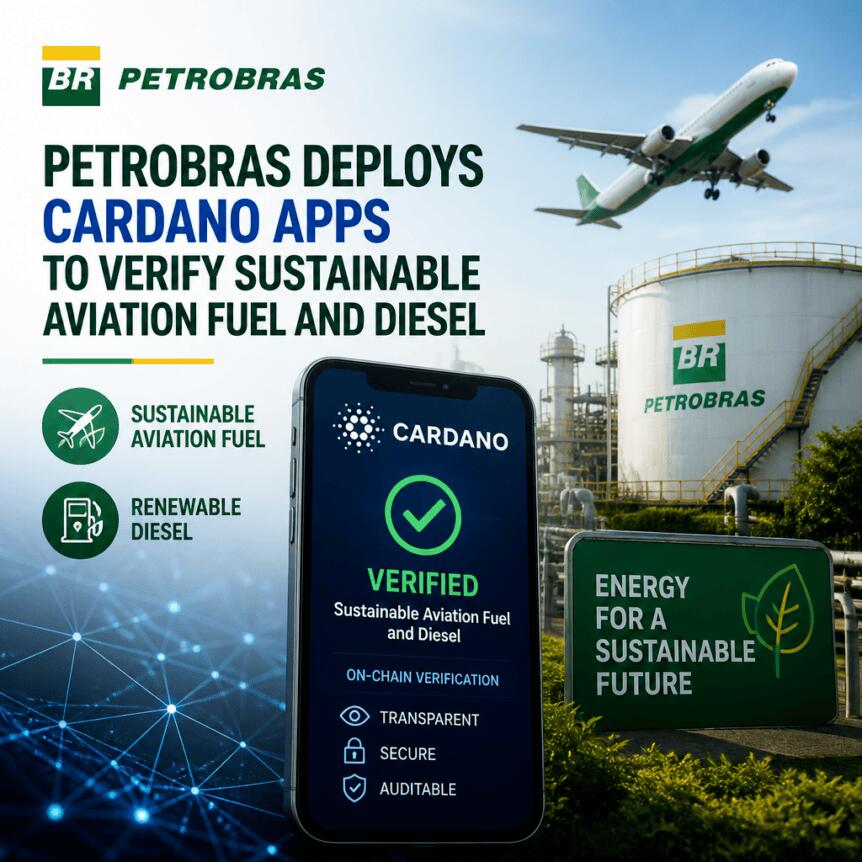
Brazil’s state-controlled oil company Petrobras says it has built two blockchain-based applications on Cardano aimed at improving how sustainability claims are traced across renewable fuels.
In an announcement shared by the Cardano Foundation, the projects focus on preventing double counting of environmental benefits—an issue that has long complicated efforts to verify claims tied to sustainable aviation fuel (SAF) and renewable diesel.
Key takeaways
- Petrobras developed two Cardano applications: one for SAF sustainability attributes and another for tracking its Diesel R renewable diesel across production to use.
- The SAF application tokenizes environmental attributes into digital tokens designed to reduce the risk of reusing the same claim multiple times.
- Petrobras’ SAF model follows a Book-and-Claim approach, separating the environmental benefit from the physical fuel so it can be assigned to specific parties.
- The Diesel R application creates “digital checkpoints” that the foundation says can support Scope 3 reporting, which covers indirect emissions across a value chain.
- Neither application’s rollout scope or covered fuel volumes were disclosed, leaving investors to watch for future deployment details.
Tokenizing SAF environmental attributes with Book-and-Claim
The first application, developed with PUC-Rio’s Ledger Labs, converts sustainability attributes associated with SAF into digital tokens on Cardano. According to the Cardano Foundation, the tokens are intended to align with the Carbon Offsetting and Reduction Scheme for International Aviation (CORSIA), and are structured to help stop the same environmental claim from being used more than once.
At the core is a Book-and-Claim model. In this setup, the environmental benefit represented by SAF is separated from the physical fuel itself. That means the benefit can be assigned to an airline, company, or passenger even if the underlying SAF is utilized elsewhere—an approach designed to make it easier to match sustainability credits with end users and reporting obligations.
The foundation also described a passenger-oriented pathway: users can claim these SAF-linked tokens through an application and receive a certificate tied to their journey and the associated environmental claim.
For market participants, the practical significance is straightforward: reliable tracking systems can reduce administrative friction for airlines and partners attempting to substantiate sustainability reporting, while lowering the risk that environmental attributes are counted twice in different parts of the supply chain.
Tracking Diesel R across the value chain
The second application targets Petrobras’ Diesel R renewable diesel. Instead of tokenizing a single attribute, the Cardano Foundation says the system uses “digital checkpoints” to record information across key stages: production, transportation, and end use.
The foundation added that the data generated by this workflow could support Scope 3 reporting. Scope 3 includes indirect emissions across a company’s value chain, so systems that provide structured traceability may help companies compile more defensible emissions disclosures.
While the announcement outlines the intended reporting utility, it does not specify how checkpoints are verified in practice, what data formats are captured, or how widely the solution is planned to be deployed. Those details matter because the credibility of any emissions or sustainability claim ultimately depends on auditability and consistency across counterparties.
How Petrobras and Cardano Foundation arrived at this stage
The Cardano Foundation framed the projects as an extension of an existing research and development relationship with Petrobras. It said the collaboration began in 2023 with blockchain education for Petrobras employees and expanded in 2025 to broader energy-sector research with PUC-Rio’s Ledger Labs.
Notably, the foundation did not disclose the fuel volumes expected to be covered by the applications, nor did it provide a timeline for broader implementation beyond the development work described in the announcement. For traders and investors watching blockchain adoption, the absence of scale metrics makes it difficult to gauge near-term network or revenue implications—though it does confirm that the technology is being evaluated for real-world sustainability infrastructure.
Sustained aviation credit tracking is becoming a competitive battleground
Petrobras is not the first energy or aviation participant to explore blockchain-based Book-and-Claim systems for SAF. The Cardano Foundation’s announcement points to Shell’s Avelia platform, which Shell launched in 2022 to track environmental attributes and reduce double counting.
In an update referenced by the announcement, Shell said Avelia contributed to more than 84 million gallons of SAF entering the global fuel network since its launch in 2022, resulting in more than 780,000 tonnes of CO₂e abatement through June 2026.
The broader push is also visible in other markets. More recently, Australia’s Viva Energy reportedly signed an agreement with NoviqTech in January to research digital Book-and-Claim systems for sustainable aviation fuel—explicitly including how blockchain could support emissions reporting and track environmental claims.
What stands out across these efforts is the shared challenge: sustainability claims need a technical way to prove origin, attribute ownership, and prevent duplicate crediting across a fragmented ecosystem of producers, logistics providers, airlines, and buyers. Blockchain networks are one tool for doing that, but the competitive question for the sector is whether any given approach can deliver consistent, verifiable data handling that counterparties will accept at scale.
For now, Petrobras’ Cardano-based SAF and Diesel R tools offer a clear glimpse of where blockchain traceability may be headed in the energy transition—yet investors and industry observers should watch closely for the missing pieces: deployment timelines, covered volumes, verification mechanics, and how the solutions integrate with existing sustainability reporting and audit processes.
This article was originally published as Petrobras Deploys Cardano Apps to Verify Sustainable Aviation Fuel and Diesel on Crypto Breaking News – your trusted source for crypto news, Bitcoin news, and blockchain updates.
0
0

 Manage all your crypto, NFT and DeFi from one place
Securely connect the portfolio you’re using to start.


