
Uniswap News Today: v4 Adds Seven Liquidity Sources to Its Swap Routes

0
0
Uniswap News Today: v4 Aggregator Launch as UNI Trades Near $6.82
The world’s biggest decentralized exchange has just changed how trades are routed.
In Uniswap news today, the team announced that v4 now pulls prices from outside sources, so swaps can find a better deal across many places in one go.
The company says the new venues cover more than 90% of exchange activity on the supported networks, and the fees they pay are tied to burning UNI.
Meanwhile, the token trades slightly lower. Here is what happened, in plain words.
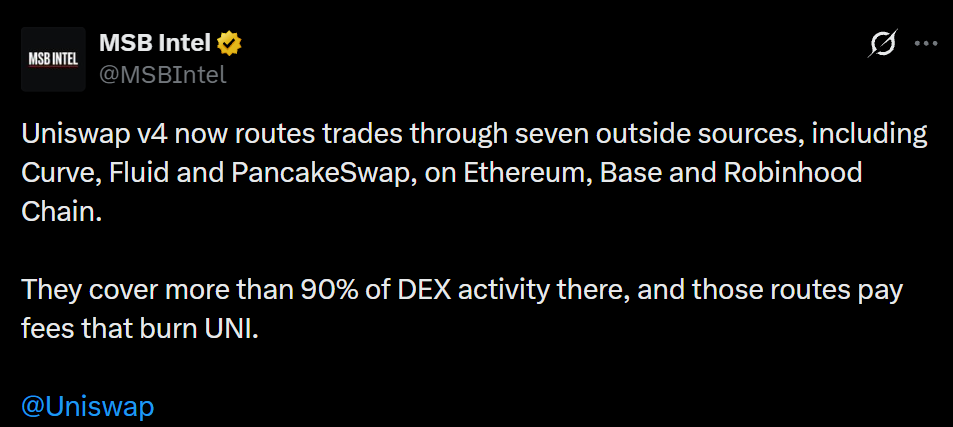
Source: MSB Intel On X
What Launched on 22 October
In its official announcement, dated 22 October 2026, the company said v4 is now an aggregator.
A feature called Aggregator Hooks wraps outside liquidity and turns it into v4 pools.
It is live in the web app and developer API on Ethereum mainnet, Base and Robinhood Chain, with seven outside venues at launch.
The post says this benefits the protocol, because liquidity that forms elsewhere can now be brought in.
Developers can route through the hooks on the same three chains, while everyday swaps in the app pick them up automatically.
| Detail | Information |
| Feature | Aggregator Hooks |
| Announced | 22 October 2026 |
| Networks | Ethereum mainnet, Base, Robinhood Chain |
| Outside venues | Seven |
| Coverage claimed | More than 90% of DEX activity on those chains |
How It Works and Which Venues Are Included
Think of a travel site that checks many airlines at once. The same post explains that each hook wraps an outside venue so any router sees it as a normal pool.
Every block, the router pulls fresh quotes, builds the most efficient route across everything it can see, and settles it in one transaction with nothing new to approve.
For everyday traders, the good Uniswap news today is that the web app includes these venues automatically.
The developer documentation lists examples such as Curve, Fluid, PancakeSwap V3, Slipstream, Uniswap V2 and V3 forks, and LitePSM, “and more."
The blog does not name the seven at launch, so the exact list should be confirmed in the app, and “seven” and “90%” are the company’s own figures.
-
Curve, Fluid, and PancakeSwap are named in the post you shared
-
Slipstream and LitePSM also appear in the docs
Why It Matters for the UNI Burn
The blog says most onchain liquidity already sits on Uniswap, which has handled more than $4.5 trillion in swaps, yet new liquidity can still form elsewhere.
Outside venues become v4 pools, and swaps through them pay protocol fees that contribute to UNI burn.
That follows the UNIfication proposal from November 2025, which suggested using protocol fees to burn UNI and noted that a fee switch needs a governance vote.
The proposal also suggested a one-time burn of 100 million UNI from the treasury.
Our reading that trades sent to an outside venue can now pass through the protocol’s own fee system, because that venue appears as a pool inside v4.
In simple terms, more trades through these hooks could mean more fees sent to the burn, but the posts give no estimate, so no figure should be assumed.
UNI Price Check: What the Chart Shows
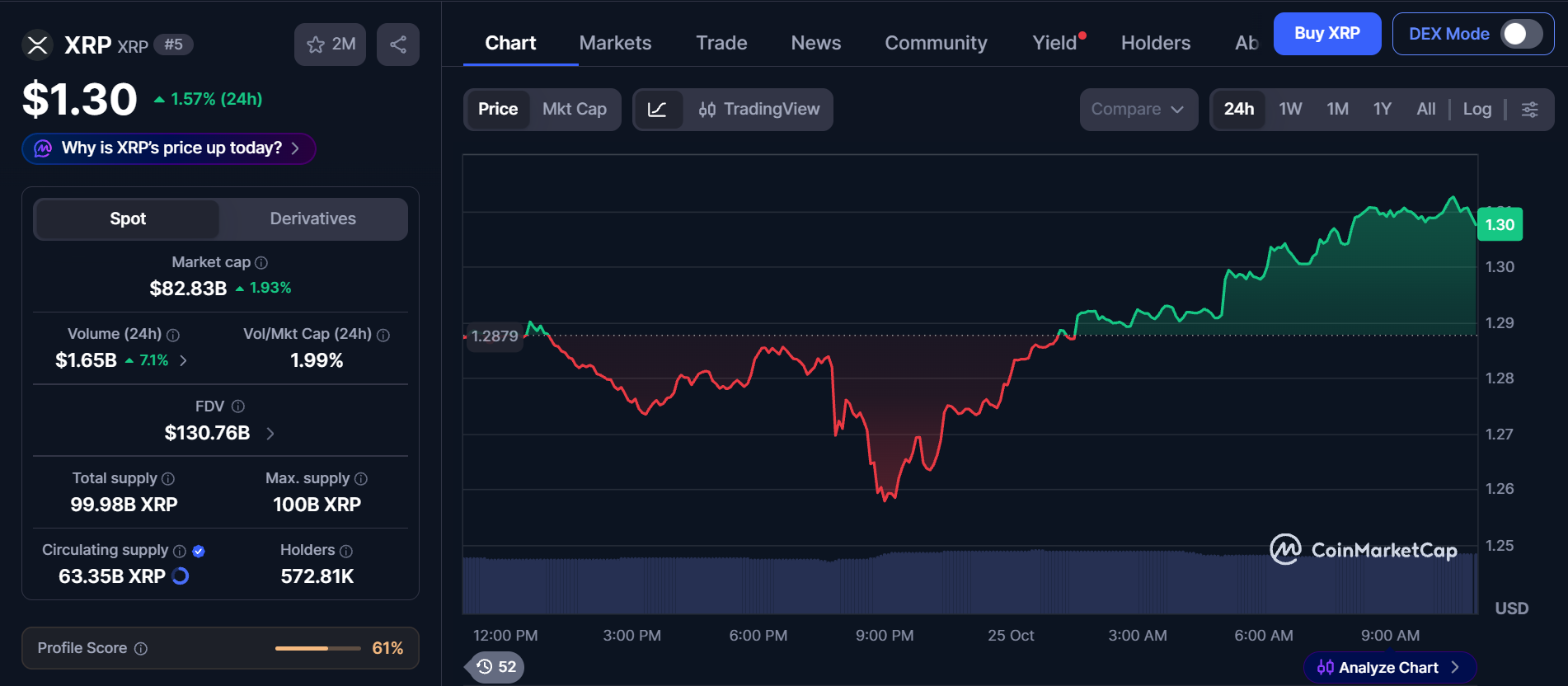
Your CoinMarketCap screenshot shows UNI at $6.82, down 1.91% in 24 hours, ranked 22nd by market cap.
| Metric | Value |
| Market cap | $4.26 billion |
| 24-hour volume | About $332M |
| Fully diluted value | $6.05 billion |
| Locked in the protocol | $4.02 billion |
| Circulating supply | 624.54M of 886.79M total |
Source: CoinMarketCap Live Data
The 24-hour chart began near $6.97, slid to roughly $6.54 late on 24 October, then recovered to about $6.9 before settling at $6.82.
Volume equals about 7.8% of market cap, a rough sign of how actively the token trades.
By our maths, about 70% of total supply is circulating, and market cap is roughly equal to the value locked, a ratio of 1.05.
Because the announcement came on 22 October, this window shows no news-driven rally, and Uniswap news today cannot explain a one-day dip. Many factors move a token.
For Developers: Guidestar and the Hook Family
Builders can now route through Aggregator Hooks on the same three networks.
The routing guide describes Guidestar, a new engine that promises quotes with lower delay and better execution than standard routing.
It is in beta, requires an opt-in, supports only same-chain swaps with a fixed input amount, and never falls back to standard routing, so developers should request a standard quote in parallel.
Every hook in the docs is described as open source and ready to deploy, and aggregator hooks are one of several maintained by the company.
The docs also list Permissioned Pools, StablePair, VolatilePair, and two conversion hooks for ETH and staked ETH.
A 14 October post says VolatilePair brings dynamic fees to volatile pairs, starting with ETH/USDC.
Conclusion
Uniswap news today shows a clear strategy shift: instead of competing with every venue, v4 now pulls them into its routing.
The upside is wider coverage and a possible link to UNI burn, but no volume or burn figures exist yet.
Check the app for the live venue list, avoid assuming price effects, and remember that this article is not financial advice.
Disclaimer
This article is for educational and informational purposes only and is not financial or investment advice. Crypto assets are high risk, their prices can be very volatile, and you can lose some or all of your money. Always do your own research and consider speaking with a licensed financial advisor before making investment decisions.
0
0


 Manage all your crypto, NFT and DeFi from one place
Securely connect the portfolio you’re using to start.


