
The 6 Best DeFi APIs for 2026: Data, Wallets & Pricing

Written by Tigran Mkrtchyan · Reviewed and fact-checked by Narek Gevorgyan · Published May 27, 2026 · Last updated October 1, 2026 · Pricing and limits verified October 2026
DeFi runs on data. Every dashboard, wallet, and trading bot depends on it.
But “DeFi API” is a loose label. It covers very different tools. Some APIs return protocol metrics like total value locked. Others read a single wallet’s DeFi positions. A few execute swaps directly on-chain. One layer just connects you to the blockchain itself. For the bigger picture, see our crypto API comparison.
Choosing the wrong type costs weeks of integration work. So this guide to the best DeFi APIs explains the categories first. Then it ranks six strong options for 2026.
Want the wider picture beyond DeFi? Our best crypto API guide covers general-purpose providers too.
Shortlisting providers? Start with the strongest crypto data API alternatives.
On Ethereum, start with the best Ethereum API for the data.
What Is a DeFi API?
A DeFi API is an interface for decentralized finance data and actions. It lets your code read on-chain information without running your own infrastructure. It can also help your app execute trades. New to the space? Our beginner’s guide to crypto APIs covers the fundamentals first.
The label spans four distinct categories. Knowing them is half the decision when picking the best DeFi APIs for a project.
The first category is market and protocol data. This covers total value locked, yields, fees, and stablecoin supply. The second is wallet and position data. This reads what a single address holds and where it is deployed. The third is swap and execution. This routes trades across decentralized exchanges. The fourth is node and RPC infrastructure. This is raw access to the chain itself. We ranked the best RPC node providers for that layer.
One distinction matters more than any other here. It separates two things that sound alike.
Many tools return balances. Far fewer return positions. That gap shapes the ranking below.
Need the full field? See strong crypto API alternatives.
How to Choose a DeFi API
Match the tool to the job. Six factors decide most choices.
We ranked the free DeFi and market data APIs by quota and rate cap.
The 6 Best DeFi APIs in 2026
Each option below leads a different category. The order reflects how often a DeFi builder reaches for each one. Pick by the job, not by the rank.
CoinStats Wallet API
Most DeFi APIs return token balances. CoinStats DeFi API goes further. It detects per-wallet DeFi positions across protocols. That includes staking, lending, and liquidity pool stakes. It does this from a single wallet address.
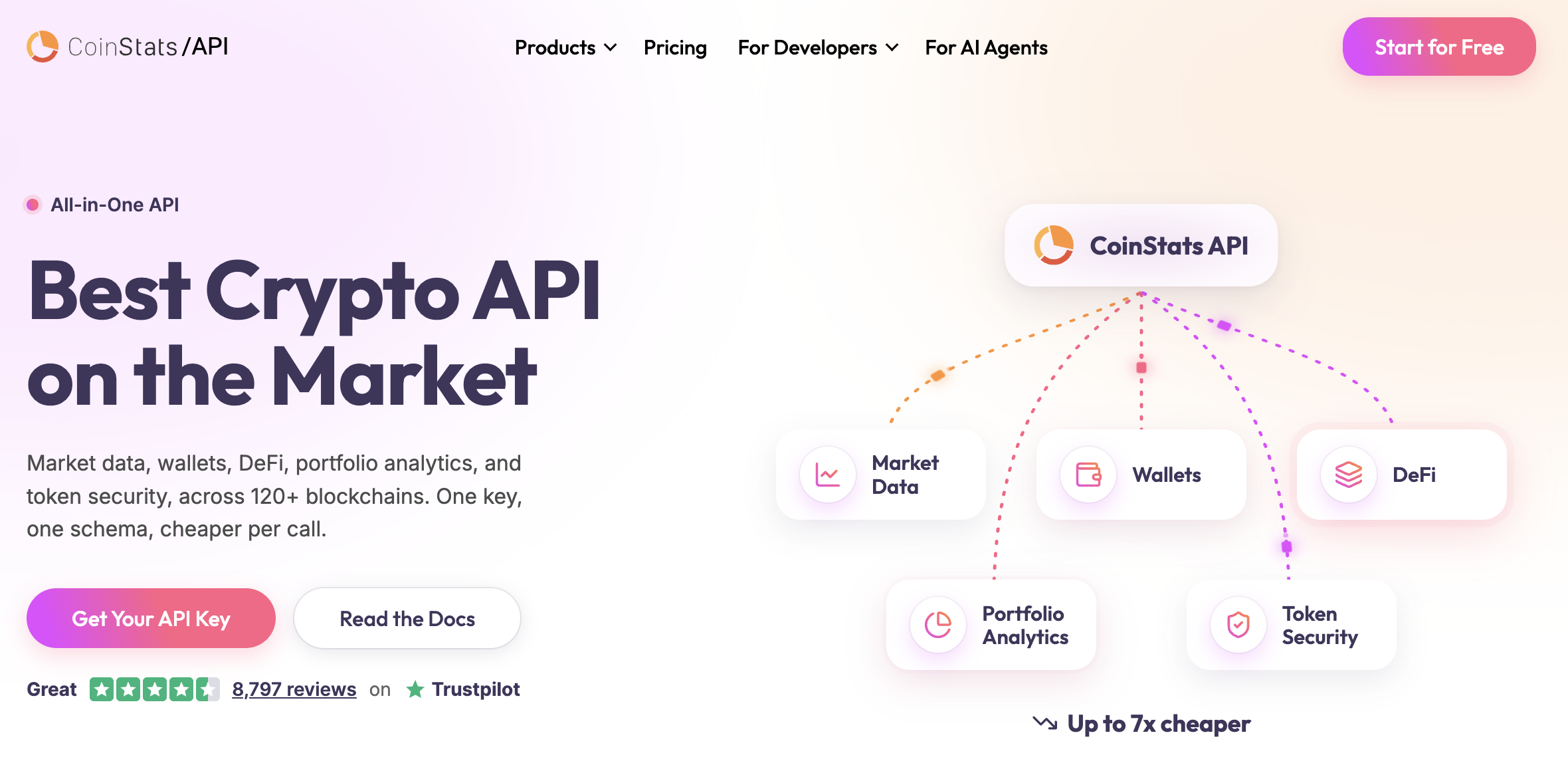
The coverage is broad. The API supports 120+ blockchains through one unified format. CoinStats API also tracks 100,000+ coins and 200+ exchanges. The same data powers the CoinStats app, used by 1M people each month.
The response format stays identical across chains. Your code handles Solana the same way it handles Ethereum. Position detection spans more than 10,000 DeFi protocols. Portfolio analytics sit on top of the raw data.
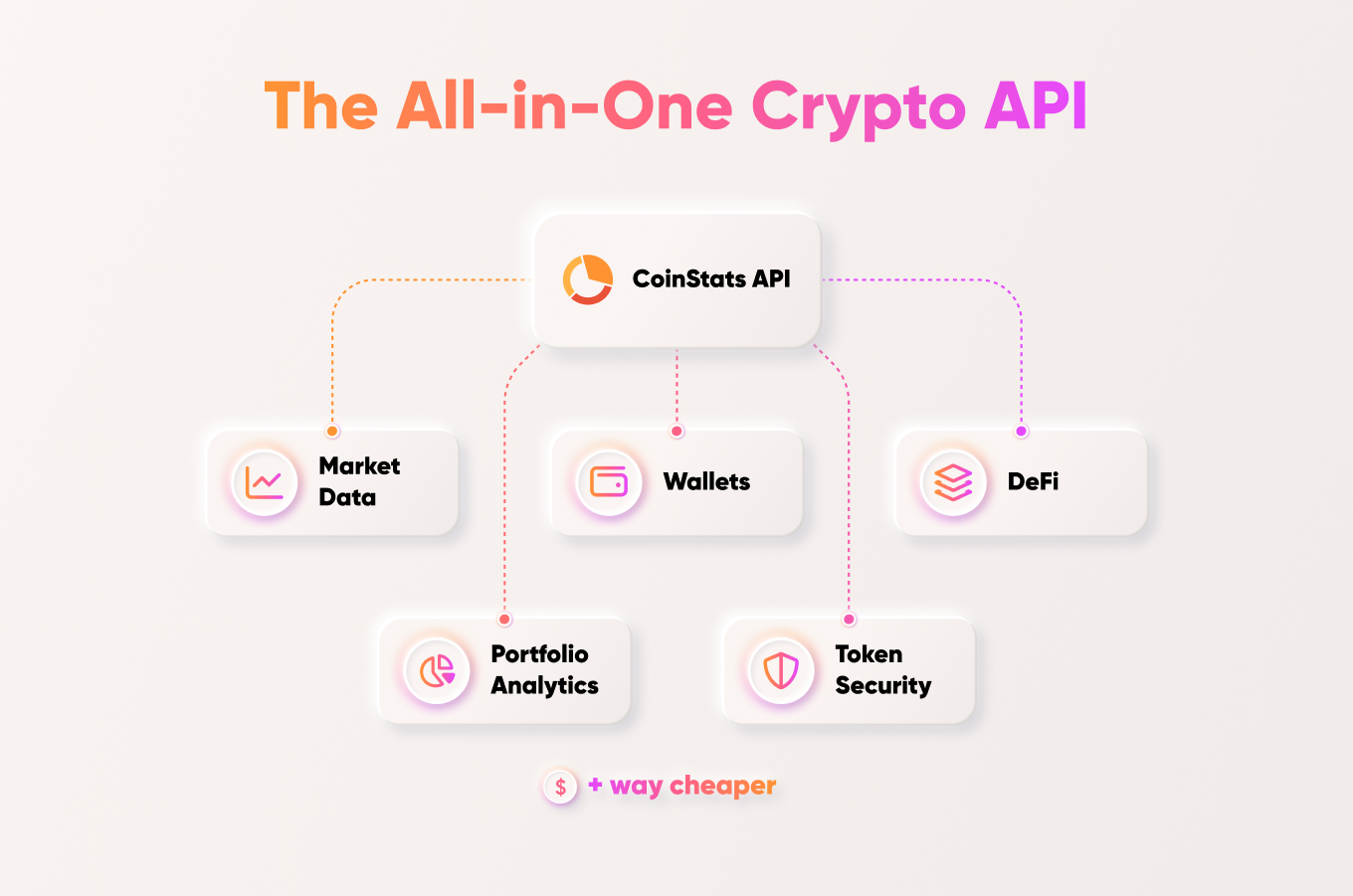
AI agents can reach all of this through CoinStats MCP Server. It exposes wallet, DeFi, and portfolio data through natural language. Most node and market-data APIs do not surface that layer.
This is not a node provider. It is also not a protocol-level TVL source. CoinStats API is the wallet and position layer. On that job it leads.
Key features
- Per-wallet DeFi position detection across 10,000+ protocols
- Balances, token holdings, and transaction history per address
- 120+ blockchains through one unified response format
- Solana, Ethereum, EVM chains, and Bitcoin support
- Portfolio analytics layered on raw wallet data
- MCP Server for AI agent and LLM access
- Reads DeFi positions, not just balances
- One format across every chain
- Free tier with no card required
- MCP Server for AI agents
- Not a raw RPC node provider
- Not built for protocol-level TVL charts
“Most teams do not need ten vendors to ship a DeFi app. They need one clean data layer that returns wallet positions across chains. That is the problem we built CoinStats API to solve.”
Chainstack
Chainstack sits one layer below the others. It provides managed node infrastructure, not packaged DeFi data. You read on-chain state through it directly. That covers DeFi protocol state like liquidity pools and oracle prices. Bots also watch pending transactions in the mempool.
The platform covers 70+ chains. That includes Ethereum, Solana, BNB Smart Chain, Arbitrum, Base, and Avalanche. It offers dedicated nodes and gRPC streaming for latency-sensitive work. Elastic scaling removes the infrastructure overhead.
Billing is simple. Every call counts as one request unit. An Unlimited Node add-on swaps per-request costs for a flat monthly fee. An MCP server exposes the infrastructure to AI agents and LLMs.
Use it for on-chain reads across many chains. The tradeoff is the work. Positions and portfolio analytics are yours to build.
Key features
- Managed node infrastructure across 70+ chains
- Dedicated nodes and gRPC streaming for low latency
- Reads DeFi protocol state and mempool activity
- Elastic scaling without infrastructure overhead
- One request unit per call, any method
- MCP server for AI agent and LLM integration
- Managed nodes across 70+ chains
- Dedicated nodes and gRPC streaming
- Elastic scaling, no infra overhead
- MCP server for AI agents
- Focused on infrastructure, not market data or execution
- Needs familiarity with RPC and blockchain primitives
DexPaprika API
DexPaprika focuses on one layer: decentralized exchange markets. It serves liquidity pools, swap transactions, and token prices through a public REST API. No API key or registration is required.
The data is real-time and historical. It tracks pools, prices, and trading volume across 35+ blockchain networks, Solana and Ethereum included. The schema stays consistent across every chain. Built by the CoinPaprika team, it carries crypto data experience dating to 2018.
Two SSE streaming feeds push live updates with no polling. One streams token prices every second. The other pushes block-level pool reserve deltas, a feed few providers offer. AI agents reach all of it through DexPaprika MCP, hosted and key-free.
The focus is DEX markets, not wallets. It reads pools and trades, not per-wallet DeFi positions. Reach for it when your app needs live DEX pricing and liquidity.
Key features
- Liquidity pools, swaps, and token prices via REST
- 35+ blockchain networks with one consistent schema
- Public API, no key or registration required
- SSE streaming for token prices and pool reserves
- Advanced pool filtering and batched token prices
- MCP server for AI agent and LLM access
- Free and key-free for most use
- Real-time DEX pricing and streaming
- Consistent schema across chains
- MCP server for AI agents
- DEX market data only, no wallet positions
- No protocol-level TVL or yield aggregation
DeFiLlama API
DeFiLlama is the reference source for protocol metrics. Most TVL numbers cited online trace back to it. The API is open and free. It needs no authentication for normal traffic.
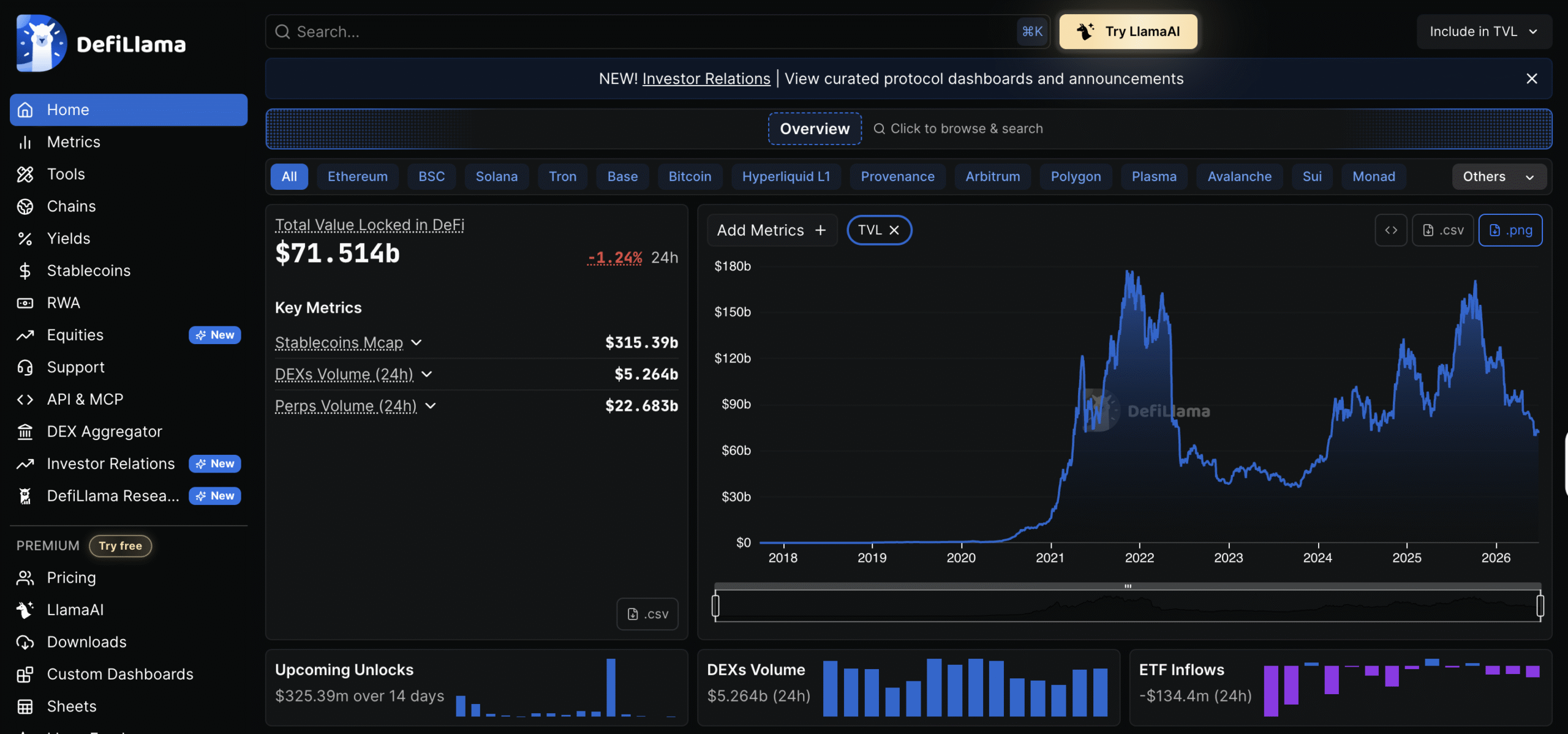
The data is wide. It covers TVL, yields, DEX volume, fees, and stablecoin supply. It tracks 350+ chains and 5,000+ protocols. The methodology is open-source. Most figures refresh hourly.
The model is fixed, though. It reports on protocols and chains, not on individual wallets. There are no wallet labels and no custom queries. A Pro tier at $300 per month adds higher limits and extra endpoints.
For protocol-level research, DeFiLlama is hard to beat — wide coverage, transparent methodology, and free for most use.
Key features
- TVL, yields, fees, and DEX volume data
- Stablecoin supply and bridge metrics
- 350+ chains and 5,000+ protocols tracked
- Open API with no auth for normal use
- Open-source, community-driven methodology
- Free and open for most use
- Widest protocol and chain coverage
- Trusted, transparent methodology
- No wallet-level or position data
- Fixed model, no custom queries
1inch API
1inch is an execution layer first. It aggregates liquidity across decentralized exchanges. It then routes a trade for the best available rate. Swaps stay non-custodial throughout.
The Swap API spans several modes. Classic mode is the standard aggregator. Fusion adds intent-based swaps. Fusion+ handles cross-chain trades. An orderbook and real-world asset support round it out.
The portal bundles more than swaps. It also offers spot pricing, token metadata, balances, and gas estimates. The suite reaches 15+ APIs across 13+ chains. AI agents can plan and run swaps through 1inch MCP.
The focus is trading, not position tracking. Balance data exists, but DeFi positions are not the product. Reach for it when your app needs to move tokens.
Key features
- DEX aggregation for best-rate routing
- Classic, Fusion, and Fusion+ swap modes
- Spot pricing and token metadata
- Wallet balances and portfolio composition
- 15+ APIs across 13+ chains
- MCP access for agentic trading
- Strong liquidity and routing
- Non-custodial swap execution
- Cross-chain swaps via Fusion+
- Agent-ready through MCP
- Not built for DeFi position tracking
- Narrower chain count than data APIs
Covalent (GoldRush)
Covalent runs the GoldRush data platform. It serves structured on-chain data through one unified API. The reach is broad. It covers 100+ chains from a single integration.

The core data is granular. It returns token balances, transactions, and event logs. It also serves historical token prices. Developer tools include SDKs for TypeScript, Python, and Go. Ready-made React components speed up front-end work.
Pricing is flexible. A free API key starts you off. A low-cost plan suits prototyping. An x402 mode even lets agents pay per request without an account.
The data is raw and wide rather than packaged. DeFi positions are not returned as a finished feature. You assemble them from balances and event logs.
Key features
- Unified API across 100+ chains
- Token balances, transactions, and event logs
- Historical token pricing data
- SDKs for TypeScript, Python, and Go
- React components and a data CLI
- Pay-per-request mode for AI agents
- Very wide chain coverage
- Granular raw on-chain data
- Strong SDK and tooling support
- Flexible, low-friction pricing
- DeFi positions need manual assembly
- Less opinionated than packaged APIs
Crypto Wallet DeFi Positions API: Reading Positions by Chain
This is the category that trips most builders. A crypto wallet DeFi positions API returns funds deployed into protocols. It reads staking, lending, and liquidity pool stakes for an address. Balances alone miss all of that. For the wider wallet API landscape — not just DeFi positions — see our best crypto wallet APIs roundup.
Among the six, CoinStats Wallet API is built for this job. It detects positions per wallet across chains. The sections below show how that works on each major network. For the broader picture, see our best multichain crypto portfolio APIs guide.
EVM Wallet DeFi Positions API
EVM chains share one address format and token standard. That makes them a natural group. An EVM wallet DeFi positions API reads holdings and deployed funds across them at once. For the EVM foundation in plain English, our Ethereum API explainer goes deeper. CoinStats covers the major EVM networks — Polygon, BNB Smart Chain, Arbitrum, Optimism, Base, and Avalanche — and one EVM token balance API call returns holdings per address. The same query surfaces positions staked or lent across protocols.
Crypto Wallet DeFi Positions API
EVM and Solana cover most of the volume. The long tail of crypto runs on dozens of other chains. A crypto wallet DeFi positions API has to handle them all without forcing a separate integration per network. CoinStats Wallet API supports 120+ blockchains through one unified format — including Cardano, Tron, Cosmos, Polkadot, Near, Algorand, Ripple, Hedera, Litecoin, Dogecoin, Stellar, and Bitcoin Cash, plus Layer 2 networks like StarkNet, zkSync Era, Polygon zkEVM, and Immutable X. The same endpoint format works across every chain, so adding a new network is one API call, not a new integration. For HD wallet tracking on Bitcoin specifically, our best Bitcoin xPub APIs comparison covers that niche in depth.
Solana Wallet DeFi Positions API
Solana uses a different account model from EVM chains. Its tokens and programs work their own way. A Solana wallet DeFi positions API has to handle that natively. CoinStats Solana API reads SPL token balances for an address and surfaces Solana DeFi positions in the same response. A Solana token positions API call returns both holdings and deployed funds — no separate Solana-only integration required.
Comparing the Top 6 DeFi APIs
The table sets all six side by side. Note that they sit in different categories. The right pick depends on the job, not on one winning row. For the wider market beyond DeFi, our best crypto data APIs roundup is the next read. And before integrating any of these into production, our best token security APIs comparison covers smart-contract risk detection for the tokens and contracts you’ll be touching.
| API | Best for | Chains | Per-wallet DeFi positions | Pricing | AI agent (MCP) |
|---|---|---|---|---|---|
| CoinStats Wallet API | Per-wallet DeFi positions | 120+ | Yes, built-in | Credit-based, free tier | Yes |
| Chainstack | Node infrastructure | 70+ | No, build yourself | Request-unit, free tier | Limited |
| DexPaprika API | DEX pools, swaps, prices | 35+ | No, DEX-level only | Free, public API | Yes |
| DeFiLlama API | Protocol TVL and yields | 350+ | No, protocol-level only | Free, Pro $300/mo | No native |
| 1inch API | Swaps and routing | 13+ | Partial, balances | Tiered, free tier | Yes |
| Covalent (GoldRush) | Broad on-chain data | 100+ | Partial, raw data | Free key, paid plans | Yes |
Which DeFi API Should You Pick?
Start from the job. Each card below points to the right tool.
Conclusion
The best DeFi API depends on what you are building. There is no single winner across every job. We applied the same logic to our own API in this alternatives roundup. Each tool here leads a different category.
For protocol research, DeFiLlama is the free default. For swaps, 1inch leads on routing. For raw access, Chainstack and Covalent serve different depths.
For per-wallet DeFi positions, CoinStats Wallet API is the strongest pick. If you would rather not build, we also ranked the best ready-made DeFi trackers. It reads balances, transactions, and deployed positions together. It does this across 120+ chains in one format. For most wallet and portfolio products, that is the layer that matters.
Frequently Asked Questions
Common questions about DeFi APIs, positions, pricing, and chain coverage.
What is a DeFi API?
A DeFi API reads decentralized finance data through standard endpoints.
It returns protocol metrics, wallet positions, prices, or swap routes.
Your code skips running its own blockchain infrastructure.
What are the four types of DeFi API?
Market and protocol data covers TVL, yields, and fees.
Wallet and position data reads what an address holds and deploys.
Swap and execution routes trades across decentralized exchanges.
Node and RPC gives raw access to the chain.
What is the difference between token balances and token positions?
A balance shows what an address holds.
A position shows funds deployed into protocols.
Positions cover staking, lending, and liquidity pool stakes.
Positions are the harder data to source.
Which DeFi API returns per-wallet DeFi positions?
CoinStats Wallet API detects positions per wallet across 120+ chains.
It reads staking, lending, and liquidity pool stakes.
Most other APIs stop at token balances.
How do I read DeFi positions for a Solana wallet?
Use a Solana wallet positions API built for its account model.
CoinStats Solana API reads SPL balances and Solana positions together.
One call returns holdings and deployed funds.
Which DeFi API covers the most chains?
DeFiLlama tracks 350+ chains for protocol metrics.
CoinStats Wallet API covers 120+ chains for wallet positions.
Covalent reaches 100+ chains for raw onchain data.
What is the difference between a DeFi API and an RPC?
An RPC node returns raw blockchain data. You send low-level calls and decode the result yourself.
A DeFi API returns ready data. It gives you wallet positions, prices, and protocol metrics in clean JSON. Most teams pair a data API for reads with an RPC only when they need to send transactions.
Is there a free DeFi API?
Yes. DeFiLlama and DexPaprika are free for most use.
CoinStats API offers a free tier with no card.
Many providers gate higher limits behind paid plans.
Is DeFiLlama API free?
Yes. DeFiLlama API is open and free for normal traffic.
It needs no authentication for standard requests.
A Pro tier at $300 per month adds higher limits.
What is the best DeFi API in 2026?
No single API wins every job.
CoinStats Wallet API leads for per-wallet DeFi positions.
DeFiLlama leads for protocol TVL, and 1inch leads for swaps.
Which DeFi API works with AI agents?
CoinStats, DexPaprika, 1inch, and Covalent expose MCP servers.
AI agents query wallet, DeFi, and market data directly.
MCP support matters more each year.
Do I need a node provider to read DeFi data?
Usually not. Packaged data APIs return positions and prices directly.
A node provider like Chainstack suits raw onchain reads.
There you build positions and analytics yourself.
Which DeFi API works with AI agents and MCP?
CoinStats API ships a hosted MCP server, so agents can call it without custom glue code.
MCP is becoming a baseline feature, not a differentiator. Check that the provider exposes the endpoints your agent needs and documents rate limits clearly.
Tigran is the Head of Digital Marketing at CoinStats, working across crypto and consumer apps. His writing covers first-hand crypto experience and marketing case studies from that work. He has taken the stage at industry-leading conferences like MAU Vegas, Business of Apps Berlin, and App Promotion Summit London.
More from Tigran on the CoinStats blog · LinkedIn · X