
Dogecoin Price at $0.072 in a Death Cross: When Will DOGE Rise Again?

0
0

What is established: the Dogecoin price stood at $0.0721 on Saturday morning, and since October 29 the 50-day moving average of DOGE has been below its 200-day moving average. Chart analysts call this setup a death cross. Our view follows further down: the signal confirms a decline that has long since played out, and it says little about when DOGE will rise again.
One Dogecoin cost $0.0721, or around €0.0647, at about 9:40 am on Saturday, November 7, 2026, according to market data from CoinGecko. That is a gain of 0.2 percent on the previous day, a loss of 4.5 percent over seven days and a loss of 17.7 percent over 30 days. The range over the past 24 hours stayed narrow, between $0.0717 and $0.0733.
For this article we analysed CoinGecko's daily closing prices for the past twelve months and calculated both moving averages ourselves. On that basis, the 50-day line stands at $0.0851 and the 200-day line at $0.0857. The price is therefore almost 16 percent below the long average and just over 15 percent below the short one.
Dogecoin price on Saturday morning: $0.0721 in thin weekend trading
Saturday has started quietly. Across all trading venues tracked by CoinGecko, Dogecoin worth $330 million changed hands over the past 24 hours. On Friday the daily figure was still just over $720 million, as DOGE posted its lowest close since August. A thin weekend market means that even small sell orders can move the price by several percent, in either direction.
Bitcoin traded at $76,050 at the same time, 0.6 percent above the previous day. Over 30 days Bitcoin has lost 8.2 percent; Dogecoin has lost more than twice as much. By market capitalisation, meaning price multiplied by the number of units in circulation, DOGE comes to $11.29 billion and stays in 13th place, just behind Monero at $11.53 billion.
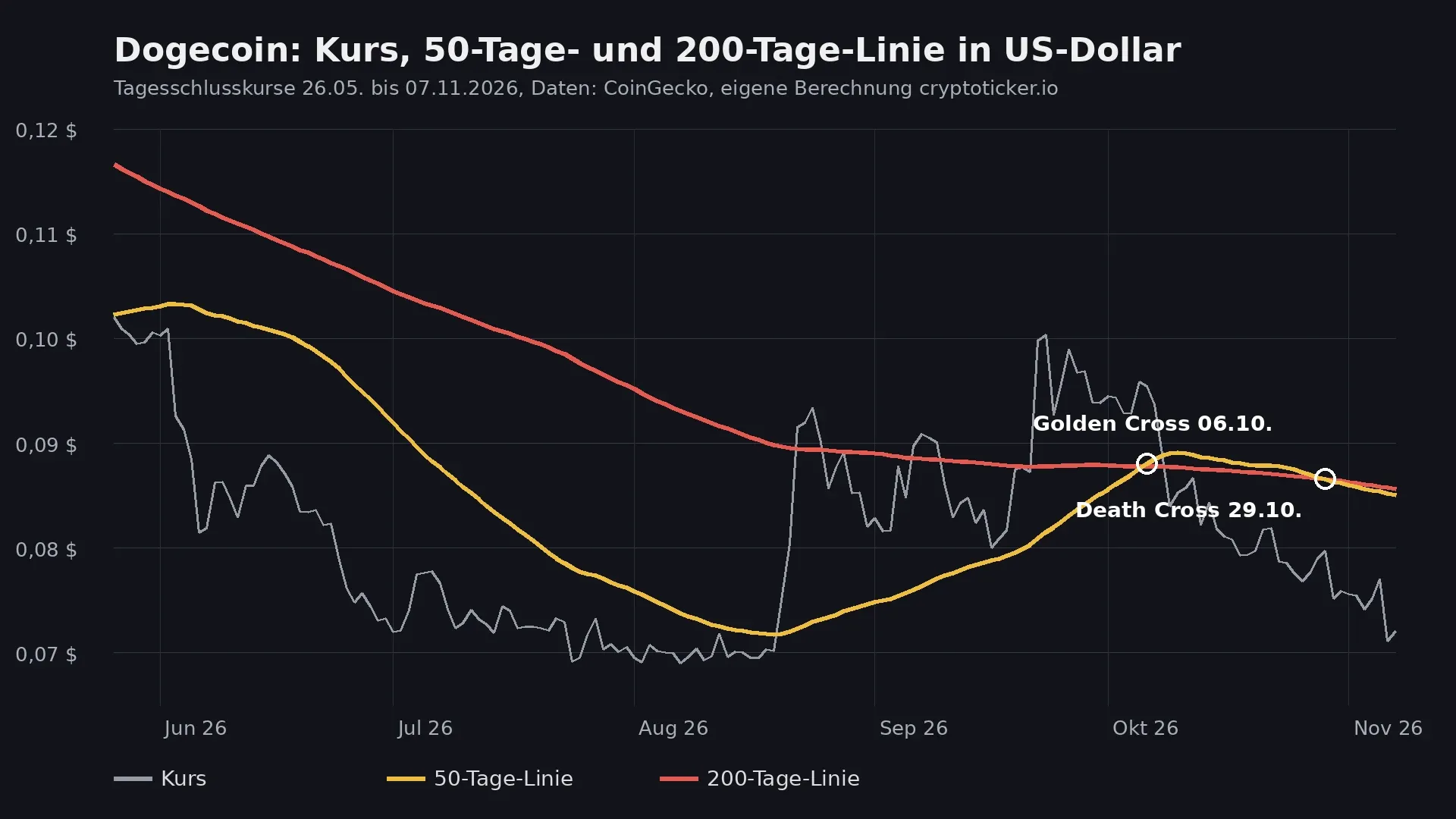
Dogecoin death cross: the 50-day moving average has been below the 200-day since October 29
A moving average is the mean of closing prices over a fixed number of days, shifting forward by one day every day. The 50-day line tracks the trend of the past seven weeks, the 200-day line the trend of a little more than half a year. When the short line falls below the long one, chart analysts speak of a death cross; when it rises above it, of a golden cross.
By our calculation, the 50-day line crossed the 200-day line from above on October 29. Dogecoin closed at $0.0797 that day. Since then the price has lost a further 9.5 percent, and the gap between the two lines is slowly widening: on Saturday the 50-day line is around 0.7 percent below the 200-day line. Both lines point downwards. The last time Dogecoin closed above both was on October 8.
How the averages are calculated matters for reading the signal. An average over 200 days reacts sluggishly, because each new day accounts for only one two-hundredth of it. It confirms a move only once that move is weeks old. The death cross is therefore not an early warning but a record of what happened in October.

Golden cross of October 6: the buy signal lasted only 23 days
The autumn shows how late such signals arrive. On October 6 the 50-day line rose above the 200-day line, a golden cross. Dogecoin closed at $0.0954 that day. But the price had already put its peak behind it: on September 23 DOGE stood at $0.1004. Anyone who bought on the golden cross is now down 24 percent.
The buy signal held for 23 days, then turned into its opposite. The reason lies in the mechanics. The short line was still rising in October because the strong September days sat inside its window. Once those days dropped out of the window, it sank back below the long line. Both crossings therefore tell the same story, only with a delay: a rally in September that was given back in October.
Summer 2026: in the last death cross DOGE rose 45 percent
A look further back contradicts the reading that a death cross prevents price gains. Our data go back to November 8, 2025, which allows the 200-day line to be calculated from May 26, 2026. From that day the 50-day line stayed below the 200-day line without interruption until the golden cross on October 6.
In exactly this phase, Dogecoin fell to $0.0690 on August 7, its low for the year. From there the price climbed to $0.1004 by September 23, a gain of 45 percent, even though the lines were in a death cross the whole time. The turn came in the price weeks before the averages showed it.
Since Friday: the 200-day moving average is unchanged at $0.0857
In our article on Friday lunchtime, Dogecoin stood at $0.0726 and Monero had just overtaken DOGE by market capitalisation. Little has moved since. At $0.0721 the price is only $0.0005 lower, and 13th place behind Monero remains. The 200-day line, which we put at $0.0857 on Friday, is still at $0.0857 by our calculation.
What is new is the view of the low. In the 24 hours to Friday lunchtime, DOGE fell as far as $0.0703, and Friday ended at $0.0711, the lowest close since August. The $0.0690 level, the low for the year set on August 7, was therefore not tested. On Saturday morning the price is about 4 percent above it.
Fear and Greed Index at 25: fear across the market weighs on DOGE too
Sentiment in the crypto market has darkened markedly within two days. The Fear and Greed Index from alternative.me stands at 25 points on Saturday, in the "Extreme Fear" zone. On Friday it was 28 points, and on Thursday still 50, a neutral reading. The index combines price volatility, trading volume, sentiment on social networks and other data into a single number between 0 and 100.
Dogecoin reacts to such phases more strongly than Bitcoin, because the coin generates no income of its own and lives almost entirely on demand. There is also the fixed issuance: every block creates 10,000 new DOGE, and at one block per minute that comes to around 14.4 million coins a day. The market has to absorb that supply before buying pressure can lift the price.
DOGE levels: $0.0760 above, $0.0690 below
Four levels can be derived from the daily data for the days ahead. On the upside, the first is $0.0760, the high of the 24 hours before our Friday article. Above that come the 50-day line at $0.0851 and the 200-day line at $0.0857. A close above both lines would be the first sign that the downtrend in place since September is breaking. That is still around 19 percent away.
On the downside, Friday's low at $0.0703 counts first, followed by the low for the year at $0.0690. Dogecoin has not closed lower on any day in the past twelve months. A close below it would mark a new low for the year, and our daily data offer no reference level for the zone beneath.
Traders using leverage should take the weekend particularly seriously. In thin trading, smaller orders are enough to trigger liquidations, and a liquidation sells automatically into a falling market. A stop-loss just below $0.0690 sits exactly where many others place their orders too. If you hold without leverage, this mechanism does not affect you.
Offsetting DOGE losses in Germany: losses only count within the holding period
For investors in Germany, the chart picture comes with a tax deadline. Gains and losses from selling cryptocurrencies are private disposal transactions under Section 23 of the German Income Tax Act. If more than a year passes between purchase and sale, a gain is tax-free. The same rule has a flip side: a loss realised after the holding period has expired is worthless for tax purposes.
This mainly affects buyers from November 2025. On November 11, 2025, Dogecoin cost $0.1818 according to CoinGecko, the high of the past twelve months. Anyone who bought then is now down around 60 percent. Selling by November 11, 2026 inclusive allows the loss to be offset against gains from other private disposal transactions, including in later years via a loss carryforward. From November 12 that option disappears. The exemption limit for such gains has been €1,000 a year since 2024.
Whether selling and buying back later makes sense depends on your other gains, on fees and on whether a new holding period is a problem. A crypto tax tool can bring together the purchase dates and cost basis across all wallets and exchanges before the deadline passes. For larger amounts, the decision belongs with a tax adviser.
Our assessment: the death cross confirms the downtrend, it does not predict it
Our assessment: the death cross of October 29 is a finding, not a forecast. Three pieces of evidence from our own data support this. The golden cross of October 6 came 13 days after the peak and lasted 23 days. In the summer Dogecoin rose 45 percent while the lines were in a death cross. And the October crossing happened at a price of $0.0797, after DOGE had already lost more than 20 percent from its September high.
Against this, both lines keep falling and the price sits well below them. As long as that remains the case, the trend needed to carry a rally is missing. The question of when Dogecoin will rise again is therefore answered not by the crossing of the lines but by the price itself: first with a close above $0.0760, then above the 50-day line. No source we could verify names a date for that. Dogecoin remains a high-risk coin, up to and including total loss.
How to buy DOGE in Germany: through an exchange with MiCA authorisation
Since the end of 2024 the EU's MiCA regulation, the Markets in Crypto-Assets Regulation, has applied. Exchanges and brokers that sell cryptocurrencies to customers in Germany need authorisation as a crypto-asset service provider to do so. Whether a provider has it is listed in the public register of the European supervisor ESMA. If you want to buy DOGE or add to a position, check the provider there first and then compare spreads and fees, which for a coin trading around $0.07 can quickly outweigh a day's price move. Which platforms offer this in Germany is shown in our crypto exchange comparison.
Custody follows the same rule as for any other coin: if you plan to hold DOGE for longer, you can move it from the exchange to a wallet of your own. If you need to keep track of the holding period, note the purchase date of every tranche, because the German tax office calculates on a "first in, first out" basis.
Dogecoin in a death cross: only above $0.0851 does the picture turn
- Set your levels: Note $0.0760 as the first hurdle and $0.0690 as the low for the year. Exchanges with price alerts are listed in our exchange comparison.
- Check the holding period: If your portfolio contains purchases from November 2025, decide before the anniversary whether to use the loss for tax purposes. Tax tools and portfolio trackers bring the purchase dates together.
- Limit leverage: At the weekend, little trading is enough for large swings. If you hold leveraged positions, compare the margin rules and fees of crypto brokers beforehand.
(As of November 7, 2026. This article is not investment advice. Prices and fee structures change; check the terms with the provider before you buy.)
0
0

 Manage all your crypto, NFT and DeFi from one place
Securely connect the portfolio you’re using to start.


