
Bitcoin Eyes $87K as US Stocks Extend Record Highs

0
0
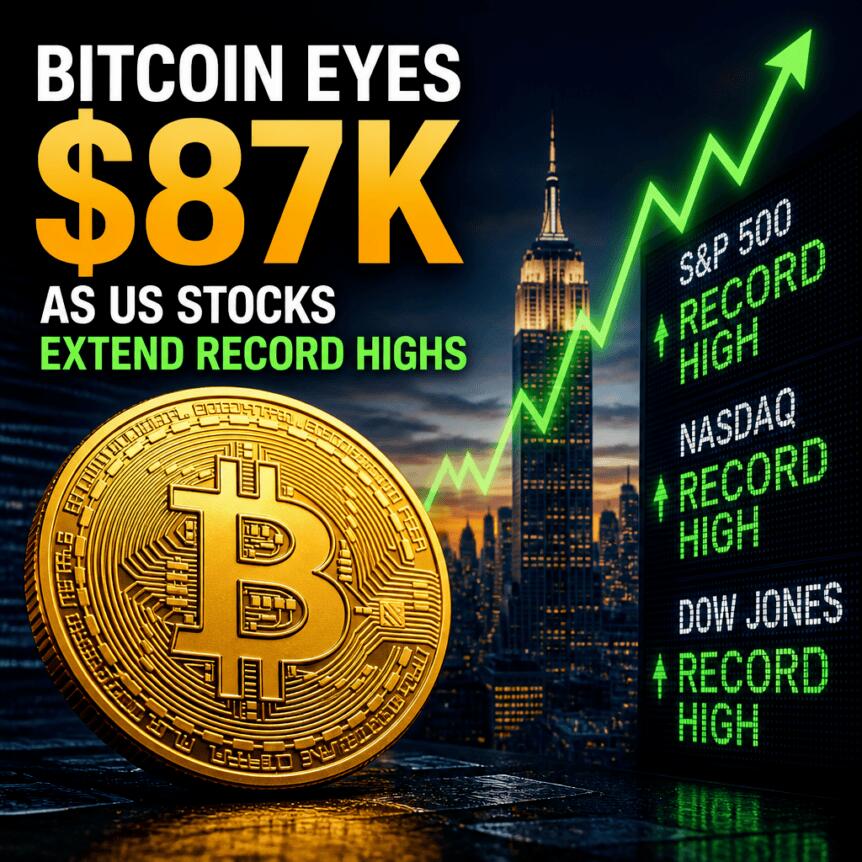
Bitcoin hovered around the $86,000 mark on Tuesday, trading largely rangebound as US equities hit fresh all-time highs. With BTC failing to sustain upside momentum toward $87,000, traders pointed to near-term friction in the order book—an environment that can matter as much as macro headlines when liquidity is clustered at key levels.
At the same time, broader risk appetite remained supported by record closes in major US indices. The S&P 500 climbed 0.8% to 7,835 points, while the Nasdaq 100 and Nasdaq Composite also printed new highs, reinforcing the close link many investors draw between large-cap equities and liquid crypto beta.
Key takeaways
- Bitcoin struggled to advance beyond $87,000 as exchange order books showed prominent ask liquidity near that level.
- CoinGlass data indicated the largest concentration of liquidation/liquidity around $87,000, with a “ladder” of asks down to roughly $86,500.
- On the technical side, a 21-day SMA near $83,500 remains the nearest widely tracked support area.
- CryptoQuant reported a modest positive correlation between Bitcoin and the S&P 500 at 0.51 as of Oct. 2—its highest since early June.
- US stocks were a key driver of sentiment, with the S&P 500 returning to all-time highs and breadth remaining comparatively weak, according to Mosaic Asset Company.
Stocks at record highs keep pressure on Bitcoin’s range
BTC/USD continued its attempt to turn upward after another unsuccessful push higher on Monday. According to TradingView data referenced by Cointelegraph, the latest rebound effort followed a failed attempt to break higher despite recent strength.
Equities drove much of the day’s attention after the Wall Street open. The S&P 500, Nasdaq 100, and the Nasdaq Composite all set new record highs, reaching 7,835, 31,312, and 27,683 points, respectively. The magnitude of the rally since early spring also stood out: The Kobeissi Letter highlighted that the S&P 500 had gained 24%—equivalent to about $71.3 trillion in value—since March 30.
Mosaic Asset Company framed the current equity momentum through the lens of shifting expectations around Federal Reserve policy. In a Tuesday analysis, Mosaic argued that cooling expectations of interest-rate hikes in Q4 2026 could provide fuel for a sustained rally. It also stressed that market breadth remained weak—only 25% of stocks were trading above their 50-day SMA last week—while tech continued to lead the upswing.
That breadth dynamic can be important for crypto watchers because it influences how durable “risk-on” flows might be. If equity gains depend heavily on a narrow group of winners, markets can be more sensitive to any change in rates expectations—conditions that often feed into Bitcoin’s liquidity-driven trading behavior.
Correlation with equities strengthens, but Bitcoin still needs its own catalyst
Data from CryptoQuant suggested the relationship between Bitcoin and the S&P 500 is firming, even if it has not translated into a clean BTC breakout. CryptoQuant analytics showed Bitcoin’s correlation with the S&P 500 at 0.51 as of Oct. 2, described as its highest level since early June.
For investors, this matters because correlation is a useful—though imperfect—indicator of how “macro liquidity” may be steering both markets. However, correlation does not automatically resolve short-term resistance. Bitcoin can remain rangebound even when equities perform well, especially if traders are actively defending specific price levels on derivatives and spot order books.
Tuesday’s trading pattern appeared to fit that description: the equity tape supported the backdrop, but BTC’s ability to break higher was constrained by concentrated liquidity around the next psychological milestone.
$87,000 faces ask liquidity; support centers on the 21-day SMA
While Bitcoin tried to return toward $87,000, overhead resistance persisted. Cointelegraph pointed to exchange order book “ask liquidity” clustered near the upper end of the range as a key factor capping upside during the session.
CoinGlass futures data added granularity. It showed the largest concentration of liquidity around $87,000 on Tuesday, and a stepped structure of asks extending down toward approximately $86,500. In practical terms, that kind of “ladder” can slow rallies by forcing buyers to keep absorbing supply at multiple price steps before the market can find acceptance higher.
On the downside, market participants were watching the nearest major trend reference. Keith Alan, cofounder of Material Indicators, identified support around $83,500—Bitcoin’s 21-day simple moving average. Alan noted that this level was last traded on Sept. 18, positioning it as a key area that could determine whether the current range continues or turns into a deeper pullback.
Alan’s broader framework also referenced specific invalidation and trend confirmation levels. In analysis posted on X, he highlighted a focus on whether buyers can clear a Monthly signal invalidation threshold at $87,375, and later discussed a scenario in which reclaiming and retesting the Yearly Open at $87,496 could strengthen the case for a more durable move above $91,540.
None of those levels guarantee direction, but they do clarify what traders are likely using to structure risk in the short term—especially in markets where liquidity pools around round numbers and technical averages can dominate price action.
What to watch next: breadth, liquidity walls, and the 21-day level
With US equities still trading at record highs and Bitcoin correlation with the S&P 500 elevated, the next development for BTC may come less from rates commentary and more from whether market structure can clear the $87,000 liquidity pocket without quickly reversing. Traders will likely keep an eye on follow-through above $87,375 and on whether $83,500 (the 21-day SMA) continues to hold as the nearest line of technical defense.
This article was originally published as Bitcoin Eyes $87K as US Stocks Extend Record Highs on Crypto Breaking News – your trusted source for crypto news, Bitcoin news, and blockchain updates.
0
0


 Manage all your crypto, NFT and DeFi from one place
Securely connect the portfolio you’re using to start.


