
Deribit Traders Have $836 Million of Puts at $60,000. Half Expire on Christmas

0
0

At 12:20 UTC on November 16, bitcoin traded at $64,001.62 on Deribit’s index, about 6.25% above $60,000. That gap is where the largest single block of put open interest on the exchange now sits: $835.6 million of puts at the $60,000 strike, spread across 11 expiries and roughly 12,922 BTC of notional, according to BlockchainReporter’s calculation from Deribit’s public options book.
The whole strike, calls included, holds $995.7 million of open interest, out of $24.4 billion across 982 listed BTC option instruments. More than half of the put wall, $431.6 million of it, expires on December 25. Another $132.1 million runs to March 26, 2027, and $93.4 million to November 27.
That distribution matters more than the headline number. A put that expires in five weeks is a hedge against a move that has not happened yet. A put that expires in March 2027 is a longer, slower position that says less about what traders expect this month. Reading the $60,000 strike as one trade misreads what Deribit’s book actually contains.
What the $60,000 Strike Actually Holds
The $60,000 level is the third-largest strike on the exchange by total open interest, behind $80,000 at $1,250.6 million and $70,000 at $1,021.5 million. It is the largest single put line: $835.6 million of puts against $160.1 million of calls at the same strike, so puts make up 83.9% of the level.
Inside the wall, the concentration is uneven. The December 25 expiry carries 6,706.2 BTC of $60,000 puts. The March 26, 2027 expiry carries 2,023.5 BTC. The November 27 monthly carries 1,457.2 BTC, and the June 25, 2027 expiry carries 927.7 BTC. The near-dated weeklies are small by comparison: $39.7 million on November 20, $10.3 million on November 18 and $3.2 million on November 17.
Strike-level open interest across the top five levels, from $60,000 to $90,000, adds up to $4,965.2 million. That is 20.4% of the entire book sitting on five prices.
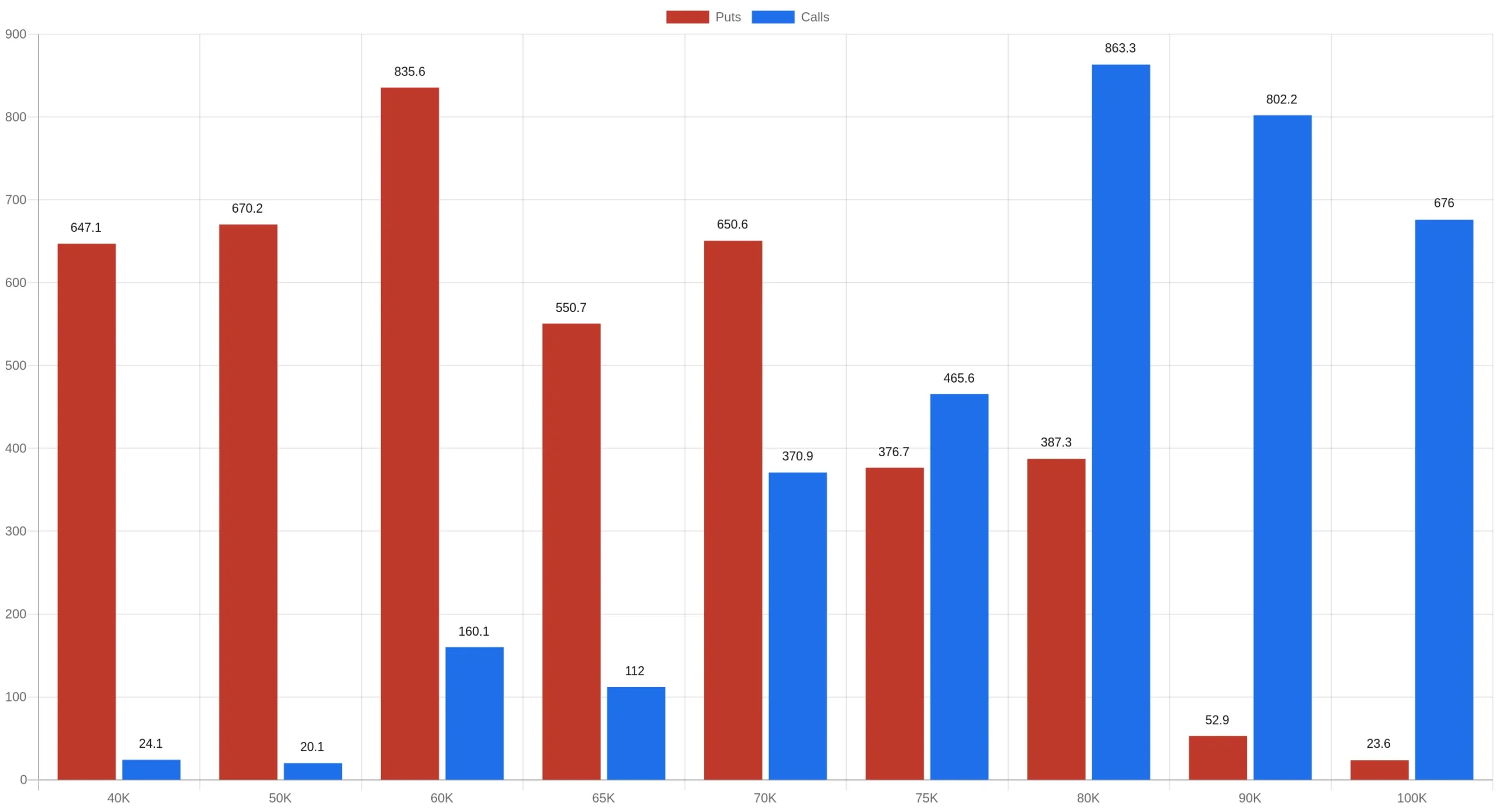
Open interest by strike on Deribit, denominated in USD millions, derived from the exchange’s public options book at 12:20 UTC on November 16, 2026. Puts cluster below spot, calls above it.
The Bigger Line Is $80,000 in Calls
If the question is which single option line carries the most money, the answer is not the $60,000 put. It is the $80,000 call, at $863.3 million of open interest, $27.7 million more than the $60,000 put and 3.3% larger.
The $80,000 strike as a whole holds $1,250.6 million, with calls accounting for 69% of it. That level is 25% above spot, and it has been built over a market that spent October between $79,900 and $84,500 before the current slide. Its size reflects where traders were positioning when bitcoin was trading near $80,000, not a fresh bet on a rebound.
The comparison to the $100,000 call is where the put side does win. That strike holds $676.0 million of calls, down from the role it played in the summer. The $60,000 put, at $835.6 million, is now 1.24 times the size of the $100,000 call. The upside bet that dominated the book earlier this year has been reduced; the downside hedge has not.
What that does not establish is direction. A put can be bought as insurance by someone holding bitcoin, or sold for premium by someone willing to buy at $60,000. Deribit’s public data shows open interest by instrument, not the identity or intent of either side. The exchange publishes volume, open interest and mark prices; it does not publish who is long and who is short.
Puts Are Now 43.1% of a $24.4 Billion Book
Across all BTC options listed on Deribit, puts carry $10,524.9 million and calls $13,873.5 million. The put share of 43.1% is the number to watch against the $60,000 wall: it says the downside hedge is a large minority of the book, not a niche position. The same strike carried more than $1.2 billion of notional open interest in June, when a Deribit executive warned that a break below $60,000 could trigger liquidations. The position has since been cut by roughly 30%.
Implied volatility has moved with it. Deribit’s DVOL index closed at 42.89 on November 15, against a 30-day average of 39.7 and a 120-day range of 33.6 to 47.3. Volatility is 8% above its recent average and 27.6% above the August low, but still below the October peak. Options are more expensive than they were three months ago and cheaper than they were at the worst of the selloff.
The spot market supplies the other half of the picture. Bitcoin traded at $64,024 at 12:14 UTC, down 2.02% in 24 hours, with a market capitalisation of $1.288 trillion, according to CoinGecko. That is below the $65,000 level the market recovered above late on November 15 and above the $61,899 low of that session.
Insurance, Not a Forecast
Deribit’s rulebook sets the contract mechanics that decide how these positions resolve. “Deribit offers European style cash-settled options and linear options. European style options are exercised only at expiry and cannot be exercised before,” the Deribit Exchange Rulebook states in its contract specifications.
Two consequences follow. First, no holder of a $60,000 put can force settlement early, so the strike cannot be triggered by a single holder deciding to exercise. Second, settlement is in cash, not in bitcoin, so an in-the-money put at expiry pays the holder in currency rather than moving coins into or out of the market.
The rulebook also explains how the exchange values positions between expiries. “Deribit may determine the mark to market value of the open Positions using the Mark Price so as to avoid spikes and unnecessary liquidations during periods of high volatility,” it states. That is a mechanism to dampen liquidation cascades during fast moves, not a promise that the $60,000 level holds.
Denominating the book in dollars requires one more step, and the rulebook describes it: “The options are priced in BTC or ETH. However, the relevant price can also be seen in USD. The price in USD is determined by using the latest futures price.” BlockchainReporter applied each instrument’s own underlying price to its BTC-denominated open interest, which is why the dollar figures differ slightly from a single-spot conversion.
Three Expiries Decide What the Wall Does
The open interest is not evenly spread across the calendar. December 25 carries $9,444.9 million, or 38.7% of the entire book, with $3,801.8 million in puts and $5,643.1 million in calls. November 27, the next monthly, carries $6,352.9 million. The annual March 2027 expiry carries $3,058.6 million.
Friday’s November 20 expiry is smaller than it looks at first glance: $2,052.0 million across the whole board, with $802.1 million in puts. The $60,000 strike contributes only $39.7 million to it. A large headline expiry does not automatically mean the $60,000 level is in play that week.
The December 25 date is the one that matters for the wall, because 51.9% of the $60,000 put open interest in BTC terms expires there. Settlement that day will be decided by Deribit’s delivery price, which is derived from the index, not by any single trade. If bitcoin is below $60,000 at that point, those puts settle in the money and the holders collect; the cash moves between accounts on the exchange.
What Would Change the Picture
The wall is a snapshot of positions, not a fixed structure. Open interest falls when positions are closed and rises when new ones are opened, and the $60,000 level can shrink without any change in price. The figure that would matter is a sustained decline in the $60,000 put count alongside a rise in puts at lower strikes, which would indicate hedging being extended rather than unwound.
On price, the reference points are narrow. Bitcoin has traded between $61,899 and roughly $65,000 in the past 24 hours, and the $60,000 strike sits 6.25% below the current index. A close below $61,899, the November 15 low, would put the market inside the zone where the $60,000 puts were bought. A recovery above $65,000 would leave the wall further out of the money without removing it.
Those levels are descriptive, not predictive. The data supports one conclusion: traders are holding more downside protection than upside exposure at the strikes closest to spot, and they have concentrated that protection at a round number that is close enough to matter and far enough to be cheap. What the book does not show is whether that protection is being bought by holders or sold by traders willing to take the other side.
Data: Deribit, CoinGecko, CoinGlass.
Frequently Asked Questions
What is a bitcoin put wall?
A put wall is a strike where put open interest is concentrated. On Deribit, the $60,000 strike held $835.6 million of put open interest at 12:20 UTC on November 16, 2026, the largest single put line on the exchange. The term describes position size, not a price floor.
Does a large put wall stop bitcoin from falling?
No. Open interest records contracts that are open, not orders waiting to buy. Settlement is cash-based at expiry, so an in-the-money put pays the holder without buying spot bitcoin. The wall can shrink or grow without any effect on price.
Why is the $60,000 strike so large?
It is a round number close enough to spot to pay off in a continued decline and far enough away to be cheaper than at-the-money protection. The December 25 expiry alone carries 6,706.2 BTC of $60,000 puts, 51.9% of the strike’s total put open interest.
What is DVOL and why does it matter here?
DVOL is Deribit’s implied volatility index for bitcoin options. It closed at 42.89 on November 15, 2026, against a 30-day average of 39.7. Higher readings mean the options used for hedging cost more, which changes the economics of holding the $60,000 puts.
When do the $60,000 puts expire?
They are spread across 11 expiries. The largest are December 25, 2026 with $431.6 million, March 26, 2027 with $132.1 million and November 27, 2026 with $93.4 million. Deribit options are European style, so none can be exercised before its expiry date.
This article is for informational purposes only and does not constitute financial or investment advice. Options trading carries the risk of losing more than the premium paid. All figures reflect the Deribit order book at the time stated.
The post Deribit Traders Have $836 Million of Puts at $60,000. Half Expire on Christmas appeared first on BlockchainReporter.
0
0

 Manage all your crypto, NFT and DeFi from one place
Securely connect the portfolio you’re using to start.
 Where will Bitcoin trade next?
Live Polymarket and Kalshi odds on Bitcoin price targets, compared side by side.
See Bitcoin price odds


