
USDT Did Not Launch on Bitcoin Today. Utexo’s Own Documentation Still Says Signet

0
0

USDT was supposed to be live on Bitcoin today. It is not. The 28 November date that Utexo, the company issuing the stablecoin on Bitcoin, had been working toward arrived without a launch announcement from Utexo or from Tether, whose dollar token it is. Utexo’s own account of the schedule changed on 27 November at 13:28 UTC, when it published a post headed “MAINNET LAUNCH UPDATE” and described partner coordination rather than a release. Its public documentation, read on 28 November at 13:50 UTC, still configures the software for Bitcoin Signet, the test network, and states that RGB over Lightning is not enabled on mainnet.
The gap matters beyond one delayed product. USDT is a $173.58 billion asset by market capitalisation at 13:48 UTC on 28 November, per CoinGecko, and Bitcoin is the network Tether stopped issuing on when it wound down Omni, the layer USDT launched on in 2014. Moving even a slice of that balance onto Bitcoin rails would change which fee market stablecoin flows pay into. A missed date says more about the plumbing than about the token.
Utexo has not published a replacement date. What can be checked today are the artefacts a launch would have to change: the network identifier in its developer documentation, the status of its Lightning support, and the date of the last item in Tether’s newsroom.
What Utexo Said on 27 November
MAINNET LAUNCH UPDATE
Since opening early access to Utexo Mint in October, we’ve made significant progress in testing our infrastructure on Bitcoin Signet and onboarding new partners.
We’re now coordinating with key operators to have their integrations go live alongside our
Utexo (@utexocom) November 27, 2026
The post names two things and omits a third. It names early access to Utexo Mint, opened in October, and it names progress on Bitcoin Signet. It does not name a new date. Every sentence is about readiness of counterparties rather than readiness of the protocol: integrations going live “alongside our” launch, in the post’s own unfinished phrasing, is a statement about wallets and exchanges being ready at the same moment, which is a different problem from getting the asset to mint.
A stablecoin on Bitcoin is not a contract deployment that a team can finish alone. The asset has to exist in a form that a wallet can display, an exchange can credit, and a merchant can accept without a custom integration per counterparty. Utexo’s model puts client-side validation on the user’s side, with Bitcoin carrying a cryptographic commitment rather than the balance itself, which means the partner software has to understand RGB state before a single transfer is useful. The company’s April work with x402 made the same bet from the other end, putting USDT payments in front of software agents that pay per request.
The company has been building toward that for longer than this quarter. BlockchainReporter reported in March that it had raised $7.5 million led by Tether to launch native USDT settlements on Bitcoin; the round closed 267 days before today’s target date. Tether’s own RGB plan was public in August 2025, 456 days before it, as we covered when the company said it would roll out the token on RGB for private, offline-capable payments.
The Documentation Still Says Signet
Launch claims are cheap to make and hard to check, so the useful evidence is the material a company must keep accurate for developers. Utexo’s documentation states the constraint plainly: “RGB over Lightning is available on test networks; it is not enabled on mainnet.” The sentence sits in the overview page describing what the stack is, not in a roadmap section.
The SDK documentation is more specific. The SDK page describes “Lightning is WIP, available only in separate experimental integrations, and not recommended for production,” and its sample wallet configuration passes network: 'signet' with a Signet block explorer endpoint. If public mainnet issuance had begun, the first code sample a developer copies would not point at a test chain.
None of that proves a mainnet mint is impossible. It does mean the public artefacts a reader can inspect on 28 November describe a system in integration, and that the documentation has not been rewritten to match a launch. Utexo did not publish a correction or a new date on its site; Tether’s newsroom listed 25 November, 19 November, 17 November and 16 November as its four most recent entries when checked at 13:55 UTC, with no USDT-on-Bitcoin item among them.
The division of labour is also worth stating, because it changes who is accountable for the date. Bitcoin Magazine reported before the deadline that “USDT on Bitcoin is launched by Utexo and not by Tether,” and that while Utexo Mint is not owned or operated by Tether, the token is “backed by USDT via Tether’s USDT0 protocol.” Tether supplies the liability; Utexo supplies the rail. A delay in the rail is not a delay in the reserve.
Where the $173.6 Billion Sits Instead
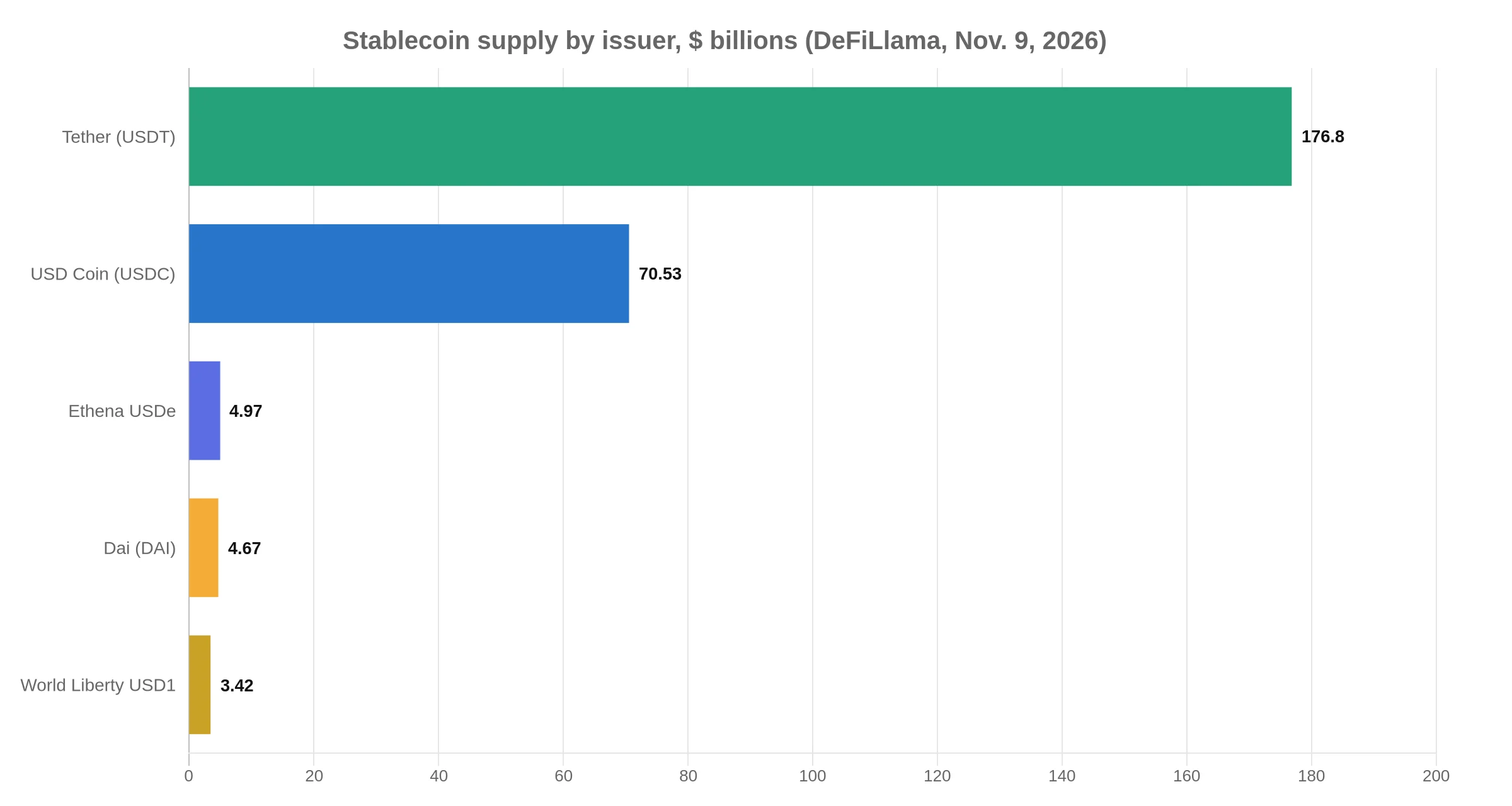
USDT carried a market value of $173.58 billion at 13:48 UTC on 28 November, with 173,697,681,399 tokens in circulation and a price of $0.999313, per CoinGecko. The same snapshot puts USD Coin at $69.46 billion. Against that pair, Tether accounts for 71.4% of the combined supply, and against Bitcoin’s $1,187.40 billion market value, USDT alone is 14.6% of it.
Those figures also date the delay. The 9 November chart above shows USDT at $176.8 billion. Nineteen days later the same measure reads $173.58 billion, a decline of $3.22 billion, or 1.82%. Stablecoin supply contracting into a launch window is a normal part of a risk-off tape, not evidence about Utexo, but it does mean the addressable float that Bitcoin rails would settle is smaller today than it was when the November date was set.
Bitcoin’s own numbers set the other side of the exchange. At $59,028 with a $1.187 trillion market value, the network’s fee revenue depends on blockspace demand, and RGB’s design deliberately keeps most transaction data off the chain. A successful USDT-on-Bitcoin rail would bring settlement volume to the network while leaving the block space it consumes small. That is the trade Utexo is selling: Bitcoin’s finality as an anchor, without Bitcoin’s fee auction as the cost of every transfer.
What a Launch Would Actually Look Like
The conditions are checkable, and none of them is a press release. A mainnet network identifier would appear in the SDK’s sample configuration. The documentation’s Lightning caveat would change from test-networks-only to a mainnet statement with an operator list. At least one exchange or wallet would credit the asset and publish deposit instructions, since a stablecoin nobody can deposit is a demo. Tether’s newsroom would date an announcement to the day it happened rather than leaving the most recent entry six days old.
Utexo’s post points at exactly that first set of conditions, with the phrase about integrations going live alongside the launch. What it does not do is commit to a sequence. There is no published statement in the 27 November post that mainnet issuance itself is blocked, and no statement that it has begun; the post is a status update on partner readiness that leaves both readings open. Readers who want the answer will have to wait for either a new date or a mainnet configuration in the docs.
For the wider market, the question that outlasts this launch is whether stablecoin settlement migrates toward networks that charge a published commission instead of a gas auction, which is the model Utexo documents: a quoted fee before the transfer, with the underlying chain fee passed through. Payment operators care about that because unit economics have to survive a fee spike, and a rail whose cost cannot be quoted cannot be priced into a merchant contract.
Bitcoin’s claim on that business is finality and censorship resistance, not throughput. The Lightning caveat in Utexo’s own docs is the honest statement of the gap: the fast path that would make small payments viable is still experimental, and the mainnet path that works today is on-chain RGB, which settles at block tempo. A stablecoin that settles every ten minutes is useful for treasury movement and much less useful for a point-of-sale terminal.
The underlying asset is already the largest dollar token in the market, the issuer is a company Tether funded, and the technical route has been public since 2025. If the launch slips again, the constraint will be visible in the same three places: the docs, the partner list, and Tether’s newsroom. Until one of them changes, the 28 November target is a date that passed, and the token is still where it was a week ago: on Tron, Ethereum and the other chains that carried it while Bitcoin did not.
Frequently Asked Questions
Did USDT launch on Bitcoin on 28 November 2026?
No launch announcement had been published by Utexo or Tether as of 13:55 UTC on 28 November. Utexo’s 27 November post described coordinating partner integrations, and its public documentation still configured the SDK for Bitcoin Signet and stated that RGB over Lightning was not enabled on mainnet. Tether’s newsroom showed no item dated 28 November.
Who issues USDT on Bitcoin, Tether or Utexo?
Utexo issues and operates the Bitcoin deployment, while Tether supplies the backing. Bitcoin Magazine reported that USDT on Bitcoin “is launched by Utexo and not by Tether,” and that Utexo Mint is not owned or operated by Tether even though the token is backed by USDT through Tether’s USDT0 protocol.
How would USDT work on Bitcoin without congesting the chain?
Through RGB, which keeps asset state with holders and writes only a cryptographic commitment to Bitcoin. Utexo’s docs describe client-side validation with on-chain anchoring, and a published commission quoted before a transfer instead of a gas auction. The trade-off is that the fast settlement path, RGB over Lightning, is described as available on test networks only.
What was the 28 November date based on?
It was Utexo’s stated public launch date for USDT on Bitcoin, reported before the deadline with a two-phase rollout beginning 28 November. The plan followed a $7.5 million round led by Tether in March 2026 and early access to Utexo Mint from October 2026, which Utexo says ran on Bitcoin Signet.
How can a reader verify a future launch claim?
Check three artefacts on the day: the network identifier in Utexo’s SDK sample configuration, the Lightning statement in its documentation, and the date of the most recent item in Tether’s newsroom. A launch that exists in all three is a launch that counterparties can use; one that exists only in a social post is not.
Prices, market capitalisations and circulating supply are a single CoinGecko snapshot taken at 13:48 UTC on 28 November 2026. Documentation and newsroom checks were made between 13:45 and 13:55 UTC the same day. Percentage and supply comparisons in this article are calculated from those figures.
Disclosure: This article does not represent investment advice. The content and materials featured on this page are for educational purposes only.
The post USDT Did Not Launch on Bitcoin Today. Utexo’s Own Documentation Still Says Signet appeared first on Blockchainreporter.
0
0


 Manage all your crypto, NFT and DeFi from one place
Securely connect the portfolio you’re using to start.
 Where will Bitcoin trade next?
Live Polymarket and Kalshi odds on Bitcoin price targets, compared side by side.
See Bitcoin price odds


