
Crypto.com’s Proof of Reserves Is Still Dated December 2022. Here Is What It Actually Covered

0
0

The newest exchange-wide proof-of-reserves report Crypto.com links from its own reserve page is dated December 9, 2022. It covers balances as of 00:00 UTC on December 7, 2022, across nine tokens, and nothing has replaced it in the 1,453 days since. On November 29, Galaxy Digital’s head of firmwide research, Alex Thorn, put the gap into one sentence on X.
crypto dot com hasn’t published a proof of reserves since december 2022
— Alex Thorn (@intangiblecoins) November 29, 2026
Thorn did not claim the exchange is missing customer assets, and nothing in the public record shows a shortfall. He pointed at a disclosure that has not moved: Crypto.com’s reserve page still states: “All customer assets held on our platform are fully backed (1:1), safely stored and available for redemption at your convenience.” The only document behind that sentence was written when the exchange served 70 million customers. The same page now says it is trusted by more than 150 million users.
The trigger was smaller than the claim. A customer spent four days locked out of an account while trying to move about $15,000 of bitcoin after a $100 test transfer cleared, an episode her friend documented on X from November 26 and that ended with an apology and the withdrawal released. One account review is not evidence of insolvency. The reason the episode spread is that customers who went looking for a current reserve statement found a 2022 one.
The nine assets Mazars checked, and the two it skipped
The document is an agreed-upon procedures engagement performed under ISRS 4400 (Revised), the international standard for reporting factual findings rather than opinions. Mazars, the audit firm, prepared it for Foris DAX MT Limited, the Malta-based entity that runs Crypto.com, and signed it on December 9, 2022 through partner Wiehann Olivier. It lists nine in-scope assets and one ratio each.
| In-scope asset | Reserve ratio, 7 Dec 2022 |
|---|---|
| BTC | 102% |
| ETH | 101% |
| USDC | 102% |
| USDT | 106% |
| XRP | 101% |
| DOGE | 101% |
| SHIB | 102% |
| LINK | 101% |
| MANA | 102% |
Two absences are more informative than the ratios. Cronos (CRO), the exchange’s own token, is not in the list. Neither is VeChain (VET). Crypto.com’s live page still explains why: “Not all tokens or chains are supported by the tools Mazars Group utilised in the verification at this moment. We are working with Mazars Group to include additional tokens, protocols and networks, including Cronos (CRO) and VeChain (VET), in the subsequent verifications.” That sentence promises a follow-up that has not appeared in four years, and it is still written in the present tense.
The coverage map has the same shape. The report covers customer spot and margin balances on eight networks: Bitcoin, Ethereum, Avalanche, Ripple, Polygon, Dogecoin, Arbitrum and Optimism. Tokens held elsewhere, or moved after 00:00 UTC on December 7, 2022, fall outside it. No total liability figure was published. Mazars compared quantities, not dollars, so a reader cannot reconstruct the size of the balance sheet that was checked.
“Not an assurance engagement”: the sentence that limits the 102%
The report states its own limits in plain language. “This AUP engagement is not an assurance (financial audit) engagement,” it reads. “Accordingly, we do not express an opinion or an assurance conclusion.” It adds that the report “does not cover any transactions and/or balance holdings of Crypto.com after the reporting date.”
Crypto.com’s 2022 announcement framed the same document differently. “Providing audited Proof of Reserves is an important step for the entire industry to increase transparency and begin the process of restoring trust,” chief executive Kris Marszalek said in the December 9, 2022 release. The word “audited” is doing work the engagement letter does not support; the auditor’s own text says no opinion was expressed.
Two procedural details are worth keeping. The customer liability report was extracted from production at 23:59:59 UTC on December 6, 2022, one second before the snapshot time of 00:00 UTC on December 7. And the balance comparison tolerated variances of up to 1%: Mazars documented that it “did not find any variances greater than 1%,” which is a statement about tolerance, not about perfection.
What customers can still check is the Merkle root. Mazars published the hash, e535cf418ab603cc4b338069a814037d53c50bf37dc5776631f3d9c3110e08af, and pointed users to its Veritas tool and an open-source verifier, so anyone can test whether their December 2022 balance was included in that tree. The full report is still the file the reserve page serves. Our guide to checking an exchange’s proof of reserves walks through the same inclusion test.
Seventy million customers became 150 million
The number that has moved is the customer count, and it is on Crypto.com’s own pages. The December 2022 release describes the company as “trusted by more than 70 million customers world-wide.” The reserve page today says “more than 150 million users worldwide.” That is 2.14 times the base the attestation was built on, a rise of about 80 million on the company’s own counts.
Peer cadence makes the gap look less like a technical constraint and more like a choice. OKX’s reserve page currently advertises its 49th proof-of-reserves report, covering $33.87 billion across 21 assets, with bitcoin at 108% and ether at 101%. Bitget says on its own reserve page that “every month, we publish Merkle Tree proof along with our platform reserves and reserve ratio.” If Crypto.com had matched a monthly schedule from December 2022, it would have published about 47 reports by now. It has published one.
| Exchange | Stated cadence | Latest disclosed report |
|---|---|---|
| Crypto.com | Not stated; one-time engagement | Snapshot of 7 Dec 2022, published 9 Dec 2022 |
| OKX | Monthly | 49th report, $33.87B across 21 assets |
| Bitget | Monthly | Monthly Merkle tree update, per its reserve page |
The comparison is not a solvency test. It measures disclosure frequency, and an exchange that publishes every month is not automatically safer than one that published once. The point is narrower: recurring reports are now the norm among large venues, which makes a four-year-old snapshot conspicuous rather than standard.
The one reserve figure on the site that does update
Crypto.com does publish a live reserve number, just not for the exchange. Its CDCBTC dashboard showed 173 BTC against 173 BTC of token supply at 11:04 UTC on November 29, valued at $10,124,119.16 with bitcoin at $58,520.92, along with the reserve address on-chain. That is a real, refreshable disclosure. It also covers one wrapped product, not customer deposits.
Set the two numbers beside each other. DefiLlama’s exchange tracker counted $1.83 billion in Crypto.com wallet assets at 11:05 UTC on November 29, down $18.0 million, or 0.98%, over 24 hours and up $150.5 million over the past month, per DefiLlama. The product-level reserve, the only one the company refreshes publicly, equals about 0.55% of that tracked total.
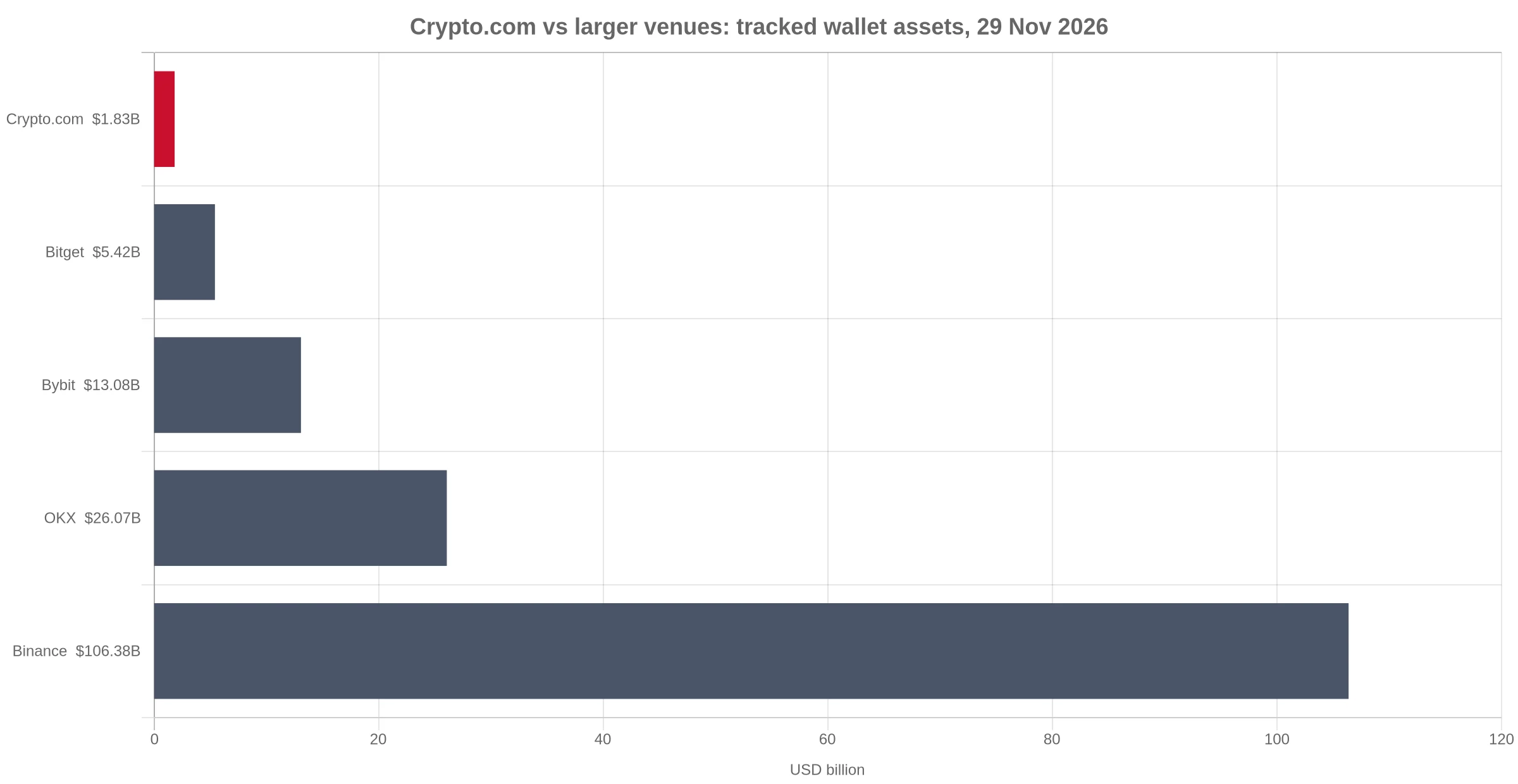
The chart carries its own caveat. DefiLlama tracks wallets it can attribute to each venue, and attribution is uneven, so the bars compare tracking coverage as much as balance-sheet size. Crypto.com’s own wallet list, published through Nansen, is not the same set the tracker uses. Treat $1.83 billion as a floor for on-chain visible assets, not as an audited total.
What a 2022 quantity ratio can still tell you
A ratio built from quantities survives price moves. If Crypto.com held 102 bitcoin for every 100 it owed in December 2022, a 70% drop in bitcoin’s price leaves the ratio unchanged, because both sides of the division fall together. That is a genuine strength of the Mazars arithmetic and the reason a quantity-based proof beats a dollar-based one.
What the ratio cannot survive is a change in the mix. Deposits, withdrawals, new listings, borrowing against collateral and the growth from 70 million to 150 million users all move the liability side without touching the published figure. The attestation is a photograph of one second in December 2022, and Crypto.com’s business has changed shape several times since.
The countercase deserves equal space. The 2022 report found the exchange fully reserved for every in-scope asset, and no later evidence contradicts that finding for that date. Thorn’s post did not allege a shortfall, and the withdrawal complaint that preceded it ended with the customer’s funds released. A slow account review raises a service question; it does not establish that reserves are short. Anyone reading the episode as proof of missing assets is going further than the record allows. Our coverage of Binance’s recurring reserve snapshots makes the same distinction: a published report measures disclosure, and a missing one is not a finding of insolvency.
What would end the argument
A single dated document would settle it: a new exchange-wide report, naming the firm that prepared it, listing in-scope assets including CRO and VET, stating the liability side in quantities, and carrying a fresh Merkle root that customers can test. Crypto.com has the plumbing for that. The CDCBTC dashboard already refreshes in real time, and the Merkle verification tools remain public.
Until then, the verifiable statement is this: the newest exchange-wide reserve attestation on Crypto.com’s site certifies quantities at 00:00 UTC on December 7, 2022, at ratios between 101% and 106% for nine tokens, and covers no period after that date. The page that hosts it has been updated since in every way except the one that matters.
Frequently Asked Questions
Does Crypto.com publish proof of reserves?
Yes, once. The exchange published a Mazars agreed-upon procedures report on December 9, 2022, covering balances as of 00:00 UTC on December 7, 2022. No later exchange-wide report has replaced it. A separate, live reserve dashboard exists for the CDCBTC wrapped-bitcoin product.
What was Crypto.com’s bitcoin reserve ratio?
102% at the December 7, 2022 snapshot, meaning the bitcoin held in wallets controlled by the exchange exceeded customer bitcoin liabilities by 2%. Ether was 101%, USDC 102% and USDT 106%. The report compared quantities, not dollar values, and did not publish the underlying amounts.
Is Crypto.com insolvent?
Nothing in the public record shows that, and Alex Thorn’s November 29 post did not allege it. The complaint that prompted the discussion involved an account suspension that was resolved and funds that were released. A stale attestation is a disclosure problem, not proof of a shortfall.
How can I verify that my balance was included in the 2022 report?
Log in, copy your Merkle leaf, and check it against the published root hash e535cf418ab603cc4b338069a814037d53c50bf37dc5776631f3d9c3110e08af using Mazars’ Veritas page or the open-source verifier. The test confirms inclusion on December 7, 2022. It says nothing about balances after that date.
Why does the auditor matter?
Because the value of a reserve report depends on who prepared it and what they were allowed to say. Mazars prepared the 2022 report as factual findings without an opinion, and it stopped taking crypto attestation clients later that month. Crypto.com’s page still names Mazars as the verifier and still says it is working with the firm on additional tokens.
Disclosure: This article does not represent investment advice. The content and materials featured on this page are for educational purposes only.
The post Crypto.com’s Proof of Reserves Is Still Dated December 2022. Here Is What It Actually Covered appeared first on Blockchainreporter.
0
0

 Manage all your crypto, NFT and DeFi from one place
Securely connect the portfolio you’re using to start.
 Where will Bitcoin trade next?
Live Polymarket and Kalshi odds on Bitcoin price targets, compared side by side.
See Bitcoin price odds


