
Crypto Mining PC Build: Why a Cheap CPU Often Beats a Costly One

0
0
Crypto Mining PC Build: Why a Cheap CPU Often Beats a Costly One
A network that keeps growing needs machines that keep up, yet most miners overspend on the wrong part.
A crypto mining PC build comes down to one rule. If you mine with graphics cards, a cheap CPU is enough. If you mine Monero on the processor, the CPU decides your hash rate.
This guide shows which part does the work, what three budgets buy, and how power rates decide the outcome.
What Should You Check Before Buying Mining Hardware?
A mining rig earns only when the coin fits the chip, the parts stay efficient, and power is cheap.
-
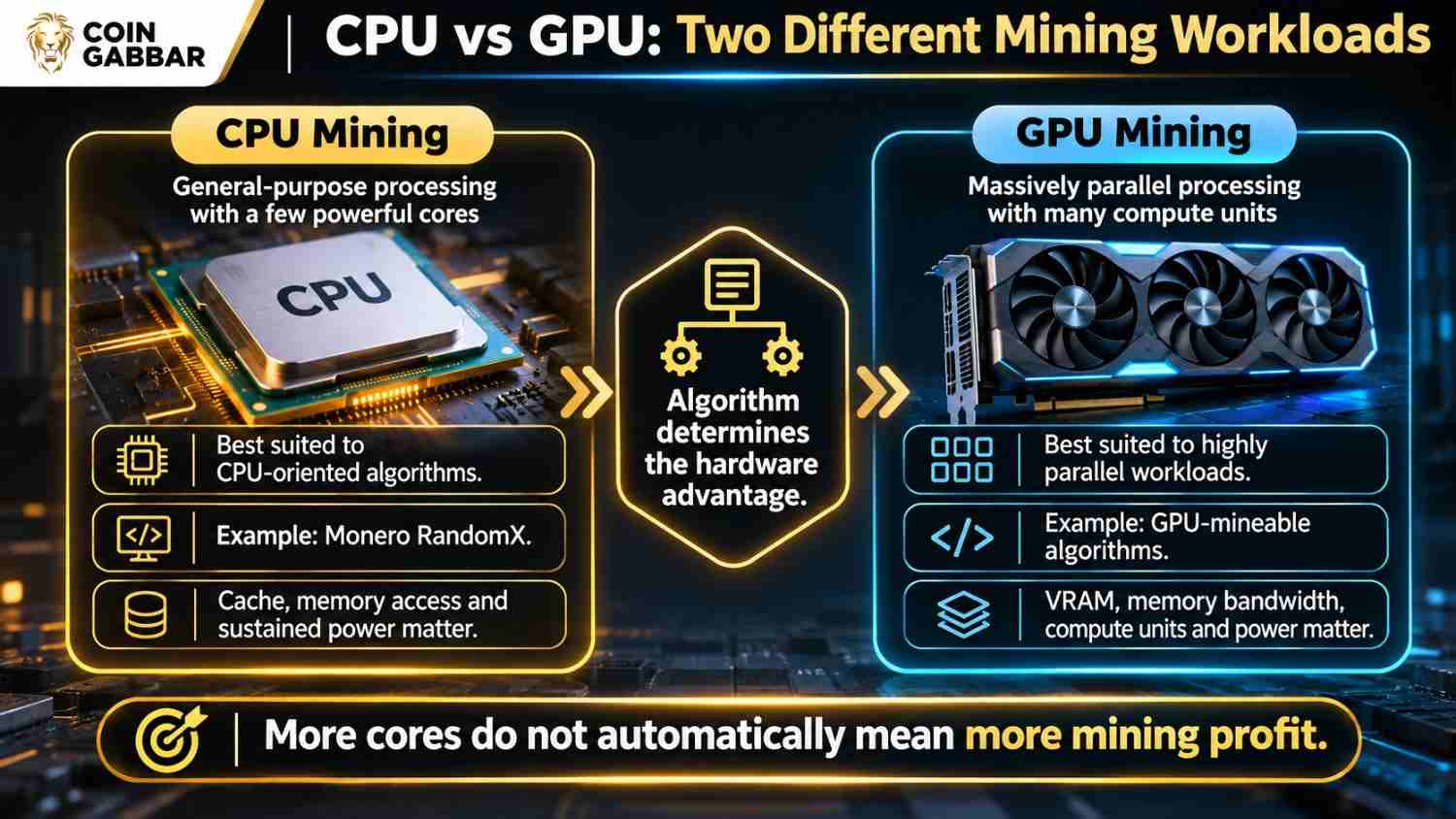
Match the part to the coin: a RandomX, Monero’s algorithm, and a GPU for memory-hard coins.
-
A GPU rig needs only a cheap two- to four-core CPU.
-
CPU mining hits an L3 cache limit before a core limit.
Bitcoin is the exception. ASICs, machines built for one algorithm, took over its mining, so PCs can’t compete.
Ethereum no longer allows GPU mining either, since it left proof of work in 2022.
Does a Processor or a Graphics Card Do the Mining Work?
It depends on the algorithm, the math puzzle a coin makes miners solve. RandomX suits processors. Memory-hard puzzles, used by coins such as Ravencoin and Ergo, suit graphics cards. Each project documents its own hardware needs, such as the Kaspa mining wiki.
A graphics card holds thousands of small cores that work in parallel. It also carries fast video memory (VRAM). Memory-hard puzzles lean on that memory speed.
So the first question isn’t which chip is fastest. It’s which coin you plan to mine.
Do CPU Cores and Threads Change Your Hash Rate?
Yes, but only up to a point. Each RandomX thread wants about 2 MB of L3 cache, the fast memory built into the chip.
Once threads use up that cache, extra ones fall back on slower RAM and the hash rate stalls. Hyper-threading (SMT) adds logical cores that share one core’s hardware, so it often adds little. The XMRig RandomX optimization guide covers cache tuning.
A chip with 16 MB of L3 cache supports about eight RandomX threads, so test up and down from there. GPU rigs differ because the CPU only feeds the cards.
Which CPU Gives the Most Monero Hashes per Watt?
TechRadar’s mining CPU guide lists five chips on RandomX. The Ryzen 9 9950X is fastest at 27.0 KH/s, where one KH/s is a thousand hashes per second.
Speed isn’t the whole story. The Ryzen 7 3700X reaches 10.1 KH/s at 65 W for about $130. That nearly matches the 9950X’s hashes per watt at under a quarter of the price.
The Core i9-13900K manages 108 hashes per watt. The old Xeon E5-2680v4 manages about 57, and its $25 price tag hides a 120 W draw.
The 9950X also needs an AM5 board and DDR5 memory, which stretches payback. Our page on Monero mining profitability shows how that plays out.
Which NVIDIA Card Suits Mining: Bus Width or Core Count?
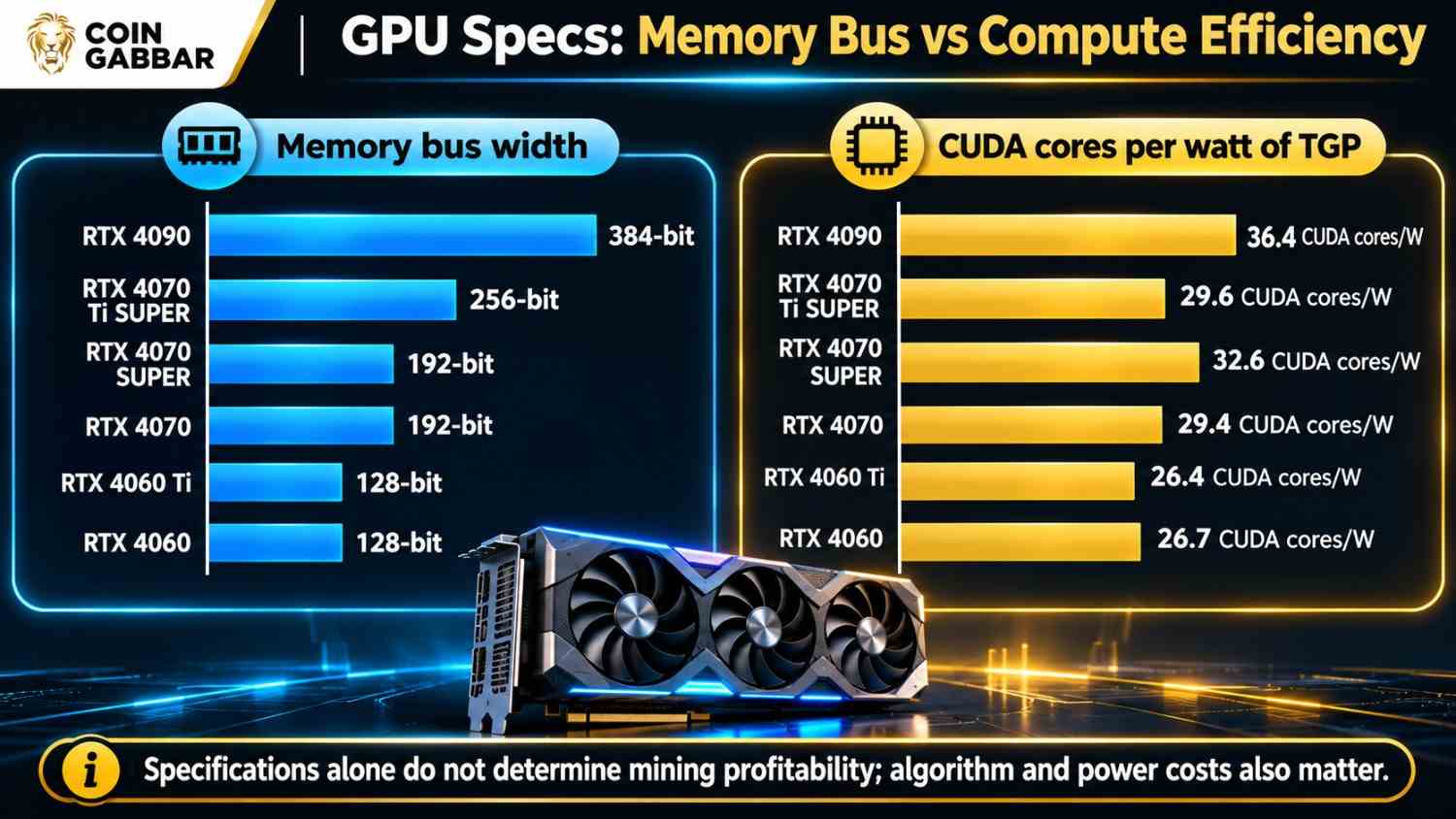
Three spec-sheet numbers matter: memory bus width, CUDA cores, and total graphics power (TGP). Ray tracing and tensor cores sit idle in classic mining, though newer coins such as Pearl use tensor cores.
Memory-hard coins reward a wide bus. The RTX 4090 has 384 bits, the RTX 4070 Ti SUPER has 256, and the RTX 4060 cards drop to 128 and struggle.
Core-heavy coins reward cores per watt. The RTX 4090 leads at 36.4 but draws 450 W, so it pays only where power is cheap. Our guide to mining Pearl with a GPU shows one full setup.
What Does a Low, Mid, or High Crypto Mining PC Build Cost?
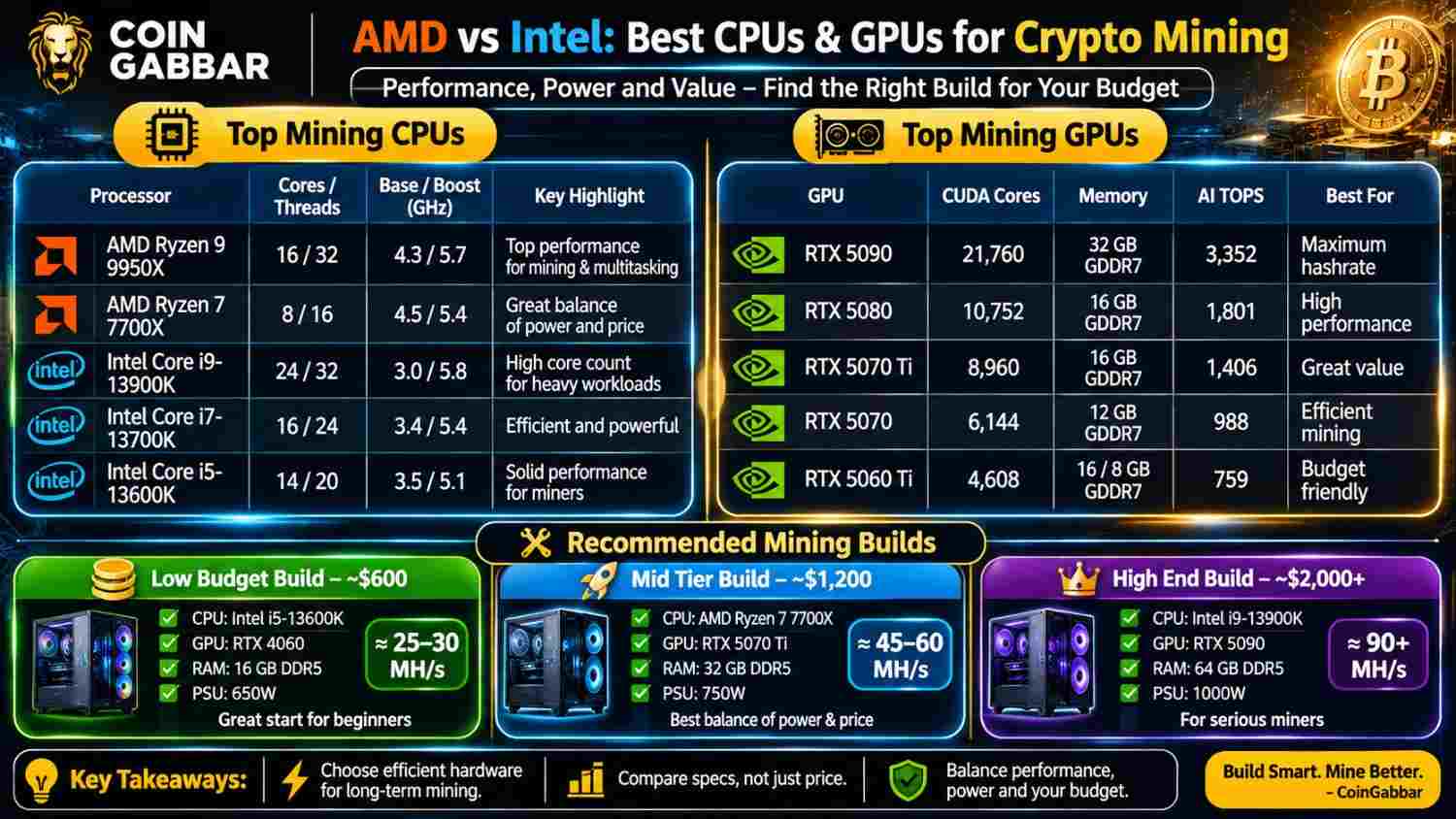
CoinGabbar estimates three complete builds in US dollars, using used graphics cards and range midpoints as of 17 November 2026.
The low tier pairs a used RTX 3060 Ti or RX 6600 XT with a Ryzen 5 5600G or Core i3-12100. The mid-tier uses an RTX 4070, RX 6800, or used RTX A4000 with a Core i5-12400. The high-tier pair is a used RTX 4090 or RTX A5000 with a Ryzen 9 7900.
The graphics card is the biggest line in every tier, from about 37 percent of the low build to 59 percent of the high one.
Every tier also needs a board with several PCIe slots, risers to space the cards, an open frame with 120 mm fans, and mining software such as XMRig or HiveOS.
Which Platform Fits Best: AMD, Intel, or a Mix?
An all-AMD rig pairs an APU, a chip with built-in Radeon graphics, with a Radeon card. The APU drives the display, so the discrete card keeps all its memory for mining.
Intel builds work the same way. A CPU without the F suffix, such as the Core i3-12100, has integrated graphics for the screen. The RTX A2000 draws at most 70 W from the slot.
A hybrid build pairs either brand with a GeForce card, which has the widest miner software support and strong resale value.
Can Electricity Costs Make or Break a Mining Rig?
For a crypto mining PC build, a common rule of thumb puts break-even near $0.10 per kWh, while the average home rate sits near $0.18. Your true line also depends on coin price, difficulty, and pool fees.
Monthly cost equals watts divided by 1,000, times 24 hours, times 30 days, times your rate. Wall draws of 145, 220, and 485 W are CoinGabbar estimates, not measurements.
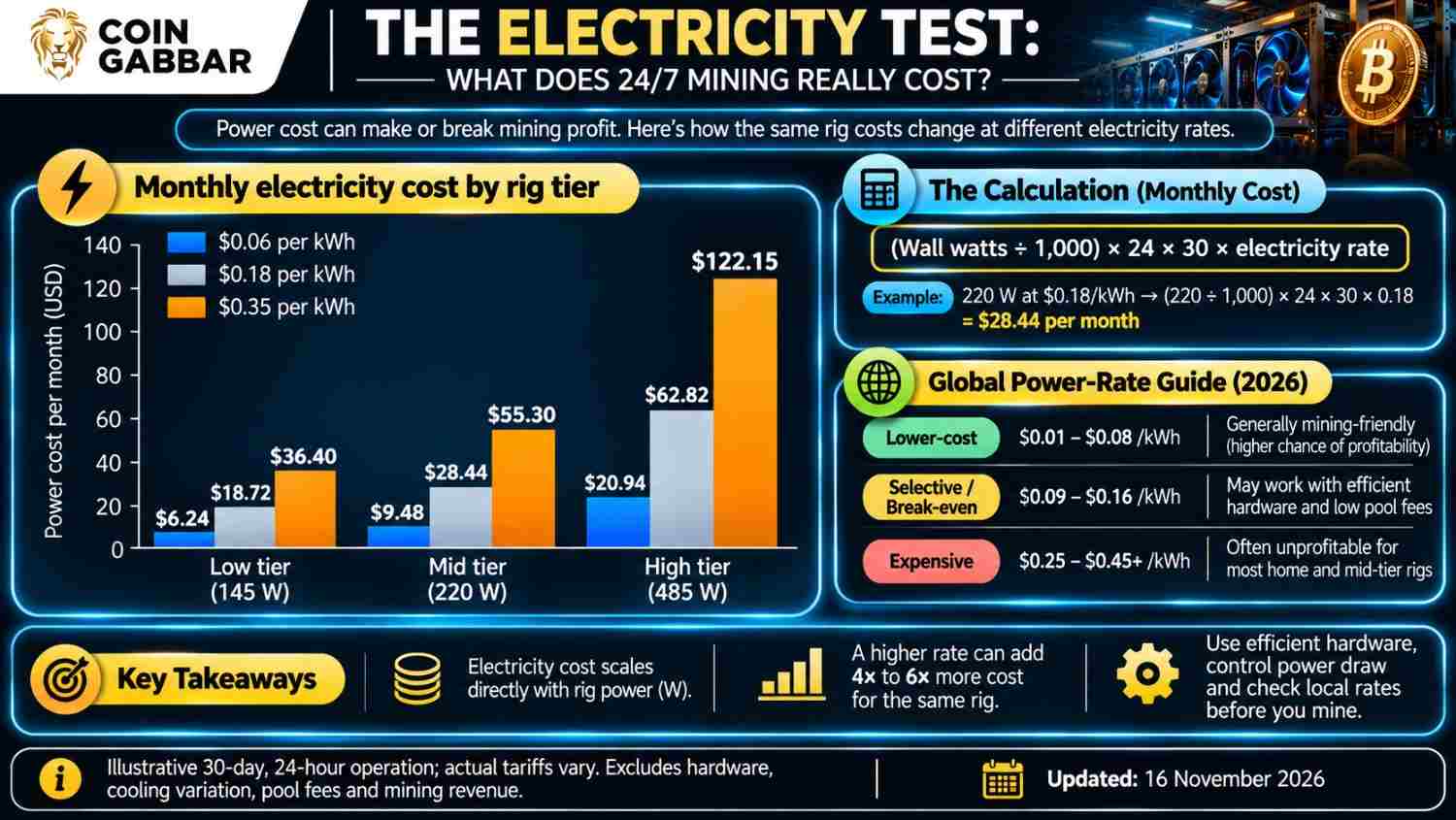
Here is a hypothetical. A low-tier rig earning $40 a month before power nets about $34 at $0.06 per kWh, but only about $3 at $0.35. Pool fees and downtime cut that further.
Location matters. Global Petrol Prices data lists Kazakhstan and Paraguay as cheap zones and Western Europe, Australia, and Japan as costly. See our crypto mining electricity costs guide.
What Risks Can a Crypto Mining PC Build Never Remove?
Hardware can’t remove price risk. A coin can fall faster than your costs.
Difficulty rises as more miners join, so the same rig earns less over time. Used cards can arrive worn, and rigs that run around the clock need power and cooling that make heat and noise.
Rules differ by country, and some places restrict or tax mining. Read our crypto mining tax rules guide and check local law before you buy.
What Do Key Mining Hardware Terms Mean for Buyers?
Hash rate: how many puzzle attempts a rig makes each second.
L3 cache: fast memory on the CPU that RandomX threads share.
TGP: total graphics power, the most watts a card draws at stock settings.
Bus width: how many bits a card’s memory moves at once.
What Should You Do Before Spending on a Mining Rig?
Pick the coin first, then the part.
Check your power rate against the cost chart, and recheck prices before you buy.
A crypto mining PC build should start with one card and a test run.
Expert Opinion: Is the CPU or the GPU the Smarter Spend?
CoinGabbar analysis suggests that in a crypto mining PC build, the graphics card sets the budget, and the power rate sets the profit. The basis is the cost split and the power chart above.
A modest CPU and an efficient card work best. This is not a forecast.
Disclaimer: This article is for information only and is not financial, legal, or tax advice. Returns are never promised or assured. Crypto assets are volatile, mining rules may change, and costs differ by country, so all the money put in can be lost. Readers should consult a qualified adviser before investing.
0
0


 Manage all your crypto, NFT and DeFi from one place
Securely connect the portfolio you’re using to start.


