
Dogecoin is 84 blocks short a day: why fewer DOGE arrive than planned

0
0

What is documented: in the 24 hours to October 28, 2026, 10:38 p.m. UTC, the Dogecoin network produced 1,356 blocks. The target is 1,440, that is one per minute. Our assessment follows further below: for the price this gap means little, but for your timing on transfers and for the money supply of Dogecoin it means more than most calculations online assume.
The figure does not come from an announcement but from the network data itself. Anyone setting the block height against the clock over longer stretches sees the same shortfall across seven days and across 30 days. So the network is not running slowly for one bad evening; it has been doing so for weeks. This article works out what follows from that, and where it affects you day to day.
Eighty-four blocks short in 24 hours
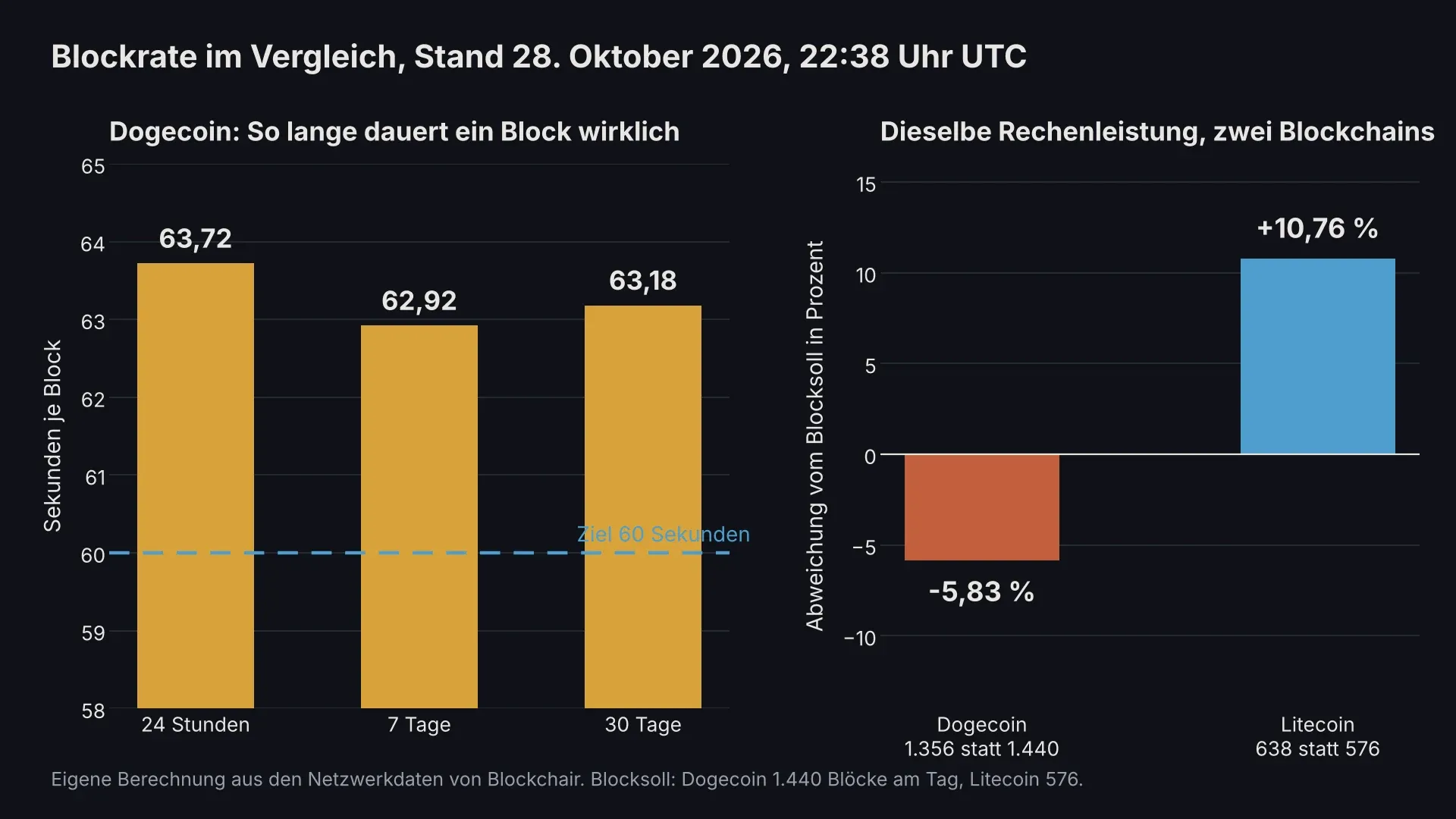
Dogecoin targets one block per minute. That works out to 1,440 blocks a day. The block height stood at 6,434,606 on October 28 at 10:38 p.m. UTC, and in the preceding 24 hours 1,356 new blocks had been added. That is 84 fewer than intended, a shortfall of 5.83 percent. Arithmetically a block therefore takes 63.72 seconds instead of 60.
A single day proves nothing on its own. Block production is a random process, and deviations of a few percent are part of normal operation on any proof-of-work blockchain. The figure only becomes interesting once it repeats over longer periods.
Over 30 days, 2,176 blocks are missing
That is exactly the case. Between September 28, 2026 at 10:43 p.m. UTC, when the block height stood at 6,393,588, and October 28 at 10:38 p.m., 41,018 blocks were created. Over that span of roughly 719.9 hours there should have been 43,194. That leaves 2,176 blocks or 5.04 percent missing, and the average block time comes to 63.18 seconds.
Over the shorter stretch of seven days the picture is similar: 9,606 blocks instead of the arithmetic 10,074, a shortfall of 4.64 percent at 62.92 seconds per block. Three periods, three times the same finding. The shortfall is not noise but the current state of the network.
Ten thousand Dogecoin per block: how the gap in the money supply arises
With Dogecoin a block is not only a unit of time but also the unit in which new money is created. Whoever finds a block receives 10,000 freshly created Dogecoin as a block reward, according to the project's Dogepedia, plus the fees of the transactions it contains. That reward has been fixed since 2015 and no longer falls, unlike Bitcoin, where it halves every four years.
From that follows a calculation anyone can check. At 1,440 blocks a day, 14.4 million new Dogecoin would be created, which extrapolates to 5.256 billion a year. That figure appears in almost every description of Dogecoin's monetary policy. In the past 24 hours, however, only 13.56 million Dogecoin were actually created, 840,000 fewer. Over 30 days that adds up to 410.18 million instead of 431.94 million, a difference of 21.76 million Dogecoin.
Annualised, the measured pace delivers around 4.95 billion new Dogecoin rather than the nominal 5.256 billion. Measured against the circulating supply of 172.23 billion Dogecoin, that is a dilution of 2.87 percent a year instead of 3.05 percent. The difference is small, but it runs in the same direction as the price: anyone holding for the long term is diluted slightly less than the standard calculation claims.
The same hash power, two blockchains: Litecoin is running above its target
Dogecoin has not been secured on its own since 2015. The Dogepedia describes the step: Litecoin founder Charlie Lee proposed in 2014 that Dogecoin recognise computational proofs produced for other Scrypt blockchains. The developers implemented this as Auxiliary Proof-of-Work, AuxPoW for short. Since then the same machine, with the same computational work, secures both networks and collects the reward in both.
AuxPoW means this: a Scrypt miner works on a Litecoin block that at the same time references a Dogecoin block. If the result meets Dogecoin's lower difficulty, a valid block has been found there too. The two blockchains keep separate ledgers and their own rules, but they share the market for hash power.
That is precisely why the comparison is instructive. Hash power averaged 3.11 petahashes per second for Dogecoin over the past 24 hours and 2.93 petahashes for Litecoin, practically the same value. Litecoin, however, produced 638 blocks in those 24 hours, although with a target time of 2.5 minutes only 576 are intended. That is 10.76 percent above target, at 135.42 seconds per block.
The same computational work, and one blockchain runs clearly above its pace while the other runs below it. The difference does not come down to the machines but to how the two networks set their difficulty.
DigiShield adjusts the difficulty at every block
Mining difficulty is the value that determines how hard a valid block is to find. If hash power on the network rises, it has to rise with it, otherwise blocks would arrive too fast. If hash power falls, it has to fall, otherwise blocks take too long.
According to the Dogepedia, Dogecoin handles this with the DigiShield algorithm and adjusts the difficulty at every single block. The procedure was introduced in 2014, after hash power had repeatedly flooded into the young network and been withdrawn again shortly afterwards. A network that only readjusts every few days is left with a far too high difficulty after such a withdrawal and fails to move blocks along for days.
The measured difficulty shows how mobile that is: on September 28 it stood at 48.9 million, on October 21 at 40.9 million and on October 28 at 45.6 million. Within a single month, then, a range of almost 20 percent. A procedure that readjusts at every block still does not hold the pace exactly, because it always reacts to what has just happened and never to what is coming. As long as hash power fluctuates, a shortfall remains on average.
In practical terms that means: the 60 seconds are a target and not a promise. Anyone counting on exactly one minute per confirmation for a transfer is counting too tightly. If you happen to be looking at which trading venues let you move Dogecoin into euros, the overview of the best crypto exchanges helps with the choice.
How to work out your deposit's waiting time yourself
An exchange only credits an incoming Dogecoin payment once a certain number of confirmations is in. Each confirmation is one more block. How many there are is set by each exchange itself and shown in the deposit screen or on the help page for the respective cryptocurrency. The calculation after that is simple: the number of confirmations required times 63.2 seconds instead of times 60.
At 20 confirmations that is 21.1 minutes instead of 20, at 60 confirmations 63.2 instead of 60 minutes. The difference does not sink a trade, but it is the reason a deposit regularly arrives slightly later than the rule of thumb promises. Added to that is the time until your transaction makes it into a block at all.
The surcharge becomes relevant wherever a deadline is running. Kraken is replacing 176 trading pairs as of November 6, and anyone wanting to move open orders or holdings beforehand has a window for it, which is set out in our article on the affected Kraken trading pairs. Anyone sending on the last day of such a deadline is better off calculating a generous buffer.
Fees and mempool: what a Dogecoin transfer costs today
The good news sits in the same data. Averaged over the past 24 hours, a Dogecoin transaction cost 0.358 Dogecoin in fees, the equivalent of 2.86 US cents. The median, meaning the typical case, came to 0.0707 Dogecoin or 0.57 US cents. The few expensive transactions pull the average up; most transfers cost well under a cent.
The mempool, the waiting room for transactions not yet confirmed, held 88 transactions at the time of measurement. Against 21,260 transactions in 24 hours that is a practically empty waiting room. So there is no fee competition: anyone leaving their wallet's default fee in place gets into the next block. The longer block time does not make a transfer more expensive, it only delays it marginally.
To put the network's size in context: at the time of measurement Dogecoin counted 8,498,097 addresses with a balance and 487 reachable nodes, Litecoin 832.
What is new since Wednesday's October review
On Wednesday afternoon we drew up the October review for Dogecoin, then with a view to the monthly performance and the question whether October really is the strong month for Dogecoin it is held to be. The price has barely moved since: $0.0799 on October 28 at 10:41 p.m. UTC, a gain of 1.67 percent within 24 hours. Over seven days there is a loss of 3.22 percent, over 30 days one of 14.62 percent. Market capitalisation stands at $12.5 billion.
What is new is the look beneath the price. The monthly review describes what the market did with Dogecoin. The block data describe what the network did in the same period, and that is a different story: hash power is not sufficient to hold the intended pace, and that for the third measurement period in a row.
Our assessment: the block rate is not a price argument
From the editorial point of view, nobody should derive a price claim from these figures, for one simple reason: the missing quantity is too small. Eight hundred and forty thousand Dogecoin a day correspond to around $67,000 at the current price. Against that stands a trading volume of several hundred million dollars a day. A supply that falls short by that amount shifts no price.
What speaks for that reading is the second figure in this article. Litecoin runs 10.76 percent above its block target with practically the same hash power, Dogecoin 5.83 percent below it. If the machines were the problem, both blockchains would have to deviate in the same direction. They do not. The deviation is therefore a result of the difficulty adjustment and not a signal about miners' interest in Dogecoin.
What speaks against it is that our measurement compares three reference dates and not a complete series. A single slow block on one of those dates shifts the result marginally. Across 41,018 blocks that barely counts, but it remains a sample and not a continuous record. Anyone wanting to recalculate the figures will find the block heights for the stated times in any Dogecoin block explorer.
What remains is one practical finding and one monetary one. The practical one: count on 63 seconds per confirmation, not 60. The monetary one: the often-quoted 5.256 billion new Dogecoin a year are an upper limit the network is not currently reaching.
Dogecoin block rate: 63 seconds per block shifts every deadline
Three steps for putting the finding to work in your portfolio:
- Plan a buffer on transfers. Look in your exchange's deposit screen to see how many confirmations are required for Dogecoin, and multiply the number by 63 seconds. If a deadline is running, do not send the Dogecoin on the last day. Which trading venues list Dogecoin against the euro and what they charge is in the overview of the best crypto exchanges.
- Review holdings you intend to move anyway. Anyone holding Dogecoin for the long term rather than trading does not need an exchange for it. Which devices are suitable for self-custody and what they cost is shown by the hardware wallet comparison.
- Document transfers. A transfer between your own addresses is not a sale for tax purposes, but it has to remain traceable so the tax office can assign acquisition dates. Tools that record this automatically are among the crypto tax tools.
(As of October 28, 2026. This article is not investment advice. Prices and fee structures change; check the terms with the provider before you buy.)
0
0

 Manage all your crypto, NFT and DeFi from one place
Securely connect the portfolio you’re using to start.


