
Bitcoin Price Prediction 2030: Targets From $500,000 to $2.4 Million Put to the Test

0
0

For the Bitcoin price prediction for 2030, four voices matter most: Standard Chartered names $500,000 for the end of 2030, ARK Invest $1.2 million in its base case and $2.4 million in its bull case. Jack Dorsey, co-founder of Twitter and head of Block, expects at least $1 million, and Bernstein around $300,000 at the cycle peak in 2029. On November 8, 2026, one bitcoin costs around $75,700 or €67,900, according to CoinGecko. Even the lowest target for 2030 therefore requires a gain of 58 percent a year for just over four years. In the last full cycle, from the 2021 peak to the 2025 peak, Bitcoin grew by 17 percent a year.
Our ongoing Bitcoin price prediction for the coming weeks and months has its own page. This article covers the years to 2030, with an outlook to 2040.
Key points at a glance
- Price targets for 2030: $500,000 (Standard Chartered, ARK bear case), $1 million (Jack Dorsey), $1.2 million (ARK base case), $2.4 million (ARK bull case).
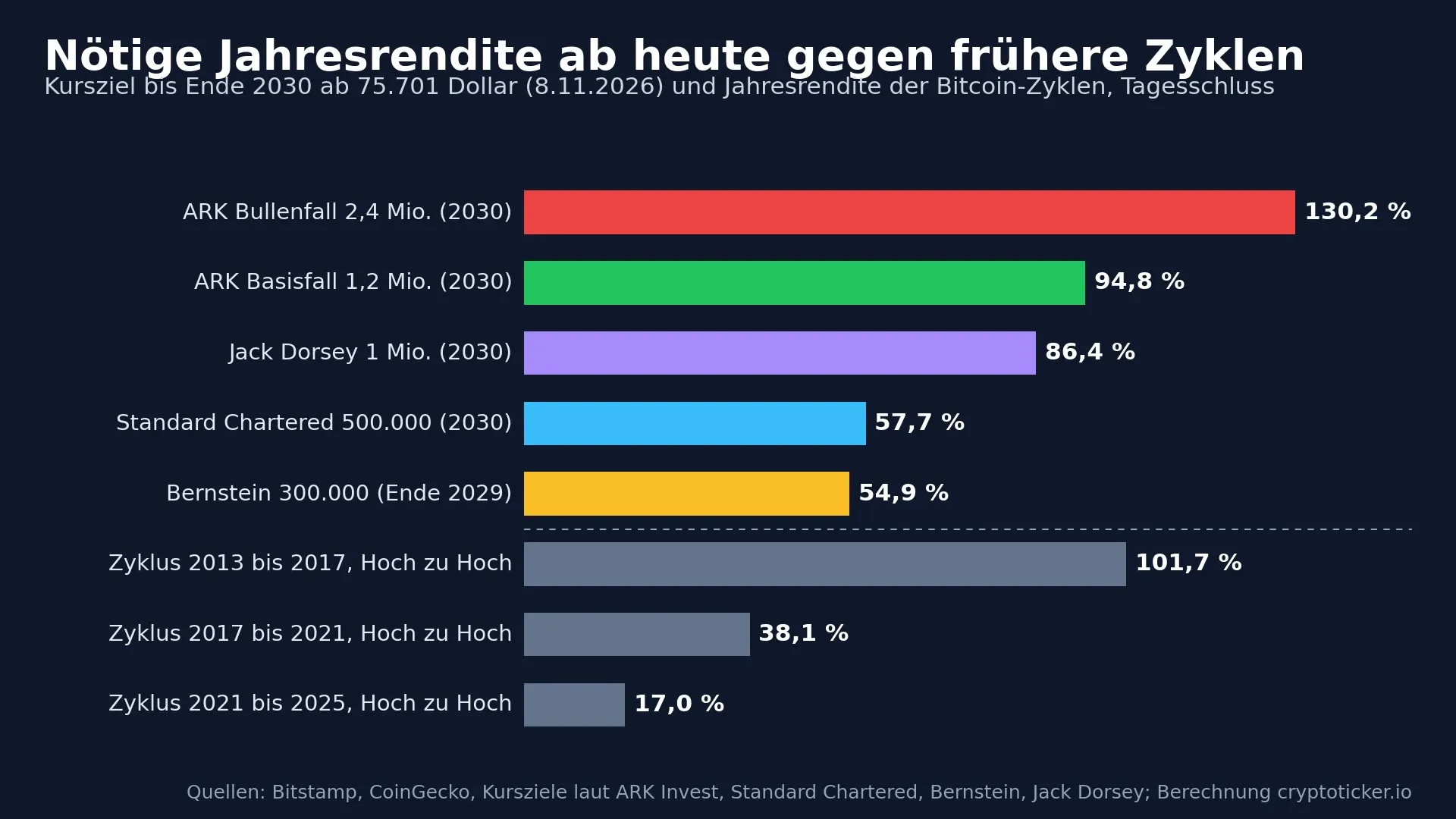
- Required return: from the price on November 8, 2026, these targets require between 58 and 130 percent a year to the end of 2030.
- The later, the steeper: when ARK published its $1.2 million base case on April 24, 2025, around 57 percent a year would have been enough. Today it is around 95 percent.
- Each cycle grows more slowly: from peak to peak, Bitcoin grew by around 102 percent a year from 2013 to 2017, 38 percent from 2017 to 2021 and 17 percent from 2021 to 2025 (Bitstamp daily closes).
- Extrapolation: if this decline continues, the next cycle peak around 2029 would be around $166,000.
- Worked example: at 17 percent a year, Bitcoin would stand at around $145,000 at the end of 2030; at 30 percent, at around $225,000.
Bitcoin price prediction 2030: analysts' price targets at a glance
Four firms and individuals have published a price target for Bitcoin around 2030. The range runs from $300,000 at the end of 2029 (Bernstein, base case) to $2.4 million at the end of 2030 (ARK Invest, bull case). The date of each statement matters for context: almost all targets were set when the price was higher than it is today.
| Who | Price target | By | Stated on | Bitcoin that day | Required per year from today |
|---|---|---|---|---|---|
| ARK Invest, bear case | $500,000 | end of 2030 | April 24, 2025 | $94,010 | 57.7% |
| ARK Invest, base case | $1.2 million | end of 2030 | April 24, 2025 | $94,010 | 94.8% |
| ARK Invest, bull case | $2.4 million | end of 2030 | April 24, 2025 | $94,010 | 130.2% |
| Cathie Wood (ARK), own figure of $1.5 million trimmed | around $1.2 million | end of 2030 | November 6, 2025 | $101,284 | 94.8% |
| Standard Chartered (Geoff Kendrick) | $500,000 | end of 2030 | December 9, 2025 | $92,695 | 57.7% |
| Jack Dorsey | at least $1 million | 2030 | May 9, 2024 | $63,075 | 86.4% |
| Bernstein, base case | around $300,000 | 2029 | August 26, 2026 | $79,023 | 54.9% |
| Bernstein, bull case | $500,000 | 2029 | August 26, 2026 | $79,023 | 82.2% |
How to read the table: "Bitcoin that day" is the daily close on the Bitstamp exchange in US dollars. "Required per year" is the steady annual return Bitcoin would need from the price on November 8, 2026 ($75,701) to the target date. For the end of 2030 that is 4.15 years; Bernstein's 2029 targets are calculated to the end of 2029, or 3.15 years. An earlier peak within 2029 would require correspondingly more. The chart below shows the price of 1 BTC since 2014 on a logarithmic scale and the paths to the targets.
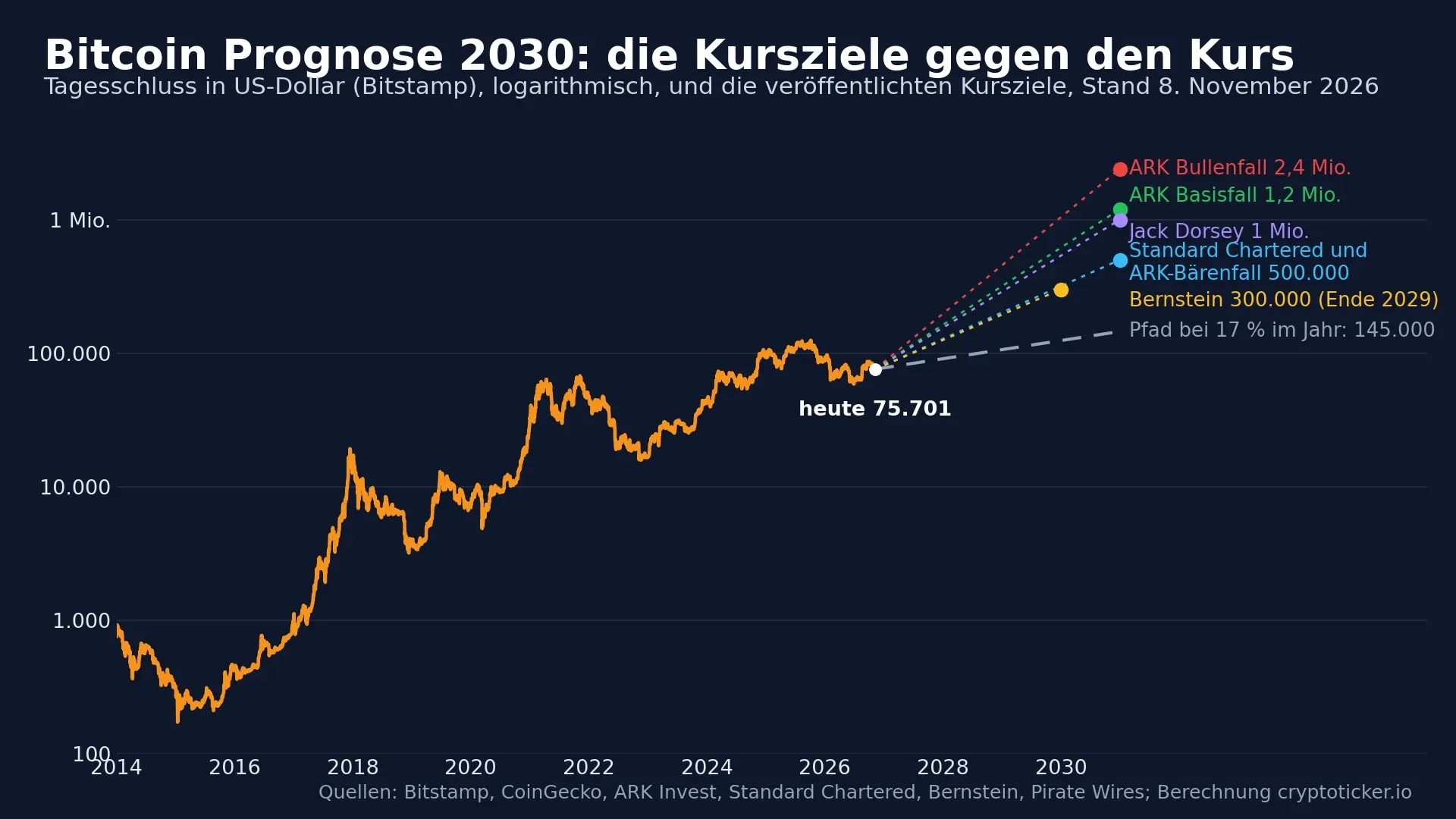
ARK Invest and Cathie Wood: $500,000 to $2.4 million
ARK Invest, Cathie Wood's fund manager, published three price targets for the end of 2030 on April 24, 2025: $500,000 in the bear case, $1.2 million in the base case and $2.4 million in the bull case. Calculated from the end of 2024, that corresponds to 32, 53 and 72 percent a year. ARK derives the targets from market shares: in the bear and base cases, the role as digital gold carries most of the weight; in the bull case, it is capital from institutional investors. Our formula also gives 53 percent for the base case from the daily close of December 31, 2024, so the calculation in the table is comparable with ARK's.
On November 6, 2025, Cathie Wood said on the US broadcaster CNBC that one could take "maybe $300,000" off the bull case. Stablecoins, she said, were taking over part of the role ARK had envisaged for Bitcoin, above all as a digital dollar in emerging markets. Wood was referring to her well-known figure of $1.5 million, which is why most reports list the trimmed bull case at around $1.2 million.
Standard Chartered: $500,000 only in 2030 instead of 2028
Geoff Kendrick, head of digital asset research at Standard Chartered, roughly halved and stretched his path on December 9, 2025: $100,000 at the end of 2025, $150,000 at the end of 2026, then $225,000, $300,000 and $400,000 in the years 2027 to 2029 and $500,000 at the end of 2030. Previously, Bitcoin was expected to reach $500,000 as early as 2028. Kendrick's reason was that purchases by the Bitcoin ETFs were the only remaining support; he no longer factors in buying by companies holding Bitcoin on their balance sheets.
For the end of 2026, the bank has since cut its target to $100,000 and reaffirmed that target at the end of September 2026, as we reported in our piece on the Standard Chartered forecast of $100,000. The bank named the $500,000 by 2030 again in June 2026.
Bernstein: $300,000 at the 2029 cycle peak
In their study from the end of August 2026, Bernstein's analysts led by Gautam Chhugani expect around $125,000 at the end of 2026 in their base case, $150,000 in mid-2027 and a cycle peak of around $300,000 in 2029. In the bull case, the figures are $200,000 in mid-2027 and $500,000 in 2029. The target of $1 million by the end of 2033 applies in both the base and bull cases; Bernstein first named that figure in mid-2024. That makes Bernstein the only firm in the table that explicitly expects a cycle peak in 2029 rather than a straight climb to 2030.
Jack Dorsey: at least $1 million
On May 9, 2024, in a conversation with journalist Mike Solana, Jack Dorsey said Bitcoin would cost "at least a million" dollars in 2030, and probably more. He did not present a model. His payments company Block puts 10 percent of gross profit from Bitcoin products into new bitcoin every month. At the time, Bitcoin stood at $63,075; the required return was 51.6 percent a year, and today it is 86.4 percent.
What annual return the Bitcoin 2030 prediction requires
Depending on the target, Bitcoin needs a return of between 54.9 percent (Bernstein to 2029) and 130.2 percent (ARK, bull case) a year from today. Standard Chartered's $500,000 requires 57.7 percent a year to the end of 2030, or 6.6 times today's price in 4.15 years. ARK's base case requires 94.8 percent a year; the price would have to rise almost sixteenfold.
A price target with a fixed date becomes more demanding with every weak month. When Standard Chartered pushed its $500,000 back to 2030 on December 9, 2025, Bitcoin stood at $92,695, and 39.5 percent a year would have been enough. Since then the price has fallen, time has grown shorter, and the required return has risen to 57.7 percent. For Jack Dorsey it rose from 51.6 to 86.4 percent, and for ARK's base case from 56.5 to 94.8 percent.
The following table works the other way round: where would Bitcoin stand at the end of 2030 if the price rose steadily by a fixed rate every year from November 8, 2026?
| Return per year | Bitcoin price at end of 2030 | Multiple of today |
|---|---|---|
| 10% | around $112,000 | 1.5 |
| 17% (2021 to 2025 cycle) | around $145,000 | 1.9 |
| 20% | around $161,000 | 2.1 |
| 30% | around $225,000 | 3.0 |
| 40% | around $305,000 | 4.0 |
| 57.7% (Standard Chartered) | $500,000 | 6.6 |
| 94.8% (ARK, base case) | $1.2 million | 15.9 |
How often has Bitcoin delivered such returns? We checked every period of exactly 1,514 days, as long as the stretch from today to New Year's Eve 2030. Of 2,815 such periods starting from 2015, the median annual return was 55.5 percent; that sounds like a tailwind for the targets. However, this figure comes mainly from the early years. For the 623 periods starting from 2021, the median was 19.0 percent a year and the best result 41.7 percent. None of these more recent periods came close to the 57.7 percent Standard Chartered needs.
Bitcoin price 2030 from the cycle perspective: the counter-calculation
Since 2013, Bitcoin has moved in cycles of around four years, and each new peak brings a smaller multiple of the previous one. Extend this decline and the next peak around 2029 would come in at around $166,000. By this pattern, 2030 would be the year after the peak, a year in which Bitcoin has so far always fallen sharply.
| Cycle | Peak (daily close) | Multiple of previous peak | Return per year, peak to peak | Low afterwards | Decline to the low |
|---|---|---|---|---|---|
| 2013 | $1,132 on December 4, 2013 | $171 on January 14, 2015 | 84.9% | ||
| 2017 | $19,188 on December 16, 2017 | 16.95 | 101.7% | $3,180 on December 15, 2018 | 83.4% |
| 2021 | $67,559 on November 8, 2021 | 3.52 | 38.1% | $15,766 on November 21, 2022 | 76.7% |
| 2025 | $124,728 on October 6, 2025 | 1.85 | 17.0% | so far $58,526 on June 30, 2026 | 53.1% |
The figures come from daily closing prices on the Bitstamp exchange. Measured logarithmically, the gain from peak to peak has slightly more than halved with each cycle: the factor was 0.445 and 0.487. Extending this with the average of 0.466 gives 1.33 times $124,728 for the next peak, or around $166,000. So far, the halving has set the rhythm: the peaks came 12 to 18 months after the halvings of November 28, 2012, July 9, 2016, May 11, 2020 and April 20, 2024. If the next halving falls in April 2028 as calculated, the next peak would by this pattern come between spring and autumn 2029. Our piece on the Bitcoin cycle explains the four phases of a cycle in more detail.
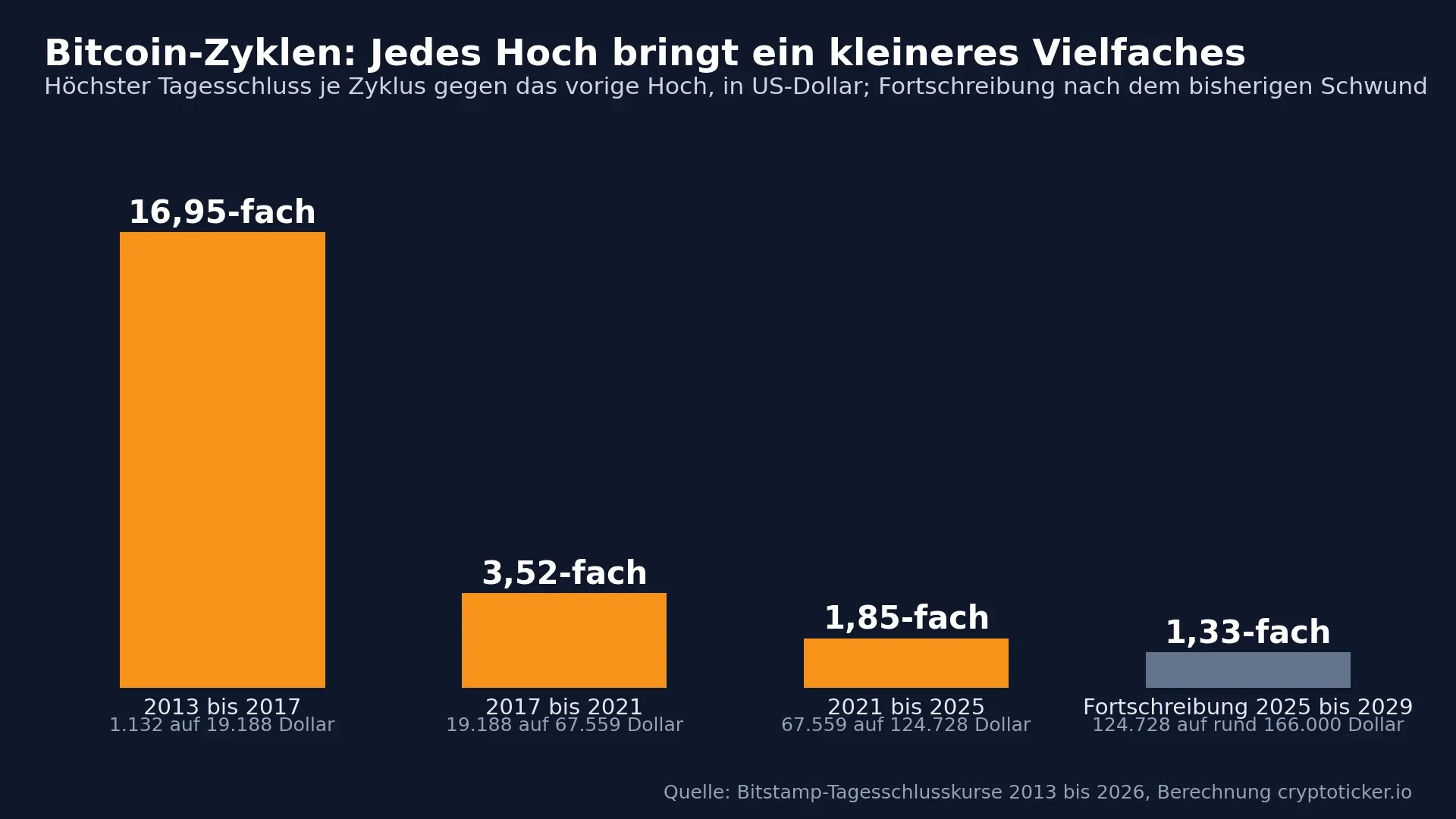
After the peaks of 2013, 2017 and 2021, Bitcoin closed the following year 71.6, 80.8 and 75.5 percent below the peak. The decline after the 2025 peak has so far been much milder: at most 53.1 percent to the low on June 30, 2026, and 39.3 percent today. If 2030 again fell in the year after a cycle peak, a decline like the one to the 2026 low would give a Bitcoin price of around $78,000 at the end of 2030, and a decline like 2022 around $41,000.
This counter-calculation is not a forecast; it simply extends the pattern of the past. Its value lies elsewhere: it shows what has to change for the big targets to be reached by the deadline. Either the four-year rhythm breaks, for example because Bitcoin ETFs and large investors buy more steadily than retail investors used to. Or the gain per cycle stops shrinking. Supporters of high targets see such a turning point in demand from the funds. How a downturn ends and what signals a new upswing is described in our guide to the bear market.
Bitcoin supply and demand: the case for a higher Bitcoin value
Supporters of high targets rely on three arguments: a fixed supply, new groups of buyers through Bitcoin ETFs, and states that hold Bitcoin. All three can be documented; what is open is how quickly they take effect in the Bitcoin market.
Supply is limited. Satoshi Nakamoto fixed the total supply in the protocol at 21 million bitcoin. This cap distinguishes Bitcoin from any state currency, whose supply is controlled by a central bank. On November 8, 2026, according to Blockchain.com, 20,109,371 bitcoin are in circulation, or 95.8 percent. New coins are now created at only 3.125 bitcoin per block. At the next Bitcoin halving at block 1,050,000, this reward halves to 1.5625 bitcoin; at 144 blocks a day, that point arrives around April 12, 2028 on paper. So far, the halving has always fallen in the year before a cycle peak.
New demand through Bitcoin ETFs. Since January 2024, investors in the US have been able to buy spot Bitcoin ETFs through an ordinary brokerage account. Spot ETFs have since channelled capital from investors who would never open an account at a crypto exchange. For Standard Chartered, buying by these funds is the most important driver to 2030. Which funds exist in Europe and how they work is covered in our overview of the Bitcoin ETF.
States as holders. In March 2025, the US set up a Strategic Bitcoin Reserve. It is funded by seized bitcoin, and the government does not sell bitcoin from this reserve. According to the White House, earlier sales of seized bitcoin have already cost taxpayers more than $17 billion in lost value.
What the targets mean in market value: at $75,701, all bitcoin together are worth around $1.52 trillion. At $500,000 it would be around $10 trillion, at $1.2 million around $24 trillion, calculated with today's supply. ARK derives its targets in a similar way through market shares: in the bear and base cases, most of the weight comes from the share Bitcoin takes from gold as a store of value. Since April 2025, ARK has calculated with the actively used supply, excluding lost and long-dormant coins.
Risks to the Bitcoin price prediction 2030
The biggest risks to high price targets by 2030 are another downturn following the cycle pattern, weaker inflows into the Bitcoin ETFs and new competition for the role of digital money. There are also technical and political questions that cannot be ruled out over four years.
- Cycle: if the four-year rhythm holds, the end of 2030 falls in a year after a peak. In all three previous cases, Bitcoin ended such a year more than 70 percent below the peak.
- Fund demand: Standard Chartered bases its path to $500,000 mainly on purchases by the Bitcoin ETFs. If investors withdraw money there, the most important driver disappears.
- Stablecoins: Cathie Wood trimmed her bull case because digital dollars in emerging markets are taking over part of the payments role ARK had assigned to Bitcoin.
- Quantum computers: Bitcoin's blockchain technology is considered secure today. Developers are, however, discussing how old addresses can be protected against future quantum computers. Our piece on the BIP 361 proposal and Satoshi's coins summarises the state of the debate.
- Market psychology: every previous cycle peak formed in a phase of great euphoria in the crypto market, and the crash afterwards in a phase of fear. Round price targets such as one million dollars can amplify such excesses.
- Interest rates and regulation: higher interest rates make assets without regular income less attractive. New rules for exchanges and custodians can make access easier or harder.
None of these risks makes a price target impossible. But they show why the range of serious Bitcoin price predictions for 2030 is so wide: between the cycle counter-calculation for the end of 2030 (around $78,000) and ARK's bull case ($2.4 million) lies a factor of around 31.
Outlook: Bitcoin after 2030 and to 2040
For the period after 2030, the targets grow even larger, but the required annual return shrinks because the time span is longer. Bernstein names $1 million by the end of 2033, Bitwise $1.6 million for 2036 in its base case, and Michael Saylor $13 million for 2045.
| Who | Price target | By | Stated on | Required per year from today |
|---|---|---|---|---|
| Bernstein | $1 million | end of 2033 | since mid-2024, most recently August 26, 2026 | 43.5% |
| Bitwise, base case | $1.6 million | 2036 | October 28, 2026 | 36.1% |
| Michael Saylor, base case | $13 million | 2045 | July 26, 2024 | 30.8% |
The Bitwise study of October 28, 2026 gives a range for 2036 from $130,686 in the bear case to $3,667,911 in the bull case; the base case of $1,599,766 corresponds to a gain of 34.3 percent a year from the price on September 30, 2026. Michael Saylor, co-founder and executive chairman of Strategy (formerly MicroStrategy), presented three cases for 2045 at the Bitcoin 2024 conference: $3 million, $13 million and $49 million.
For comparison, our extrapolation to the end of 2040: at 10 percent a year, Bitcoin would then stand at around $292,000, at 17 percent at around $698,000, at 20 percent at just under $1 million and at 30 percent at around $3.1 million. The older debate about one million dollars in 20 years is covered in our Bitcoin price prediction for 2040.
What the Bitcoin price prediction 2030 means for investors
Bitcoin is the largest cryptocurrency and, for many investors, their first investment in this market. For investors, which price target turns out right matters less than the assumption behind it. Anyone reading the big numbers should translate them into an annual return and compare that with what Bitcoin has managed recently. Three points help with the assessment.
Spread your timing. Because nobody knows whether 2030 will be a year after the peak or whether the rhythm breaks, a savings plan spreads your entry across many dates. Crypto exchanges and multi-asset brokers offer such savings plans, but costs differ markedly, as our comparison of crypto brokers shows. If you want to trade yourself, you will find fees and regulation in our comparison of crypto exchanges.
Plan for declines. In every previous cycle, Bitcoin fell by more than half after the peak, most recently by 53.1 percent to June 30, 2026, and before that by 76.7 to 84.9 percent. A position that cannot withstand such a decline is too large.
Factor in taxes. In Germany, gains on bitcoin held as private assets have so far been tax-free after a holding period of more than one year. Whether that will remain so is politically open; our overview of the crypto holding period tracks the current state. This section does not replace tax advice.
How things could develop in the short term is shown in our piece Will Bitcoin go back up? Three scenarios to year-end. Bitcoin remains a highly volatile asset. This article is not investment advice; the price targets show what analysts assume, not where the price will stand in 2030.
0
0

 Manage all your crypto, NFT and DeFi from one place
Securely connect the portfolio you’re using to start.
 Where will Bitcoin trade next?
Live Polymarket and Kalshi odds on Bitcoin price targets, compared side by side.
See Bitcoin price odds


