
Zcash Drops Below $1,000 for First Time Since September

0
0
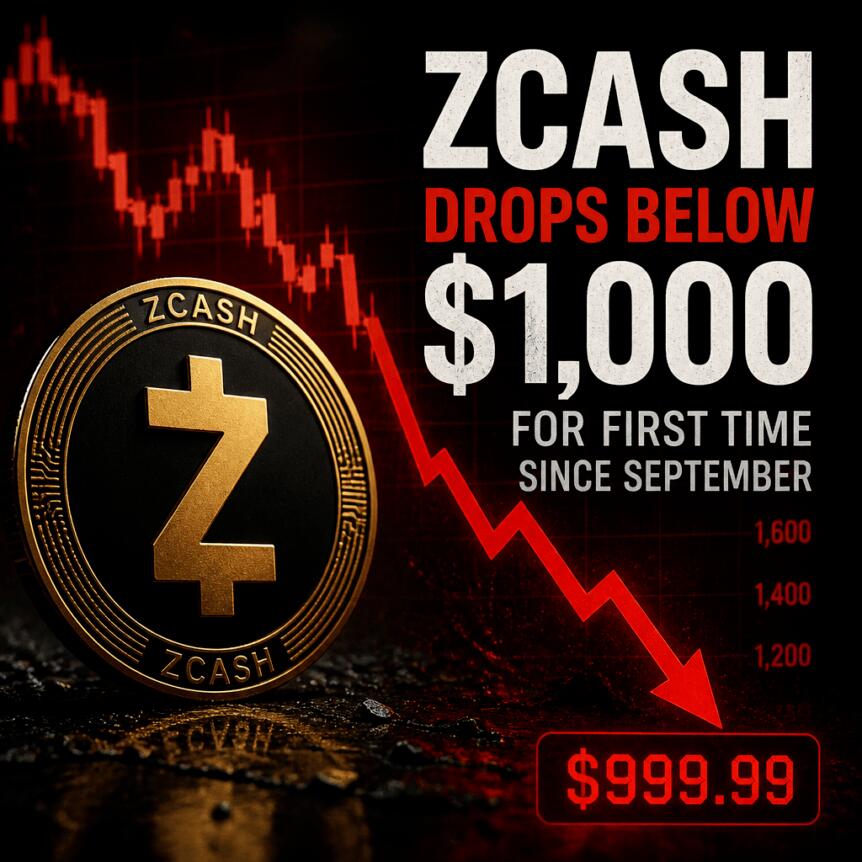
Zcash (ZEC) slid to a two-month low of $962.85 on Wednesday, dropping further despite the recent activation of the NU7 upgrade and new institutional activity tied to the network. The selloff pushed ZEC to one of the weakest performers among major crypto assets, reflecting a broader risk-off move across digital markets.
By 12:20 pm UTC, ZEC was down 13.5% on the day and down 24.5% over the prior seven days. Over the same stretch, CoinGecko data showed Bitcoin (BTC) down 5.8% and Ether (ETH) down 11.6%, as markets continued to react to fresh macro pressure and weakening sentiment.
Key takeaways
- Zcash fell to $962.85, a two-month low, with a sharper daily decline than many large-cap peers.
- ZEC’s selloff coincided with a broader market downturn, where BTC and ETH also posted meaningful weekly losses.
- Prices weakened after US October consumer inflation printed higher than economists expected.
- NU7 was activated recently to shorten block targets and improve confirmation speed, but that catalyst has not prevented a price pullback.
- Grayscale’s Zcash ETF complex saw net outflows in recent months, according to SoSoValue.
Macro pressure and a synchronized market selloff
Wednesday’s move for ZEC followed a broader pullback that began in earnest after US data. Crypto prices fell further on Tuesday after US consumer prices rose 0.4% in October compared with the prior month—above the 0.3% forecast cited in coverage of the release from earlier this week. Higher-than-expected inflation tends to raise expectations for tighter financial conditions, which can weigh on speculative assets like cryptocurrencies.
The correlation is evident in the numbers: alongside Zcash’s steep drop, CoinGecko reported BTC down 5.8% and ETH down 11.6% over the same period. When large benchmarks and major altcoins decline together, it often points to liquidity and risk appetite being the dominant drivers rather than coin-specific news.
NU7 upgrade in focus, but the market response remains muted
Zcash’s recent technical roadmap has not insulated it from the current drawdown. The network activated its NU7 upgrade on Friday. The change reduced the target time between blocks from 75 seconds to 25 seconds in an effort to speed up transaction confirmations, and it also made roughly 12,224 ZEC held in the network’s original privacy pool unspendable.
For Zcash users, faster confirmations can improve the day-to-day usability of shielded payments—transactions where sender and recipient addresses and transaction amounts are kept out of public view. However, short-term price action is not always aligned with protocol-level improvements, particularly when broader markets are turning down.
Still, traders and builders watching NU7 should note that the upgrade can matter beyond immediate price moves: faster settlement can influence how quickly shielded transactions propagate through exchanges, wallets, and payment flows. Whether that translates into improved adoption or demand for ZEC over time remains an open question while the market is in a risk-off phase.
Privacy-coin rally fades as category value contracts
Zcash has previously benefited from strong momentum in privacy-focused tokens. Earlier this year it helped drive a rally in the sector, gaining 138% over the 30 days to Sept. 7, according to reported figures. At the same time, it remains the largest privacy coin by market value, representing about 60% of the $28 billion category tracked by CoinGecko for privacy coins.
But the category is not immune to the current downturn. CoinGecko data in the coverage indicated that the privacy-coin group’s combined market capitalization fell about 7% over 24 hours. That context helps explain why even a dominant asset like ZEC can lose ground quickly: when investors rotate away from risk assets, liquidity can drain across the entire segment.
Grayscale’s Zcash commitments vs. ETF outflows
Wednesday’s decline also followed a notable institutional headline. Grayscale announced it would commit $1 million to nonprofits and projects supporting the Zcash network. The announcement came a day before ZEC hit its two-month low.
At the same time, flows into the regulated product structure have shown pressure. Grayscale converted its Zcash Trust into a US spot exchange-traded fund (ETF) that began trading on NYSE Arca on Aug. 25, according to the ETF launch coverage. Even with that expansion of investor access, SoSoValue data cited in the reporting showed the fund recorded about $15 million in net outflows in November through Monday, after roughly $46 million in October.
This combination—public-facing commitments to the ecosystem alongside observed ETF outflows—highlights an important tension. Ecosystem support announcements may signal long-term alignment, but they do not necessarily translate into immediate net inflows from ETF investors. For market participants, the near-term direction of ETF flows can be a useful real-time proxy for how quickly institutional demand is reasserting itself after periods of selling.
Earlier coverage also underscored that the sector’s technical iterations are still evolving. A related report noted that Zcash developers proposed another cut to block timing after NU7’s activation. That kind of follow-on tuning suggests development momentum, but investors will likely continue to weigh tangible demand signals—such as sustained ETF inflows, expanding usage of shielded transactions, and broader risk sentiment—more heavily during volatile macro periods.
Going forward, readers should watch whether ZEC’s renewed weakness is purely a continuation of the market-wide drawdown or whether it persists despite NU7-related improvements and ecosystem support headlines. The next signals to track are ETF flow direction from SoSoValue and whether macro data keeps pushing traders toward the same risk-off positioning seen this week.
This article was originally published as Zcash Drops Below $1,000 for First Time Since September on Crypto Breaking News – your trusted source for crypto news, Bitcoin news, and blockchain updates.
0
0

 Manage all your crypto, NFT and DeFi from one place
Securely connect the portfolio you’re using to start.


