
Bitcoin Falls Under $70K as Liquidity Dries Up and ETFs Exit

0
0
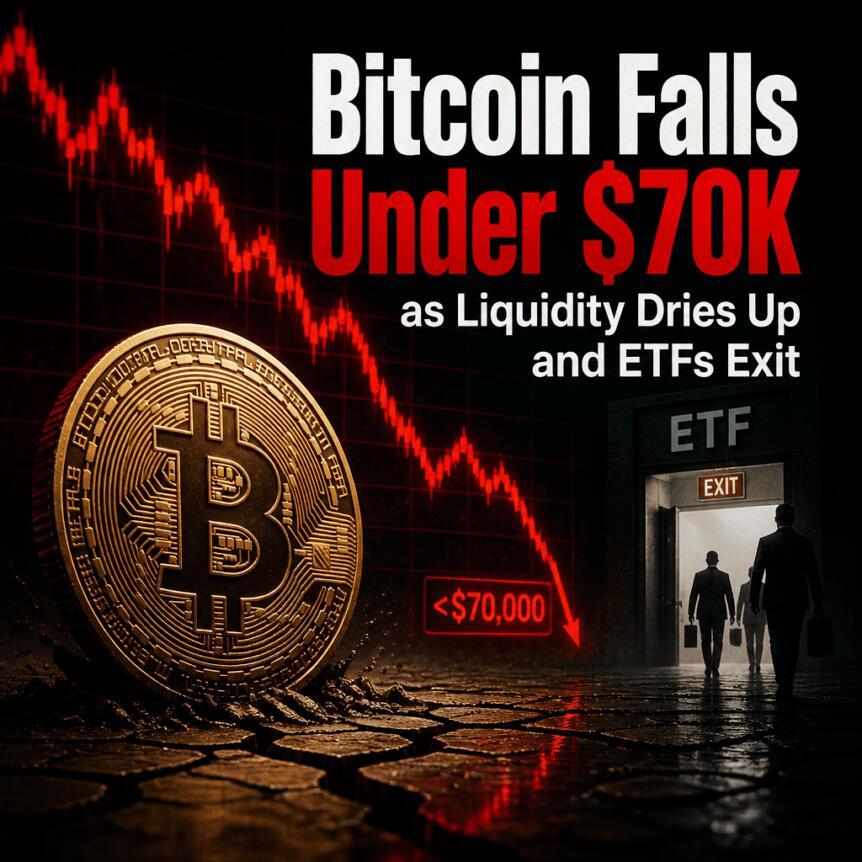
Bitcoin slipped below $70,000 on Friday, extending a broader pullback as risk appetite weakened and investors continued to reduce exposure to crypto—tightening liquidity at a time when US macro pressures are also weighing on sentiment.
At the time of writing, Bitcoin was trading around $68,607, down 9.2% over the past week, according to CoinGecko. The move comes as the Crypto Fear & Greed Index fell to 20 on Friday, its lowest level in more than four months and a reading described as “extreme fear,” a level last seen on July 8.
Key takeaways
- Bitcoin’s drop below $70,000 aligns with a deterioration in risk sentiment, with the Fear & Greed Index hitting “extreme fear.”
- 10x Research points to a growing link between Bitcoin and US yields/dollar strength, rather than equity market performance.
- Talos warns that thin order-book liquidity and elevated leverage could magnify swings in either direction.
- Spot Bitcoin ETF flows remain pressured, with BlackRock’s IBIT showing large multi-session outflows and additional net outflows reported into Thursday.
Fear deepens as liquidity tightens
The selloff is taking place against an increasingly cautious backdrop. The Fear & Greed Index dropping to 20 suggests investors are not only moving to the sidelines, but doing so at a time when market positioning can become fragile.
Vikram Subburaj, CEO of crypto exchange Giottus, tied Bitcoin’s weakness to institutional outflows that reduce available liquidity in crypto markets, while also linking the move to expectations of a December Federal Reserve interest rate hike. He cautioned investors against chasing short-term dips and against using excessive leverage in a market where liquidity conditions can change quickly.
Bitcoin’s changing correlations: equities vs. yields and the dollar
In a Friday note, 10x Research highlighted a divergence between Bitcoin and US stocks. From Nov. 5 to Nov. 12, Bitcoin fell 5.9% while the Nasdaq 100 rose 6.4%, indicating the cryptocurrency’s direction was not tracking technology equities during that window.
Instead, 10x Research argued that Bitcoin appeared to respond more to rising Treasury yields and a stronger US dollar. The firm added that Bitcoin was trading increasingly alongside gold over the same period—gold fell 5.5% while the US 10-year Treasury yield moved above 5%—reinforcing the idea that rate sensitivity is becoming a larger driver than equity sentiment.
Order-book depth shrinks; leverage risk rises
Beyond broad sentiment and macro factors, market microstructure has also come under pressure. Talos, an institutional trading platform, warned that low liquidity combined with elevated leverage can increase volatility and create sharper market moves.
Talos’ weekly report showed that order-book depth across major exchanges fell to about $72 million on Nov. 9, approximately 33% below normal levels. In a market with thinner books, bids and offers can be consumed faster, making price gaps more likely during bursts of selling or aggressive hedging.
Tanay Ved, a senior research associate at Talos, said liquidity remains thin while leverage stays elevated, leaving the market vulnerable to sharp moves. He added that a rebuild in order-book depth—paired with a turn in capital flows—would provide a more stable foundation for recovery.
Spot Bitcoin ETF outflows remain a central pressure point
Institutional positioning is also reflected in spot Bitcoin ETF flows. The selloff follows sustained withdrawals from US spot Bitcoin ETFs, with BlackRock’s iShares Bitcoin Trust (IBIT) reporting more than $2 billion in net outflows across nine consecutive trading sessions through Wednesday, according to earlier coverage. Broader funds reportedly shed nearly $1.44 billion over five sessions.
Preliminary data from Farside Investors indicated another $47.7 million in net outflows on Thursday, though figures for BlackRock and Fidelity were still pending at the time of that update.
Taken together, the ETF flow picture helps explain why liquidity conditions can deteriorate quickly: when large allocators reduce exposure via ETFs, fewer marginal buyers may be present—especially if broader risk sentiment is also weakening.
What to watch next
Investors will likely focus on whether ETF outflows continue or start to stabilize, and whether order-book depth begins to rebuild from current thin levels. With correlations shifting toward yields and the dollar, traders should also monitor Treasury yield momentum and any changes in expectations for US monetary policy as the next catalysts for Bitcoin’s direction.
This article was originally published as Bitcoin Falls Under $70K as Liquidity Dries Up and ETFs Exit on Crypto Breaking News – your trusted source for crypto news, Bitcoin news, and blockchain updates.
0
0

 Manage all your crypto, NFT and DeFi from one place
Securely connect the portfolio you’re using to start.
 Where will Bitcoin trade next?
Live Polymarket and Kalshi odds on Bitcoin price targets, compared side by side.
See Bitcoin price odds


