
Aave Markets Unfrozen: V3 and V4 Reopen After Binance Hack

0
0
Aave Markets Unfrozen: What Changes for V3, V4 and DeFi Users?
A major decentralized lending platform has reopened for business. All Aave markets unfrozen across V3 and V4 on 30 October 2026, roughly 16 hours after the DAO paused them as a precaution during the Binance security incident.
The protocol says its contracts were never affected and that every position stayed fully backed.
Still, a short list of assets remains restricted. Here is a clear, plain-language guide to what happened, how the unfreeze works, and what to watch next.
What Was Announced
In its official update on X, published at around 13:57 UTC on 30 October, the DAO confirmed that every market it operates on V3 and V4 is open again.
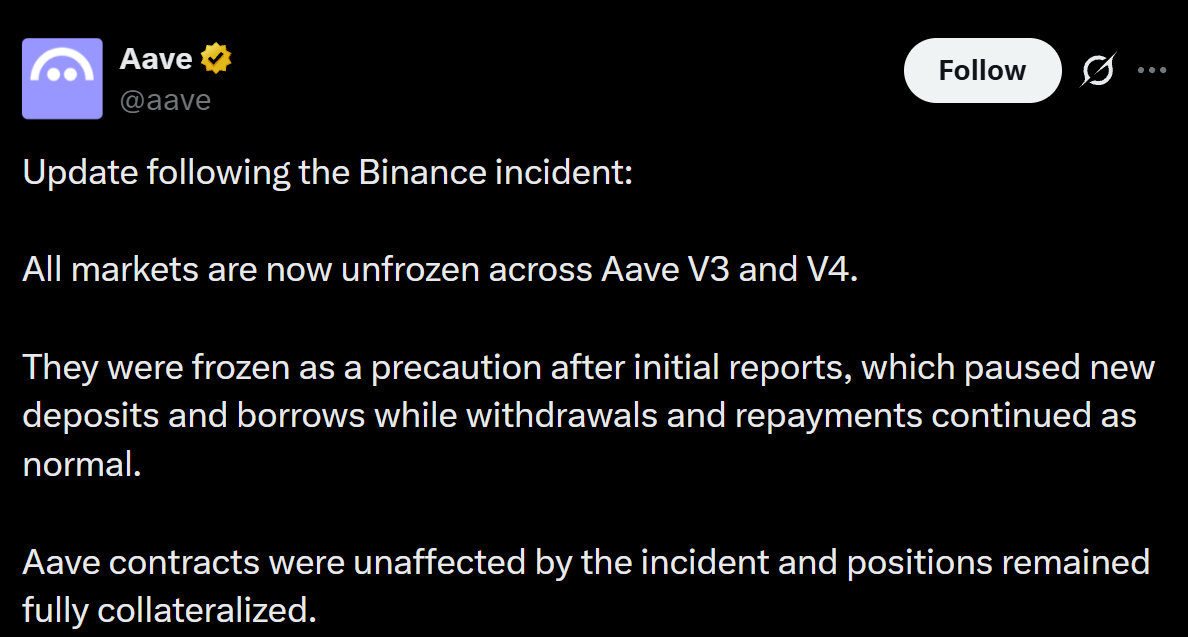
The freeze had paused new deposits and borrows, while withdrawals and repayments continued as normal.
By our own count, the first freeze lasted nearly 16 hours and 15 minutes. Times come from the governance post and the posts’ own dates.
Why the Markets Were Frozen
The first announcement said the team had seen reports of a possible incident involving Binance-affiliated wallets and froze every DAO-operated market on V3 and V4 as a precaution.
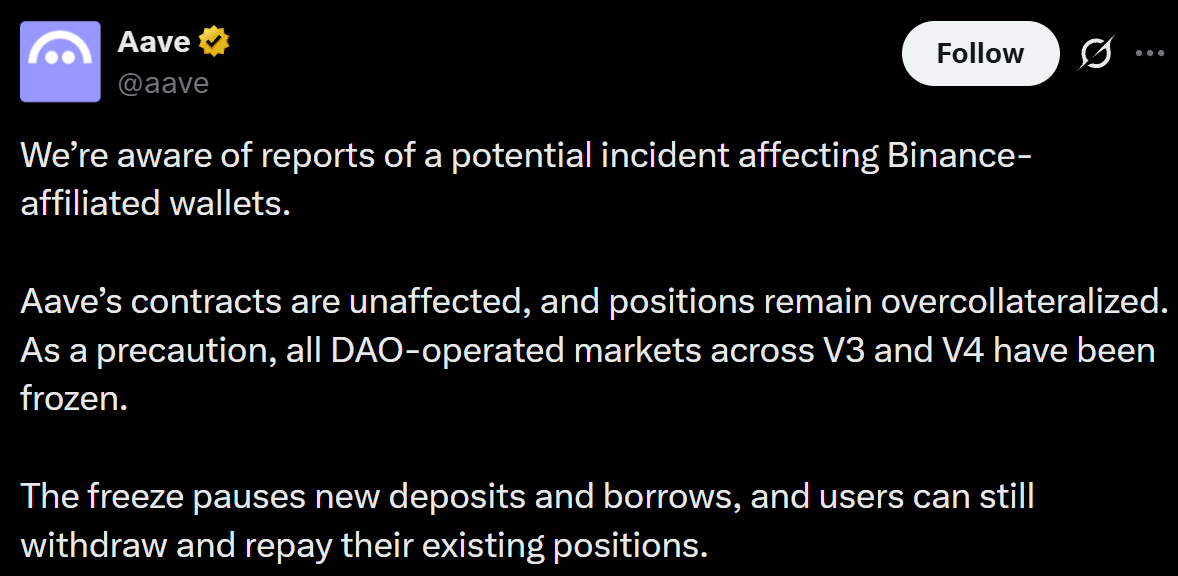
Positions stayed overcollateralized throughout, meaning each loan was backed by more value than it borrowed.
The governance forum explains the reasoning in more detail. According to the risk team’s response, a joint war room formed within 10 minutes of the first reports.
The thief could have swapped stolen coins into any listed asset, so freezing only a few tokens would have left other doors open.
A freeze can be reversed by the guardian, while lowering supply caps would have needed a governance vote and around five days to undo.
In total, 175 reserves were frozen on V3 across 16 networks and 117 on V4 across four networks.
The Horizon market for tokenized real-world assets stayed open because its collateral is permissioned and cannot be used by the exploiter.
What the Exploiter Did on the Platform
The same forum thread reports that one wallet linked to the attacker deposited 60 million USDT and borrowed 19,762 WETH, worth around $44.6 million, between 20:58 and 21:01 UTC.
This was roughly 40 minutes before the first freeze. The public wallet record cited in the thread shows the cluster’s address.
The position holds $59.9 million of collateral against $43.8 million of debt, so by simple maths the loan is near 73% of its collateral.
It remains subject to normal liquidation, and no attacker wallet has touched the platform since 21:01 UTC.
The team says suppliers are not at risk. Price feeds worked normally, and stablecoins held their pegs, though the platform’s own stablecoin GHO slipped from $0.998 to $0.997 as holders redeemed nearly $4.6 million.
How the Unfreeze Works
The reopening happens in four waves, run by the guardians. First, all frozen V3 reserves unfreeze with their borrowing power kept at zero.
Second, on V4 a set of keep-list assets gets a zero collateral setting. Third, borrowing power returns on V3 for most reserves. Fourth, V4 reserves unfreeze while the keep-list stays restricted.
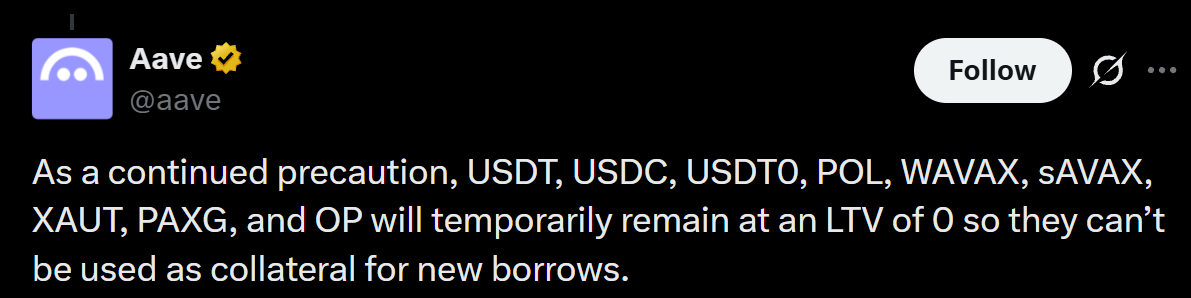
As announced on X, these assets will temporarily stay at zero borrowing power so they cannot back new loans:
USDT, USDC, and USDT0
POL, WAVAX, and sAVAX
XAUT, PAXG, and OP
That is why Aave markets unfrozen still come with guardrails. Supplying, withdrawing, borrowing, and repaying these assets works normally.
On V3, existing positions keep their liquidation thresholds, so health factors do not change.
Risk managers also took protective steps while markets were frozen. A rate adjustment capped borrow rates at full utilization at 10% APR, because withdrawals pushed some reserves to 92%–100% utilization.
Borrow caps were also cut to around 2% above pre-incident levels, removing around $3.7 billion of unused capacity on V3 and $130 million on V4.
The Binance Side and What to Watch
In its second incident update, published on 30 October, the exchange said its hot wallets were compromised at around 20:05 UTC on 29 October, with losses of roughly $6.3 billion.
It has set aside more than $6.34 billion, covering roughly 80% of the impact, and says near $3 billion is frozen on-chain.
Withdrawals are suspended for now, while deposits remain operational. The exchange targets a phased restart within roughly 34 hours, a proof of reserves result by 2 November, and more technical findings within roughly 48 hours.
It says it found no evidence of private key leaks, though early notes about a laptop were joined by additional breach points.
Things worth watching now that Aave markets unfrozen are live:
Whether the restricted assets regain borrowing power
Utilization and borrow rates on the largest reserves
Any attacker activity on the platform
Updated findings from Binance
Conclusion
With Aave markets unfrozen, normal activity can resume, yet the safeguards show how seriously the DAO treats exploit risk.
The protocol itself was not breached, but the episode proves that one exchange’s problem can spill into DeFi within minutes.
Follow the official governance forum, check each asset’s current settings, and remember that this article is not financial advice.
Disclaimer
This article is for educational and informational purposes only and is not financial or investment advice. Crypto assets are high risk, their prices can be very volatile, and you can lose some or all of your money. Always do your own research and consider speaking with a licensed financial advisor before making investment decisions.
0
0

 Manage all your crypto, NFT and DeFi from one place
Securely connect the portfolio you’re using to start.


