
Bitcoin price $80,159: the smallest October loss in the field

0
0

Here is what is documented: Bitcoin stands at $80,159 on Thursday morning, and October ends on Saturday. Of the seven largest tradable coins, Bitcoin has lost the least this month, namely 4.1 percent. Cardano gave up 19.2 percent over the same period, 4.7 times as much. Our assessment is at the end of this article: this spread shifts the weights in a mixed portfolio more than most investors notice, and before the turn of the year it becomes a tax question.
October ends on Saturday, and Bitcoin is 4.1 percent short
On 1 October a Bitcoin cost $83,576. On Thursday morning it is $80,159. Between the two lie $3,417, or 4.1 percent. The month has two trading days left, Friday and Saturday, after which the balance is fixed.
Taken on its own, that is an unremarkable number. In recent years Bitcoin has had months with double-digit swings in both directions. The figure only becomes notable once you place it next to the other large coins, and that is exactly what we did on Thursday morning.
The whole field compared: Cardano loses 4.7 times as much
For seven coins we compared the price on 1 October with the level on Thursday morning. The result is unambiguous: Bitcoin leads the field with a loss of 4.1 percent, while all the others sit between 13 and 20 percent down.
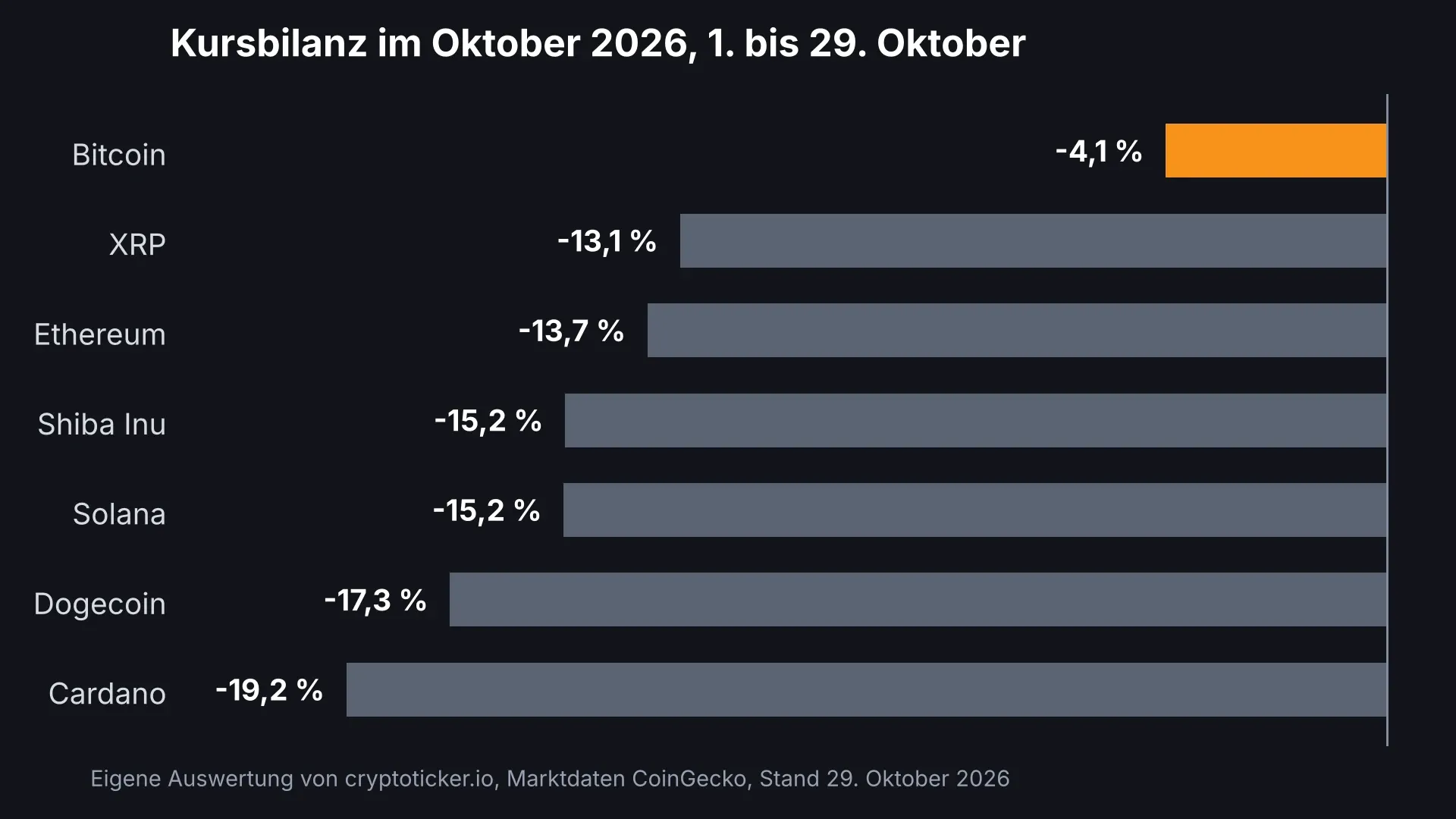
In detail: Ethereum lost 13.7 percent, XRP 13.1 percent, Solana 15.2 percent, Shiba Inu 15.2 percent, Dogecoin 17.3 percent and Cardano 19.2 percent. The average of those six is 15.6 percent. Bitcoin therefore carried only a little more than a quarter of the loss the rest of the field had to absorb.
The basis is market data from CoinGecko, and the reference point in each case is the price of 1 October 2026. cryptoticker.io compiled this analysis itself on 29 October 2026, covering seven coins.
A red October for the second time in a row
October long counted as a reliably strong month on the crypto market. That expectation has not held for two years. October 2025 ended with a loss of around 3.7 percent, and October 2026 is now heading for a second consecutive loss. Two back-to-back losing Octobers had never occurred in Bitcoin's price history until then; before that, only the years 2014 and 2018 were on the books with a red October.
Anyone who times their purchases by seasonal patterns of this kind gets a number worth writing down here. A pattern that breaks twice in a row has become weaker as a basis for decisions.
$80,159 on Thursday morning, and a narrow night
The price stands at $80,159 on Thursday morning. Over the past 24 hours that is 0.87 percent less. The overnight low was $79,636 and the high $81,698, both values from the hours around Wednesday evening's rate decision. Over the week there is a loss of 3.75 percent. The price is 36.4 percent short of the record high of $126,080 from October 2025.
The round $80,000 level gave way briefly overnight and is holding again in the morning. That line is cited most often this week because it also marks the lower bound of the October range.
Since Wednesday morning the funds' cost basis has moved further away
On Wednesday morning the price stood at $80,913 and thus just below the cost basis of the US spot ETFs, which we placed at around $81,500 in Wednesday's morning piece. Since then $754 has come off. The distance to the cost basis has therefore more than doubled, from around $600 to around $1,340.
The funds themselves have kept buying in that time. On Tuesday the US spot ETFs took in a net $176 million according to data from SoSoValue, $151.5 million of it into BlackRock's fund and $24.5 million into Fidelity's. Over the full month, however, an outflow of around $202 million is on the books. The purchases at the end of the month therefore do not yet offset the outflows from its start.
The Fed holds its key rate at 3.75 to 4.00 percent
On Wednesday evening the US central bank left its key rate unchanged in the range of 3.75 to 4.00 percent. Two members of the open market committee voted against; they would have preferred an increase. The next meeting dates are in the Federal Reserve's meeting calendar.
The reaction on the crypto market was muted because the decision had been expected. For investors in Germany the second part of the message matters most: as long as short-term dollar rates sit at around four percent, an asset that pays no interest, such as Bitcoin, has a benchmark it must measure up against.
Your portfolio has shifted without you doing anything
This is where the spread from the chart becomes practical. Suppose a portfolio was half invested in Bitcoin on 1 October and the other half spread evenly across Ethereum, XRP, Solana, Shiba Inu, Dogecoin and Cardano. Anyone who has done nothing since then no longer holds a 50:50 portfolio.
Calculated with the prices above, that portfolio now stands at 53.2 percent Bitcoin and 46.8 percent altcoins. In four weeks the weighting has therefore shifted by a good three percentage points without a single order being executed. The total value of the example portfolio is at 90.1 percent of its level at the start of the month.
For investors that means a fixed target allocation has quietly drifted far enough to be noticeable. Three percentage points in a month, in a portfolio of Bitcoin and six altcoins, is not noise but the trend of the month.
Before rebalancing, the one-year rule decides the tax
Rebalancing means selling, and in Germany a sale is a private disposal under section 23 of the Income Tax Act. The gain stays tax-free only if more than a year lies between acquisition and sale. So anyone trimming Bitcoin to get back to 50 percent is selling units that may not yet have been in the portfolio for twelve months.

Which units count as sold is set by the order: for crypto assets the tax authorities apply the method under which the units acquired first are also disposed of first, and they do so separately for each wallet and each exchange account. Anyone whose holdings are spread across several platforms is therefore not calculating one pool but several.
Three points count now: the acquisition date of the oldest position per account, the question of whether a partial disposal has already passed the one-year mark, and the exemption threshold of 1,000 euros up to which gains from private disposals remain tax-free in a calendar year. If it is exceeded by one euro, the entire gain is taxable, not only the part above it. How far lawmakers are currently reworking the one-year rule is tracked in our status of the holding period reform.
Anyone who would rather not track the deadlines by hand will find programs that keep acquisition dates per account in our comparison of crypto tax tools and portfolio trackers.
Losses from this year can be offset until New Year's Eve
The second side of the same calculation concerns the altcoins. Anyone who lost 13 to 19 percent in October and bought those positions within the one-year window holds losses from private disposals that can be offset against gains from the same type of income.
The cut-off date is what matters here: offsetting happens within a calendar year, and the loss must be realised by 31 December. A paper loss does not count, it takes an actual sale. If a surplus remains at the end of the year, it can be carried forward into the following year and offset there again against gains from private disposals.
In concrete terms: anyone who intends to rebalance anyway can handle the sale of the weak altcoin position and the offsetting in one step instead of planning the two separately. This is not tax advice and does not replace it, but it is the order in which the two questions affect each other. Which licensed trading venues in Germany are suitable for it is shown in our exchange comparison.
$79,636 on the downside, $81,698 on the upside
On the downside the next documented level is the overnight low of $79,636, below that the round $79,000 line. On the upside the overnight high of $81,698 caps the range, and only above it does the funds' cost basis at around $81,500 come back within reach. Both values come from the same night, and at a good $2,060, or around 2.6 percent, the range is narrow.
On Friday morning the large monthly expiry on the Deribit options exchange also runs out. Which strike levels hang there and what the calculated point of maximum pain means is broken down in our article on the options expiry of 30 October.
Our assessment: the monthly balance says more than the daily range
This is our interpretation and not a statement of fact. The 0.87 percent of the day is the least important number in this article on Thursday. More interesting is that Bitcoin lost markedly less than everything else in the field over a full month, and that this spread does not come from a single event but built up over four weeks.
Two things argue that it will last: the inflows into the spot ETFs go into Bitcoin alone and not into the rest of the field, and at a rate level of around four percent the market finds it harder to carry money into the smaller assets. Against it stands the fact that a valuation gap this wide has historically often closed again once the market turns. Which of the two happens is open. What is settled is the shift in the portfolio, and that can be recalculated today.
Bitcoin at the month's close: 4.1 percent down instead of 19.2 like Cardano
October closes on Saturday. Bitcoin stands at $80,159 and thus 4.1 percent below the start of the month, while the six other large coins have given up 15.6 percent on average. A mixed portfolio has thereby shifted from 50:50 to 53:47 in Bitcoin's favour. Anyone reversing that checks the acquisition date per account and the exemption threshold of 1,000 euros first; anyone wanting to offset altcoin losses has until 31 December to do so.
(As of October 29, 2026. This article is not investment advice. Prices and fee structures change; check the terms with the provider before you buy.)
0
0


 Manage all your crypto, NFT and DeFi from one place
Securely connect the portfolio you’re using to start.
 Where will Bitcoin trade next?
Live Polymarket and Kalshi odds on Bitcoin price targets, compared side by side.
See Bitcoin price odds


