
Cardano open interest climbs to $395 million while ADA falls

0
0

Traders are betting more on Cardano in the futures market again, even though the price keeps slipping. According to data from analytics firm CoinGlass, analyzed by U.Today on Tuesday, open interest in ADA futures rose 5.42 percent within 24 hours to $395.09 million. At the same time, Cardano slipped below $0.175 on Wednesday morning, November 11, 2026. What is documented: new positions are being added while the price falls, and the funding rate in the perpetual market is just below zero. Our assessment follows further down: rising open interest during a falling price mainly increases the risk of violent swings in both directions, and no bottom can be read from it yet.
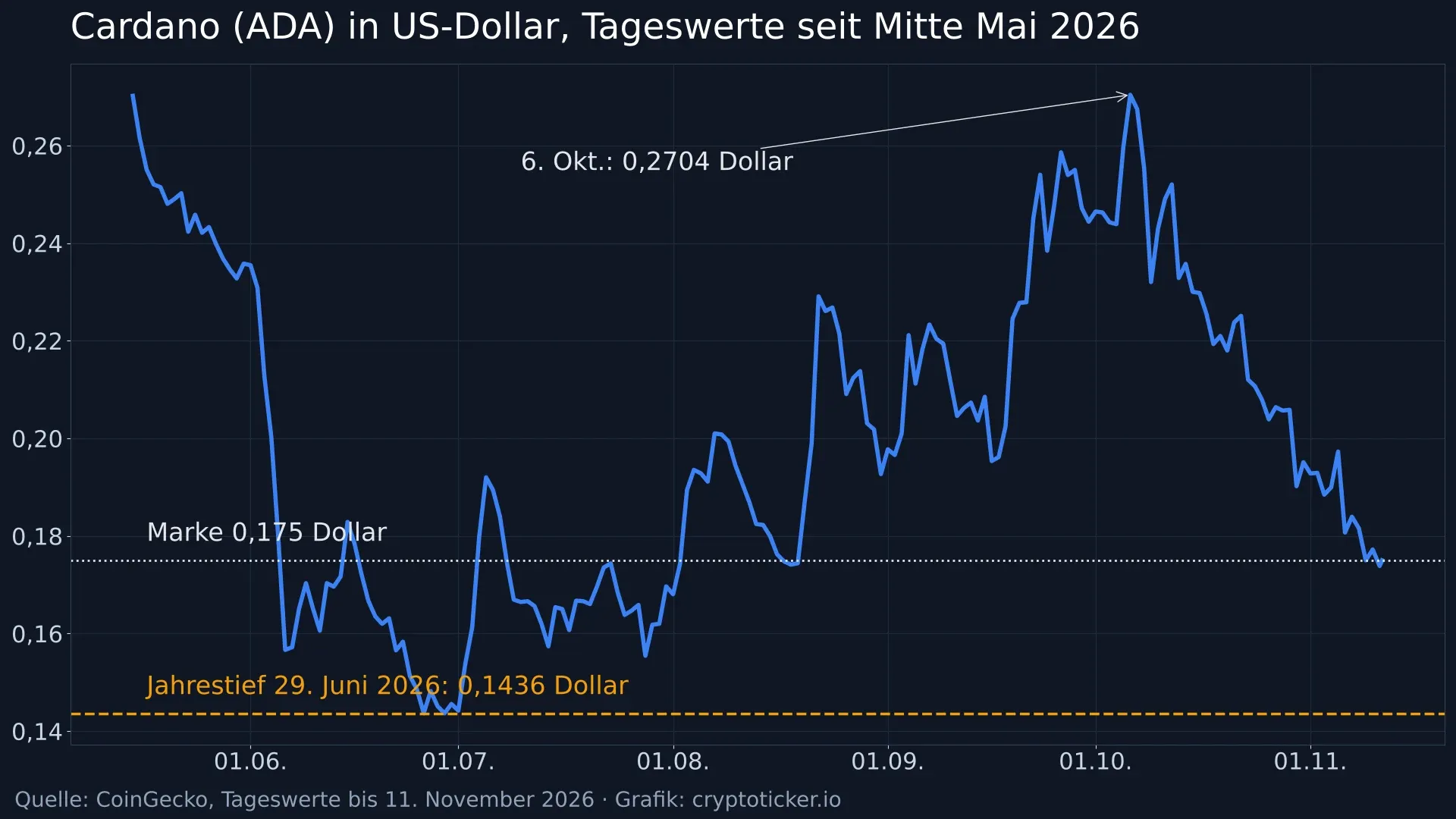
On Wednesday morning ADA cost $0.1748 according to CoinGecko and €0.1572 on the Kraken exchange. That is a loss of 2.2 percent over 24 hours, 8.0 percent over seven days and 30.8 percent over 30 days. The daily low was $0.1709. With a market value of around $6.6 billion, Cardano is the 18th-largest cryptocurrency and has lost considerably more since early October than Bitcoin, which gave up around 12 percent over the same period.
Open interest at $395 million: what the CoinGlass figure measures
Open interest is the sum of all open futures contracts on a coin, measured in dollars. Every contract has a buyer and a seller, so the figure does not say whether more money is betting on a rising or a falling price. It shows how much capital is tied up in the futures market and how much leverage is in the system.
If open interest rises while the price falls, traders are opening new positions rather than closing old ones. These are often short sellers betting on further losses. They could just as well be buyers speculating on a rebound after five losing weeks. CoinGlass data offers a clue: in futures on Tuesday, aggressive buying, meaning buy orders executed immediately at the market price, outweighed aggressive selling by 3.9 percent. In the spot market, by contrast, selling dominated, by a net $1.27 million.
The contradiction is typical of a phase in which futures traders position themselves against the trend while holders sell their coins. It usually resolves with a fast move: either the futures buyers give up and sell too, or short sellers have to buy back when the price rises.
Funding rate on OKX: longs and shorts almost evenly matched
A second metric shows which side is under more pressure. The funding rate is the fee that buyers and sellers of perpetual futures, known as perpetuals, pay each other every eight hours. If it is positive, buyers pay, because more money is betting on rising prices. If it is negative, short sellers pay.
For the ADA perpetual against Tether on the OKX exchange, the last settled rate on Wednesday morning was minus 0.0014 percent per eight hours, with the current period at minus 0.0006 percent. Both are very close to zero. Short sellers have a slight upper hand, but there is no sign of a one-sided bet in the market. On OKX itself, around 132 million ADA were held in open perpetual contracts at the same time, equivalent to about $23 million.

Order books at $0.177 to $0.179: where large sell orders sit
The order books of the major exchanges show where supply is piling up. According to CoinGlass, on Tuesday there were around $477,000 in sell orders at $0.179 on Bitget, around $415,000 in the same area on Crypto.com and about $445,400 at $0.177 in the Binance futures market. The $0.177 to $0.179 zone is therefore the first area where a rise would meet a lot of supply.
Below that, buy orders gathered between $0.170 and $0.175. That is exactly the zone the price moved into on Wednesday morning. Large orders in the order book are not a fixed boundary, however: traders can withdraw them at any time, and a wall that stands in the evening has sometimes vanished by the next morning.
Since November 9: price almost unchanged, DeFi deposits slightly recovered
On Monday we described Cardano DeFi deposits at their yearly low. ADA cost $0.1741 at the time; today it is $0.1748. The price has barely moved in two days, even though the US inflation data came out on Tuesday in between. According to DefiLlama, deposits in Cardano protocols stood at $48.9 million on Monday and $49.4 million on Wednesday. What is new is the futures market as a second view of the situation: the capital in the protocols stays almost flat, while the capital in futures grows.
ADA has not returned to the first hurdle of $0.193 named at the time. The yearly low of $0.1436, on the other hand, has come closer; measured from Wednesday morning, it is still 17.8 percent away.
From the August low to the yearly low: what happened at $0.174 last time
A look at our own daily values from CoinGecko shows that the zone around $0.174 is not unfamiliar territory for Cardano. On August 18, 2026, ADA stood at $0.1741. Four days later, on August 22, it was at $0.2291, a rise of around 32 percent. Back then the recovery came without the yearly low of June 29 at $0.1436 being tested again.
The comparison has a limit. In August ADA was coming out of a sideways phase; now the coin is coming off a decline from $0.2704 on October 6, the highest daily value of the past six months. Five consecutive losing weeks have pushed many autumn buyers into the red, and precisely these buyers like to sell at their entry price on any recovery. According to CoinCentral, the analyst More Crypto Online named the zone from $0.1617 to $0.1824 as a possible area for a bottom on November 9, but saw no signal for a low yet.
US inflation data as the trigger: why ADA falls harder than Bitcoin
The latest decline was triggered by US consumer prices for October, which came in higher than expected on Tuesday. We put the figures and the consequences for Bitcoin into context in our article on the US inflation data and stops before December 9. Higher inflation makes rate cuts by the US Federal Reserve less likely, and that hits risky assets first.
Cardano reacts more strongly than Bitcoin. Over 24 hours, ADA lost 2.2 percent on Wednesday morning and Bitcoin 1.0 percent. Over 30 days, ADA is down 30.8 percent and Bitcoin 12.1 percent. The reason lies in the market itself: smaller coins lack large buyers such as the Bitcoin ETFs that could cushion a decline. No spot ETF on Cardano trades in the US; according to CoinCentral, Grayscale withdrew its application in August.
Leverage and liquidation: at 5x, the threshold sits close to the yearly low
If you trade ADA futures, you should calculate the liquidation threshold before entering. Liquidation means the exchange forcibly closes a leveraged position as soon as the posted collateral no longer covers the loss. A worked example with Wednesday morning's price and an isolated long position: at 10x leverage, a decline of just under 10 percent is enough, putting the threshold at roughly $0.159. At 5x leverage, it is around $0.142, almost exactly at the yearly low. The exact values depend on the exchange's maintenance margin and fees.
This matters especially when open interest is rising. If many leveraged positions cluster in the same zone, a break of the $0.170 mark can trigger a wave of forced sales that makes the price fall faster than the actual trigger would. Conversely, short sellers buying back push the price higher still on a rise above $0.179.
For retail investors in Germany, leverage on crypto CFDs is capped at 2 to 1; the financial regulator has set this for regulated brokers. Anyone trading on foreign platforms with higher leverage bears the full risk of losing all their collateral. You can find an overview of providers for leveraged trading in our comparison of the best crypto brokers.
ADA holding period in Germany: using losses before one year is up
If you bought ADA in the past twelve months, you are almost certainly at a loss at the current price: a year ago Cardano still cost around $0.55. In Germany, a sale within the one-year holding period is a private sale transaction. The loss can then be offset against gains from other private sale transactions in the same year or carried forward to later years. After the period expires, a sale is tax-free, but a loss then no longer counts either. We track the status of plans to abolish the holding period on our page on the holding period reform.
The holding period does not apply to futures. Gains and losses from futures transactions are treated differently for tax purposes than a spot purchase, regardless of how long the position was open. Anyone mixing spot and futures therefore needs a clean record of all trades.
Cardano staking continues: delegated ADA remain freely available
One difference from many other networks helps holders in a phase like this. Staking on Cardano does not lock the coins. If you delegate ADA to a stake pool, you can sell or move them at any time, and rewards are credited every five days at the end of an epoch. According to a query of the blockchain service Koios, epoch 667 is currently running. The network's treasury holds around 1.42 billion ADA, whose use the community votes on; an open proposal for 22 million ADA for a copper reserve expires with epoch 668.
Staking does nothing to change the price risk. It does, however, bring ongoing income in ADA without tying you to a date. When buying through an exchange, it is worth checking whether it offers staking itself and what share of the reward it keeps. We compare exchanges with a MiCA license for customers in Germany on our page on the best crypto exchanges. If you want to buy ADA in this situation, you are better off placing a limit order in the $0.170 to $0.175 zone than buying at the market price.
Our view of the ADA futures market
From the editorial team's perspective, more points to continued swings than to a quick bottom. Three documented points support this: open interest of $395 million that grows as the price falls, the sell orders between $0.177 and $0.179, and the net spot outflow of $1.27 million in a single day. The neutral funding rate argues against a further slide. If short sellers dominated the market, it would be clearly negative.
In our view, the $0.170 to $0.175 zone is decisive. If it holds, a move like the one in August is possible, when ADA rose around 32 percent within four days from the same area. If it breaks, the next documented level is only the yearly low of $0.1436. This is an assessment of the situation and not a recommendation to buy or sell. With cryptocurrencies, a total loss is possible.
ADA futures: below $0.170 things get tight for longs
- Calculate the liquidation threshold: For every leveraged ADA position, check where the exchange will forcibly close you out, and compare the conditions in our comparison of the best perp DEXs.
- Document losses: Record the purchase date and entry price of every ADA position before the holding period expires. Suitable tools are listed in our comparison of crypto tax tools.
- Use staking: If you hold ADA anyway, you can delegate them without a lock-up. Providers and their fees are in the comparison of staking platforms.
(As of November 11, 2026. This article is not investment advice. Prices and fee structures change; check the terms with the provider before you buy.)
0
0

 Manage all your crypto, NFT and DeFi from one place
Securely connect the portfolio you’re using to start.


