
S&P Global Rates Assesses Tether’s USDT Peg at 5 (Weak), Citing High-Risk Reserve Assets and Limited Disclosure

0
0
Standard & Poor’s Global Ratings has published a Stablecoin Stability Assessment for Tether’s USDT that assigns the token a score of 5 (Weak) on a scale of 1 to 5, where 1 is very strong and 5 is weak. The report is dated Nov. 18, 2026 and was made available by S&P Global Ratings.
In its summary, S&P Global Ratings said the assessment reflects “the significant proportion of high-risk assets backing USDT’s reserve” and “persistent gaps in disclosure,” assessing USDT’s ability to maintain its peg to the U.S. dollar at 5 (weak). S&P also noted that USDT, issued in 2014, is the longest-standing stablecoin and has the largest volume in circulation.
High-risk holdings and gaps in reserve transparency
S&P said its asset assessment remains at 5 (weak) because the share of high-risk assets in USDT’s reserves has continued to increase since its most recent review. While S&P said exposure to bitcoin declined, it reported that Tether increased investments in gold and began investing in public equity.
The report describes other risky assets as including secured loans, corporate bonds and other investments where it said creditworthiness disclosure is limited. S&P said a significant drop in the value of these assets could lead to USDT being undercollateralized.
According to S&P, a large portion of reserves remains invested in short-term U.S. Treasury bills and other U.S. dollar cash equivalents, but the firm highlighted limited public information on the creditworthiness of custodians, counterparties, and bank account providers. S&P also pointed to limited transparency on reserve management and risk appetite, the lack of a robust regulatory framework, the absence of asset segregation to protect against issuer insolvency, and limitations to USDT’s primary redeemability.
Reserve figures tied to Sept. 30, 2026
S&P said USDT is fully backed by reserves and is issued by Tether International S.A. de C.V., incorporated in El Salvador. It also stated that Tether moved to El Salvador from the British Virgin Islands in 2025 after securing a license as a digital asset service provider.
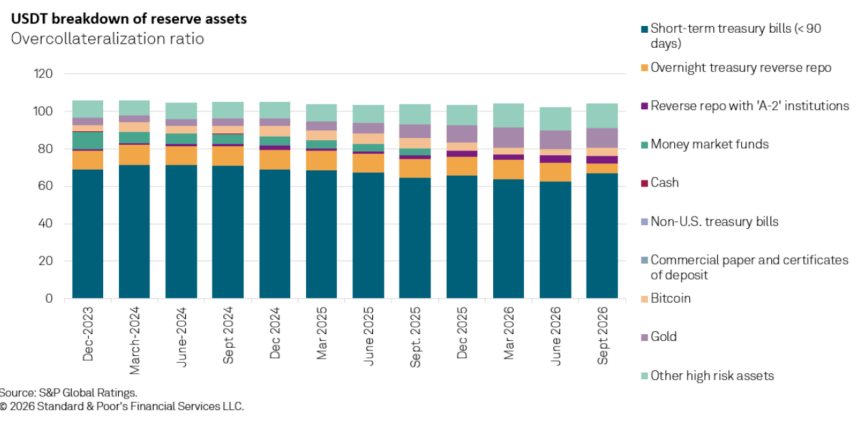
The report said Tether publishes quarterly reserve reports, and cited the most recent report dated Sept. 30, 2026, attested by BDO Italia. S&P reported that reserves of $191.5 billion backed $183.5 billion of USDT in circulation, with a collateralization ratio of 104.3%, slightly higher than 103.9% on Sept. 30, 2025.
S&P broke down collateral composition, including short-term U.S. Treasury bills with an average tenor of less than 90 days (67%), U.S. Treasury-bill-backed overnight reverse repos (5%), other reverse repos and non-U.S. Treasury bills (4%), and cash and bank deposits of less than 0.5%. It also said a mix of riskier assets made up 28% of reserves, with limited transparency on composition.
S&P reported that exposure to risky assets increased over the past year. It listed corporate bonds, precious metals, bitcoin, secured loans, public equities and other investments subject to market, interest-rate and foreign-exchange risks. S&P said these assets accounted for 28% of USDT in circulation as of Sept. 30, 2026, compared with 24% on Sept. 30, 2025. Within that, it said gold holdings rose to about $19 billion (10%) from $12.9 billion (7%), public equities were added at $4.2 billion (2%), and bitcoin declined to $8.4 billion (5%) from $9.9 billion (6%).
Redeemability constraints and disclosure limitations
S&P said U.S. Treasury bills and Treasury-bill-backed overnight reverse repos represent low-risk assets in its view, describing their combined exposure as exceeding $130 billion. However, the report said reserve reports do not disclose custodians, counterparties, or bank account providers.
The firm also said USDT redemption on Tether’s website is restricted to holders with a verified account, subject to a $150 verification fee, as well as redemption thresholds and fees. S&P said holders that do not meet those requirements would need to use secondary markets, where it described liquidity as generally strong due to USDT’s market reach.
What could improve the assessment
S&P said the stablecoin stability assessment could improve if exposure to high-risk assets decreased, alongside better disclosure about asset composition and valuation and the creditworthiness of custodians, counterparties and bank account providers.
The assessment notes that S&P did not produce the report at the request of the stablecoin issuer or sponsor, and it also states that the publication does not constitute a rating action.
This article was originally published as S&P Global Rates Assesses Tether’s USDT Peg at 5 (Weak), Citing High-Risk Reserve Assets and Limited Disclosure on Crypto Breaking News – your trusted source for crypto news, Bitcoin news, and blockchain updates.
0
0


 Manage all your crypto, NFT and DeFi from one place
Securely connect the portfolio you’re using to start.


