
Raydium Revenue Surge: Revenue Jumps 264%—Can RAY Keep the Momentum?

0
0
Raydium Revenue Surge: Tokenized Stocks Lifted Q3 Fees by 264% See Why
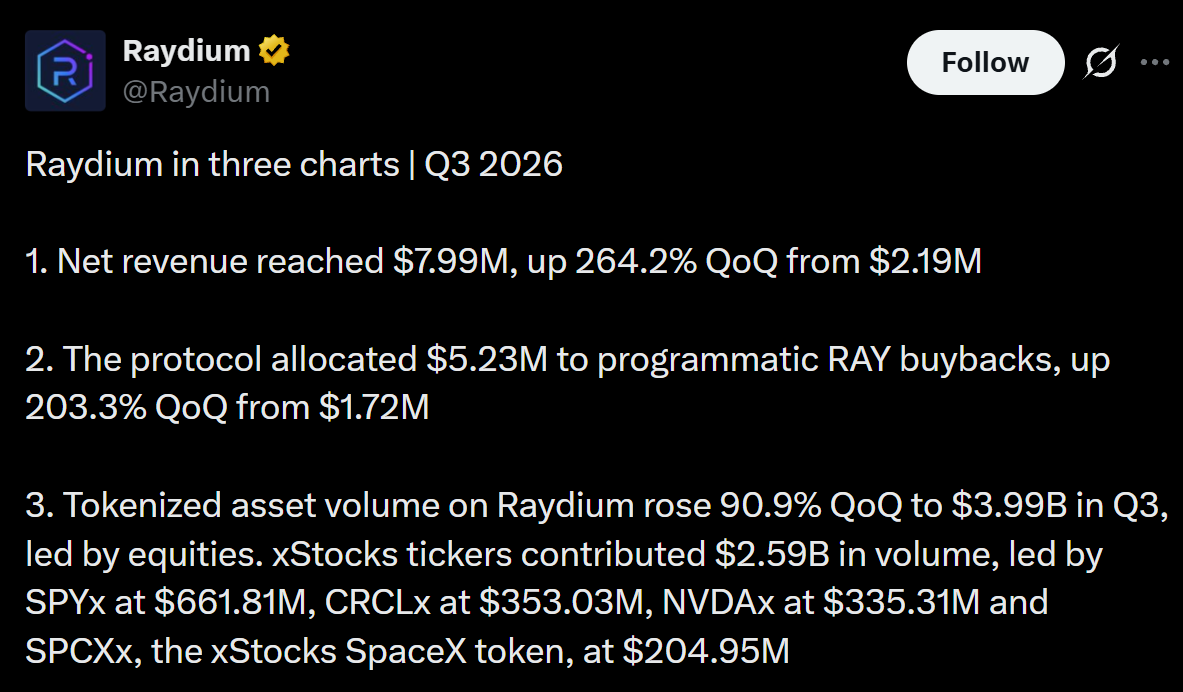
A Raydium revenue surge defined the third quarter of 2026. According to the Blockworks quarterly report published on October 21, 2026, net revenue more than tripled to $7.99 million, while buybacks of the RAY token and trading of tokenized stocks climbed sharply.
This article breaks the numbers down in plain words, so anyone can follow what changed and why.
Source: Protocol’s official post
Q3 2026 at a Glance
The Blockworks report says the protocol’s quarterly net revenue reached $7.99 million, up 264.2% from $2.19 million in Q2.
September alone brought in about 76% of that total, with $6.06 million, the strongest month in more than a year.
That is the clearest sign of the Raydium Revenue Surge, and it matters because Q2 had been the lowest point of a long slide.
| Metric | Q3 2026 | Change vs Q2 |
| Net revenue | $7.99M | +264.2% |
| Operating cash flow | $8.67M | +263.6% |
| RAY buybacks | $5.23M | +203.3% |
| Tokenized asset volume | $3.99B | +90.9% |
| Total trading volume | $19.99B | +103.0% |
| Treasury assets | $242.89M | +150.1% |
Tokenized Stocks Become the Biggest Fee Source
The biggest story is tokenized assets, which are tokens that represent real-world stocks and funds.
According to the Blockworks report, trading in these tokens rose 90.9% to $3.99 billion, and they generated 45% of swap fees, even though they made up only one-fifth of total volume.
The exchange also captured nearly half, 49.8%, of all spot trading of these assets on Solana, up from 36.2%.
The top xStocks tickers by volume were:
-
SPYx: $661.81M
-
CRCLx: $353.03M
-
NVDAx: $335.31M
-
SPCXx (the xStocks SpaceX token): $204.95M
In total, xStocks tickers contributed $2.59 billion. A second issuer, Backpack Securities, added $1.17 billion, up from just $0.05 billion in Q2.
The report links the fee jump to higher fee tiers and new fee tools in the protocol’s concentrated liquidity pools.
The protocol earned about 6.67 basis points of volume on these pairs, up from 1.74 in Q2. In simple terms, each dollar traded in stock-token pools earned nearly four times more for the protocol than before.
The report notes that this link to the new tools is inferred from fee data, not measured directly.
Buybacks and Treasury Grow Alongside Fees
Higher fees fed bigger purchases of the protocol’s own token. The report shows $5.23 million went to programmatic RAY buybacks, up 203.3% from $1.72 million, bringing lifetime buybacks to $204.32 million.
Buybacks equalled about 60% of operating cash flow, which rose 263.6% to $8.67 million. Repurchased tokens are not sold to fund operations, and the buyback wallet now holds about 32% of circulating supply.
Circulating supply stayed unchanged at 272.34 million RAY, against a fixed maximum of 555 million, and staked RAY held near 13.6% of it.
Treasury highlights at quarter end:
-
Total treasury assets: $242.89 million, up from $97.13 million
-
Non-RAY reserves, mostly SOL and dollar-pegged assets: $72.55 million
-
USDC holdings: $35.37 million, up 62.5%
Part of the treasury rise came from RAY and SOL price gains, not only new money, as the report points out.
What Powered the Growth: Pools and Launchpad
Most of the Raydium Revenue Surge came from concentrated liquidity (CLMM) pools, which earned $4.55 million, or 56.9% of the total, and handled 77.8% of trading volume.
The launch platform LaunchLab also bounced back, rising from $0.21 million to $1.85 million after StonkFun, a launchpad that pairs new tokens with tokenized stocks, moved over on September 5.
According to the report, StonkFun accounted for about 86% of platform-attributed LaunchLab fees, and token launches jumped from 24,504 to 162,861.
Product mix:
-
CLMM: $4.55M (56.9%)
-
LaunchLab: $1.85M (23.2%)
-
CPMM: $1.20M (15.1%)
-
Older AMM v4: $0.39M (4.9%, down 13.4%)
The protocol also launched permissioned pools on July 23 for KYC-gated assets, with Superstate as the first partner.
No security incidents affecting active programs were reported in the quarter.
Risks, Competition and the Road Ahead
The picture is not all positive. The report notes the figure is still 72.1% below the Q3 2025 peak of $28.62 million.
Competition is also rising: Robinhood Chain, an Ethereum Layer 2 built around stock tokens, went live on July 1 and began overtaking Solana in daily stock-token volume by late July.
The report adds that part of the treasury growth reflects higher SOL and RAY prices rather than fresh capital, and that net profit was not stated because expense data was unavailable.
Looking ahead, the report points to early Q4 listings of tokenized BlackRock and Powerus shares through Backpack’s Sunrise platform, both trading on the protocol’s pools, plus more launch partners using the any-token-pair model.
The report is also sponsored: Reactor Labs funded it, while Blockworks says it kept editorial control. Readers should treat all of this as information, not investment advice.
Conclusion
The Raydium Revenue Surge shows how fast a decentralized exchange can recover when new demand arrives. Stock tokens, concentrated liquidity, and a busy launchpad lifted fees, bigger buybacks followed, and the treasury grew.
Still, the total remains far below its 2025 high, and competition is growing, so the next quarter will show whether this momentum can last.
Disclaimer
This article is for educational and informational purposes only and is not financial or investment advice. Crypto assets are high risk, their prices can be very volatile, and you can lose some or all of your money. Always do your own research and consider speaking with a licensed financial advisor before making investment decisions.
0
0


 Manage all your crypto, NFT and DeFi from one place
Securely connect the portfolio you’re using to start.


