
Binance Hack Spurs Market Drop: BNB Slumps 8% as Bitcoin Nears $77K

0
0
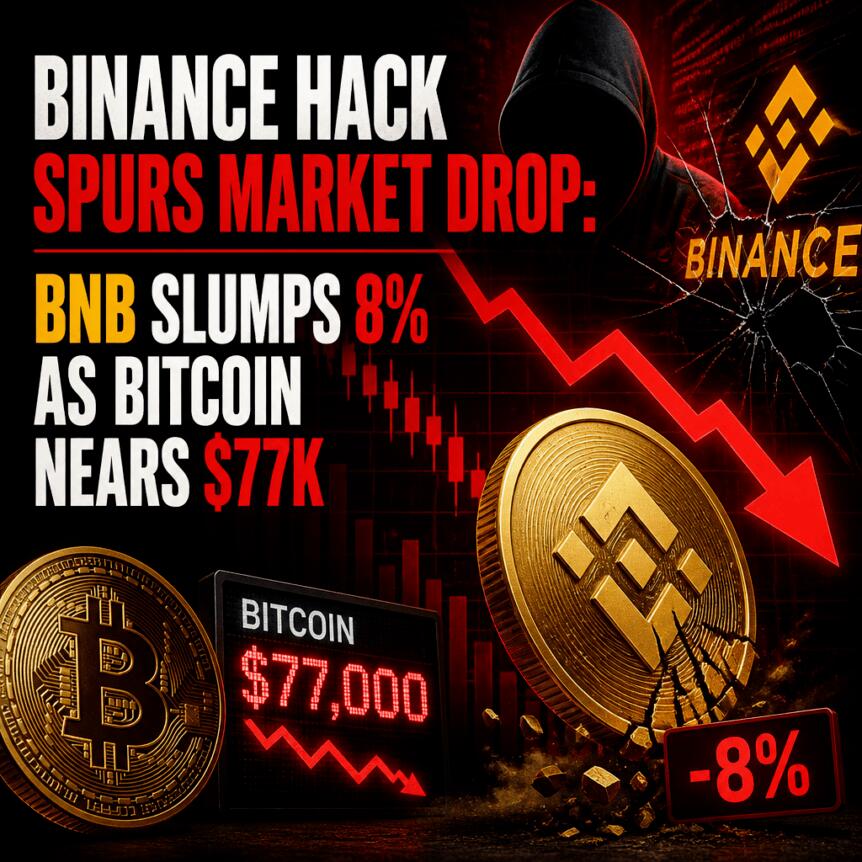
Crypto markets slid further in early trading on Friday as investors digested fallout from the Binance-linked hack, with BNB and major altcoins leading the move. BNB dropped more than 8% over the last 24 hours, while Bitcoin traded close to the $77,000 level, indicating broader risk-off pressure rather than a single-token shock.
At the time of writing, CoinGecko data showed BNB trading near $693 (down about 8.2%). Bitcoin was down roughly 4.8% to around $77,131, and Ether fell about 5.7% to approximately $2,217. DeFi tokens also weakened: Aave’s AAVE slid about 11.3% to $118.54 and Uniswap’s UNI dropped around 10.4% to $6.48, according to CoinGecko.
Key takeaways
- BNB extended losses, falling more than 8% in 24 hours, as market participants priced in continued uncertainty around the Binance incident.
- Bitcoin remained under pressure near $77,000, suggesting the sell-off spilled beyond BNB and into broader sentiment.
- Binance pledged to cover all losses from the hack and suspended deposits and withdrawals while running security checks.
- Binance updated its figures for frozen assets to about $3 billion, up from an earlier estimate of $2.54 billion.
- Aave froze new deposits and borrowing on community-operated V3 and V4 markets, while allowing withdrawals and loan repayments.
BNB weakness pulls broader markets lower
The immediate market response centered on BNB, reflecting how tightly investors track Binance’s operational and security posture. With BNB down around 8% over the past day, the move quickly spilled into other large-cap assets and the DeFi complex.
Bitcoin’s decline to the low-$77,000s is notable because it implies traders were not only reacting to BNB-specific risk. Instead, the timing of the sell-off suggests a wider reassessment of counterparty and exchange-risk exposure across the crypto ecosystem.
Ether and major DeFi tokens followed the same direction. Ether fell to around $2,217, while AAVE and UNI saw sharper percentage declines, consistent with the way DeFi liquidity and user flows often react during exchange-linked security events. CoinGecko price data reflected this broad-based weakening across multiple sectors.
Binance updates: covering losses and revising frozen assets
Binance said it would cover all losses stemming from the hack and temporarily halted deposits and withdrawals during security checks. The exchange’s operational suspension is typically aimed at limiting additional risk exposure while teams verify balances and assess affected paths.
Binance later provided a revised update on the scope of funds it has frozen. The verified total of frozen assets was reported at around $3 billion, rising from an earlier figure of $2.54 billion. That step matters for market pricing because it changes the perceived magnitude of the disruption—both in terms of direct exposure for users and potential knock-on effects for liquidity.
Earlier coverage from Cointelegraph noted concerns around a Binance-linked wallet and warned that a possible exploit could be involved. The latest market movement and Binance’s own updates underline that traders are still working through the implications of that incident.
DeFi caution spreads: Aave freezes new activity
Beyond centralized exchange risk, the incident prompted caution across DeFi platforms. Aave announced it had frozen new deposits and borrowing across its community-operated V3 and V4 markets as a precaution.
Importantly for users, Aave stated that its contracts were unaffected. The protocol also allowed users to withdraw funds and to repay loans, which helps reduce the immediate fear of getting stuck in a system that is unable to resolve positions.
This type of partial freeze—limiting new inflows and leverage creation while preserving exits and repayments—often aims to slow down liquidity demand during periods of heightened uncertainty. For traders and liquidity providers, it also changes the near-term risk profile: the protocol can become less efficient for new capital deployment even if core functionality remains intact.
What investors should watch next
As of now, the market’s focus is likely to remain on how Binance’s security review progresses and whether the exchange’s updated frozen-asset figure becomes a stable reference point. Traders should also monitor whether additional DeFi protocols follow Aave’s approach with similar restrictions, or if those precautions begin to ease—both of which can materially affect liquidity and sentiment across crypto.
This article was originally published as Binance Hack Spurs Market Drop: BNB Slumps 8% as Bitcoin Nears $77K on Crypto Breaking News – your trusted source for crypto news, Bitcoin news, and blockchain updates.
0
0


 Manage all your crypto, NFT and DeFi from one place
Securely connect the portfolio you’re using to start.
 Where will Bitcoin trade next?
Live Polymarket and Kalshi odds on Bitcoin price targets, compared side by side.
See Bitcoin price odds


