
11 billion dollars expire on Friday: is a Bitcoin setback coming?

0
0

The evidence: 135,159 Bitcoin option contracts are open on the derivatives exchange Deribit for Friday's expiry on October 30. At a price of $81,179 on Thursday afternoon, that comes to a notional value of roughly 11 billion dollars. The calculated pain point of this expiry, max pain in the trade's jargon, sits at $78,000. Our assessment follows further down: the figure works as a pointer to where option sellers' interests lie, not as a price target.
Bitcoin trades at $81,179, or 72,735 euros, at around 4 p.m. German time on Thursday, October 29. Over the past 24 hours the range ran from $79,636 to $81,698; over seven days there is a loss of 0.77 percent, over 30 days one of 3.04 percent. The all-time high of $126,080 is 35.6 percent away. Where the price can point on a horizon of months is set out in our Bitcoin price prediction. This piece is about the next 48 hours.
What happens on Friday at 09:00 German time
An option is a right, not an obligation. Hold a call and you may buy Bitcoin at the agreed strike price; hold a put and you may sell at that price. On expiry day the settlement price alone decides whether that right is worth anything. If the price sits above a call's strike, it pays out. If it sits below, the contract expires worthless and the premium stays with the seller.
Deribit settles its monthly options at 08:00 UTC, which in Germany is 09:00 under winter time. What counts is not the price in a single second but the average of the Deribit Bitcoin index over the preceding 30 minutes. That is why the decisive stretch on Friday falls between 08:30 and 09:00, not at settlement itself. Anyone looking to defend or break a level in that half hour has to trade in the spot market, not on the derivatives exchange.
For the cash market that has a practical consequence: turnover regularly picks up in this window, because option sellers have to unwind their hedges. Bitcoin trading volume across all exchanges stood at 28.8 billion dollars over 24 hours on Thursday. Against that size, a single hedging wave is noticeable but not market-defining.
135,159 contracts and 11 billion dollars: the order of magnitude
Of the 135,159 open contracts, 88,715 are calls and 46,445 puts. The put-to-call ratio therefore sits at 0.52. At first glance that looks like an optimistic market, because almost twice as many rights to buy as rights to sell are open. The second glance shows where those rights to buy sit, and the picture turns.
85 percent of all calls have a strike above the current price; among the puts, 88 percent sit below it. Added together, 116,265 of the 135,159 contracts expire worthless on Friday, which is 86 percent. In the money, 18,895 contracts remain. The expiry is therefore less a clearing house for large sums than a tidying-up: by far the largest part of these positions was settled before Friday even begins.
Max pain at $78,000: what the number says and what it does not
Max pain is the strike at which the sum of all options due to pay out comes out smallest. For this expiry it sits at $78,000, which is 3.9 percent below the current price. The arithmetic behind it is plain: for every conceivable settlement price, what calls and puts would cost together is added up, and the price with the lowest sum wins.
Market commentary often turns that into a price target. It does not hold. Max pain describes the interests of those who have sold options, not the power to enforce them. The cash market for Bitcoin is many times larger than the open interest of a single expiry, and option sellers are not a closed group with a shared plan. The figure is useful all the same, because it shows which way the hedging trades pull when nothing else happens: the draw is towards 78,000, not upwards.
To place the distance: from $81,179 to $78,000 is $3,179. The daily range of the past 24 hours was $2,062. The walk to the pain point therefore amounts to roughly one and a half normal trading days, not an exceptional move.
The wall at $95,000 and what is left of it
By far the largest single block of this expiry sits at a strike of $95,000: 20,152 contracts, of which 19,951 are calls. Above that follow $100,000 with 11,285 contracts and $90,000 with 10,756. Above $90,000 alone, 58,717 call contracts are open.
Those strikes sit 11, 17 and 23 percent above the current price. For them to be worth anything by Friday, Bitcoin would have to make a one-day jump the market has not shown at any point in 2026. In practice that means these positions are already written off. Whoever bought them has lost the premium; whoever sold them keeps it.
On the other side of the price, the puts gather between $69,000 and $75,000, 17,592 contracts in total. They too expire worthless as long as Bitcoin stays above $75,000. The buffer to there is 7.6 percent.
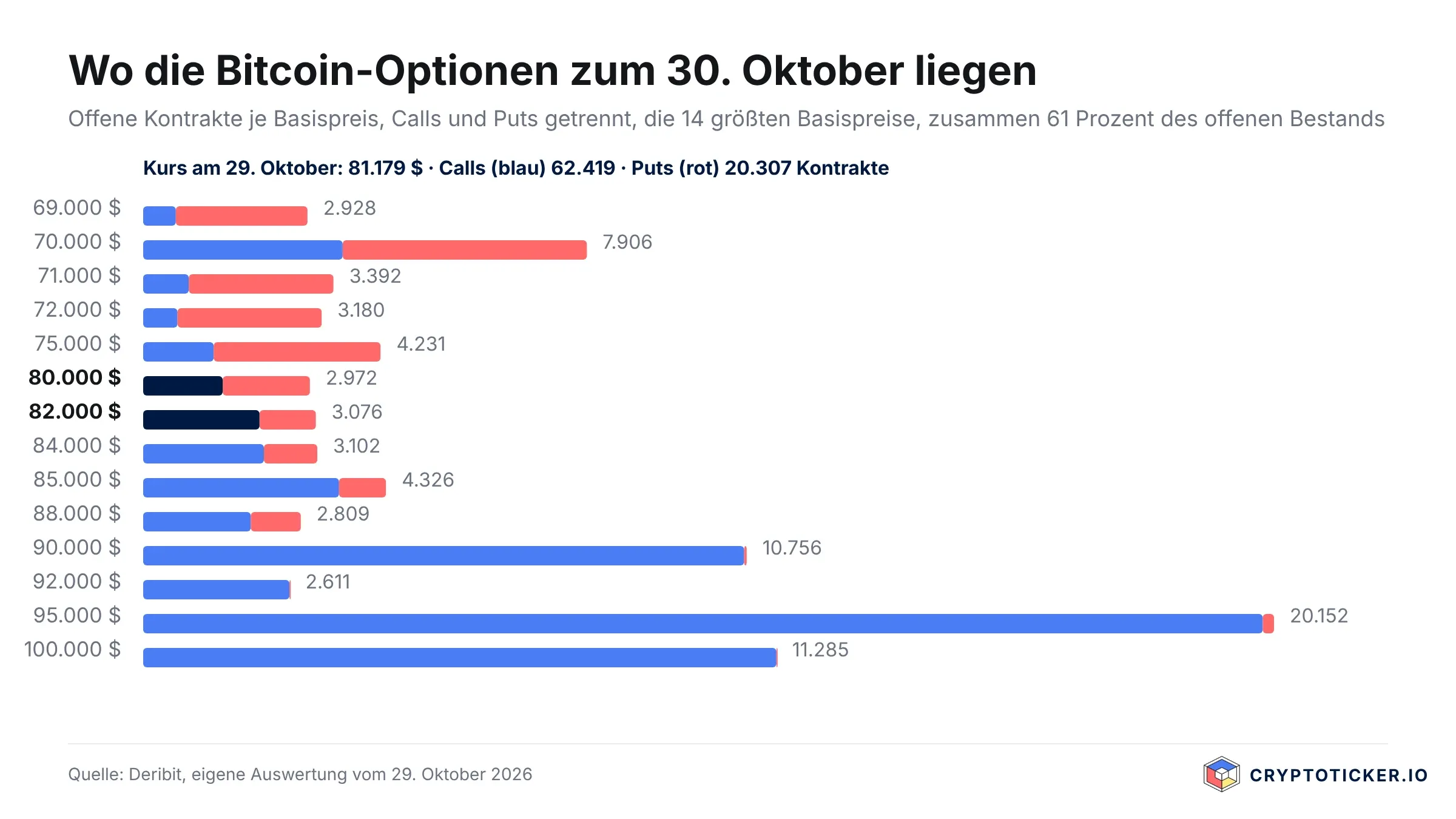
The distribution explains why the expiry generates less downward pressure than the sheer figure of 11 billion dollars suggests. In the area around the current price, between $80,000 and $85,000, barely 13,500 contracts are open. Where settlement is actually likely to happen, the book is thin.
What has changed since Wednesday
On Wednesday this spot carried the arithmetic to year-end: Bitcoin was 9.8 percent short of the closing price of New Year's Eve 2025 at the time. The price stood at $80,446 there. Since then $733, or 0.9 percent, has been added, so the yearly gap has shrunk to around 9 percent.
Two things are new since. First, the US Federal Reserve announced its rate decision on Wednesday evening and left the policy rate unchanged; the market answered with a gain of under one percent, which is restrained measured against earlier rate dates. Second, with Friday a date is now in reach that was still two days off on Wednesday. The $80,000 level, which counted as the lower edge on Wednesday, has held twice since: the daily low of the past 24 hours was $79,636, and the price returned above it within a few hours each time.
The last three monthly expiries and what followed them
Whether an expiry moves the price can be checked against our own data. For the three preceding monthly expiries of the year, the daily closing prices show the following picture, taken two days before the date, on the date itself, and three days after:
- July 31, 2026: from $63,882 to $64,743 on expiry day, a gain of 1.3 percent. In the three days after, it fell back 1.9 percent to $63,504.
- August 28, 2026: from $78,511 to $80,268, a gain of 2.2 percent. After that the price fell 3.3 percent to $77,658.
- September 25, 2026: from $86,183 to $84,378, a loss of 2.1 percent. In the three days after, the price barely moved, ending with a gain of 0.1 percent at $84,449.
The pattern is weak, but it points one way: twice out of three times a pullback of around two to three percent followed expiry day, and once nothing happened. A sample of three cases establishes no rule. Three cases are enough, though, not to treat the second half of the week as settled merely because Friday morning has been survived.

The derivatives market is not overheated
Alongside the options, the open-ended futures contracts, the perpetuals, are worth a look. Their funding rate says which side is currently paying: if it is positive, buyers pay sellers, which points to an overweight of long positions. On Deribit it stood at 0.0032 percent per eight-hour period on Thursday, which annualises to around 3.5 percent.
That is slightly positive and therefore far from the readings that preceded the liquidation waves of recent months. For the situation ahead of the expiry that means there is no over-leveraged stack of longs waiting to set off a chain reaction on a slip below $80,000. To see how fees and liquidation rules differ between such products, the terms are in our comparison of perp DEX platforms.
Taken together, the options book and the funding rate give a picture that differs from the preceding months. The large bets of this expiry sit far out of the money and are settled, and the leveraged market is quiet. That argues for a Friday with elevated turnover but without the swings an overloaded book produces.
Holding period and tax: what counts two months before the year turns
For investors in Germany the calendar carries more weight at this point than the expiry date. Under section 23 of the German Income Tax Act, gains from selling Bitcoin remain tax-free if more than a year lies between purchase and sale. Sell inside that period and the gain is taxed at your personal income tax rate, provided the total of all private disposals in the year exceeds the 1,000 euro exemption threshold.
That leads to a check you can settle today, one that has nothing to do with Friday: when exactly were the holdings bought that are now up for sale? If the purchase falls in November or December 2025, only weeks are left until tax exemption. A sale triggered by a three percent price move can then cost more than waiting. The order of disposal follows the FIFO principle, so the oldest holding goes first. Which tools carry these deadlines per wallet and exchange is shown in the comparison of crypto tax tools.
On the state of the political debate about this deadline we keep a separate overview at crypto holding period: the current status. As long as no decided change stands there, the one-year rule applies unchanged.
These levels count on Friday
To the upside, the first resistance sits at $81,698, the daily high of the past 24 hours. Above that follows the zone around $85,000, where 4,326 contracts are open and where the price last traded on October 24.
To the downside, $80,000 is the level with the shortest history and the widest attention: the price has reclaimed it twice from below this week, and it is at the same time the round strike with 2,972 open contracts. Below it, the calculated pain point begins at $78,000. If that does not hold either, the next dense put zone only starts at $75,000, which is 7.6 percent below the current price.
These levels are grounded in the options book and in this week's price action, not in chart patterns. Their scope is the coming trading days, not beyond.
Our assessment: the expiry explains Friday, not November
From the editorial desk, this monthly expiry is a smaller date than its headline figure suggests. Three pieces of evidence from this text support that: 86 percent of the contracts expire worthless, fewer than 13,500 contracts sit in the area around the current price, and the funding rate of 0.0032 percent shows no over-leveraged market. The pain point at $78,000 points down, but the distance to it amounts to one and a half normal daily ranges.
Against that stands our own history: after two of the last three monthly expiries, Bitcoin gave up two to three percent in the following days. Anyone deriving an expectation from that should aim it at the days after Friday, not at Friday itself. And for anyone watching the holding period, December is the more important date. None of this is a recommendation to buy or sell; crypto assets can lose their entire value.
Monthly expiry: after Friday, 116,000 contracts are missing from the book
Three steps that can be settled before Friday morning:
- Dig out the purchase dates of your holdings. Anyone who bought in November or December 2025 is close to the one-year deadline. Which tool carries the deadlines per position is set out in the comparison of crypto tax tools.
- Measure open leveraged positions against $78,000. If the liquidation price sits between $78,000 and $80,000, it falls into the zone the expiry pulls towards on paper. Providers' margin rules differ; they are listed in the perp DEX comparison.
- Check your trading venue against Friday morning's range. Between 08:30 and 09:00, turnover and spread rise. Anyone planning to trade in that window should know their exchange's fee structure; the terms are in the exchange comparison.
(As of October 29, 2026. This article is not investment advice. Prices and fee structures change; check the terms with the provider before you buy.)
0
0

 Manage all your crypto, NFT and DeFi from one place
Securely connect the portfolio you’re using to start.
 Where will Bitcoin trade next?
Live Polymarket and Kalshi odds on Bitcoin price targets, compared side by side.
See Bitcoin price odds


