
Monero price falls 8.6 percent: XMR hits its lowest level since mid-October

0
0

Monero (XMR) fell considerably more on Thursday than the rest of the crypto market. According to CoinGecko, the coin lost 8.6 percent in 24 hours and cost around $537 in the evening, roughly €486. XMR last had such a low daily value on October 13. The decline comes in a weak overall market in which bitcoin slipped below $72,000 and leveraged positions were unwound on a large scale.
No trigger of its own, affecting only Monero, has been established so far. The announced integration with the THORChain exchange has still not been enabled, and in the EU the deadline is approaching after which regulated providers may no longer offer privacy coins. Prices in this article are as of November 12, 2026, around 6:50 pm UTC.
Monero price on November 12: down 8.6 percent in 24 hours
CoinGecko market data shows a price of $536.59. Over the past 24 hours, Monero moved between just over $538 and just under $592, so the current price sits at the very bottom of that range. Over seven days, the loss adds up to 12.3 percent. Over 30 days, XMR is only 1.5 percent up, and over the year it is up 37.2 percent.
Market capitalisation stands at around $10.1 billion. That puts Monero in 13th place among the largest cryptocurrencies, down from 12th the day before. Around $148 million worth of XMR changed hands in 24 hours. The coin is now just under 33 percent below its all-time high of $797.73 from January 14, 2026.
Measured against the monthly high of $640.02 that Monero reached on November 4, the decline amounts to just over 16 percent. In market jargon, a correction refers to a pullback of at least 10 percent after a rise. XMR has clearly crossed that threshold, after the price had gained more than a fifth from mid-October to early November.
Liquidations and a weak overall market: what is behind the Monero decline
Most of the pressure comes from the market as a whole. Bitcoin fell 3.8 percent in 24 hours to around $71,700 according to CoinGecko. As Bitcoin.com News reports, bitcoin slipped below $72,000 on the Bitstamp exchange, and derivatives positions worth $656 million were forcibly closed across the crypto market, mainly leveraged bets on rising prices. The Fear and Greed Index from alternative.me, a sentiment gauge on a scale of 0 to 100, stands at 28, in the fear zone.
A liquidation occurs when a position financed with borrowed money falls so far into the red that the collateral posted no longer covers the loss. The exchange then closes the position automatically and sells on the market to do so. When many such positions fall at the same time, the sales reinforce one another. Coins with comparatively low trading volume are often hit harder by such a wave than bitcoin, and with daily turnover of around $148 million, Monero is among the less liquid assets among the 25 largest coins.
There is also a technical factor. In the preceding weeks, Monero was one of the strongest large coins and was trading well above its moving averages. Anyone sitting on gains there could lock them in during a falling market. The share of such profit-taking in the decline cannot be proven, however, because exchanges do not publish figures on it.
XMR vs BTC: Wednesday's lead has been wiped out
As recently as Wednesday, cryptoticker.io reported a Monero price of $584.62 and a daily gain of 6.3 percent, while bitcoin was treading water. The picture has since reversed. XMR is a good 8 percent below that level, and Wednesday's daily low of $545.55 has been breached.
Monero has also lost ground directly against bitcoin. One XMR currently costs 0.00747 bitcoin according to CoinGecko, while the high of the past 24 hours was 0.00795 bitcoin. That corresponds to a decline of around 6 percent within a day. Monero is therefore no longer outperforming the market but falling more than twice as hard as bitcoin. Over the year, however, its lead over bitcoin remains large: XMR is 37 percent higher than twelve months ago, while bitcoin has stayed well below its record of $126,080 from October 2025 over the same period.
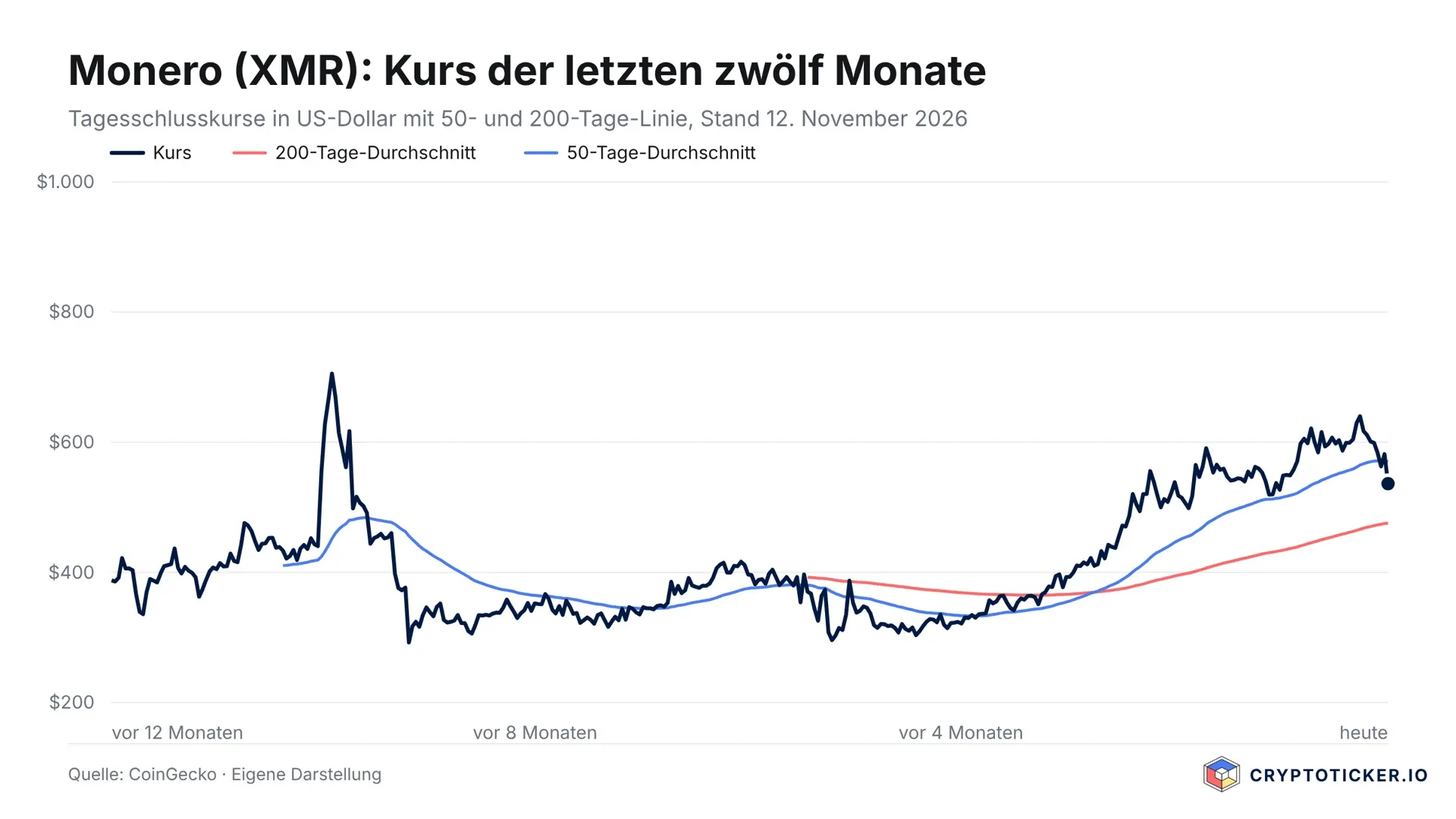
Monero support levels: $519, $500 and $476
A moving average smooths daily prices over a fixed period and thus shows the direction of the trend. By our own calculation based on CoinGecko daily closing prices, Monero's 50-day average is around $570 and its 200-day average around $476. With the decline, the price has fallen below the shorter line but still holds a gap of just over 12 percent to the longer one.
The first level on the downside is around $519. Monero closed at that level on October 10 and 11, before the climb above $600 began. Below that comes the round $500 mark, where many buy and stop orders tend to cluster. The third zone is the 200-day average at around $476. If the price falls below that as well, the uptrend that has been in place since the summer would be broken. XMR recorded its lowest daily value of the past 90 days on August 15, at just under $400.
XMR resistance levels: $546, $570 and $640
On the upside, Monero first has to reclaim Wednesday's daily low of $545.55. A former support level often turns into resistance after it breaks, because buyers from there want to exit their positions at break-even. Next comes the zone around $568 to $570. There, the 50-day average meets the level XMR had fallen to on November 10.
Only above the 24-hour high of just under $592 would this Thursday's decline be recovered. The monthly high of $640.02 is around 19 percent above the current price. Whether and when Monero reaches these levels depends heavily on whether the overall market stabilises. As long as bitcoin is under pressure, smaller coins generally find it hard to decouple.
THORChain and Monero: XMR swaps are still not enabled
THORChain is a decentralised exchange through which coins from different blockchains can be swapped directly against one another without a company holding the coins. The developers had completed the Monero integration technically. Trading will only be enabled, however, once node operators re-form their group in a so-called churn and generate a new shared key in the process. cryptoticker.io reported on this on November 10.
On Thursday evening, Monero was still not included in THORChain's status list, which shows all connected blockchains with their deposit addresses. The list covers 13 blockchains, including Bitcoin, Ethereum, Litecoin and Zcash, but not Monero. cryptoticker.io compiled this check itself on November 12, 2026. For investors, this means that the additional swap route without a central exchange, which many Monero holders are waiting for, is not yet available. The operators have not given a fixed date for the launch.

Buying Monero in the EU: purchase route and the EU anti-money laundering regulation
If you want to buy XMR, first check whether your exchange lists the coin at all. That cannot be taken for granted, because platforms licensed under the European crypto regulation MiCA have to prepare for a fixed deadline for privacy coins. An overview of providers with an EU licence is available in our comparison of regulated crypto exchanges. The deadline comes from Brussels.
In Article 79, the EU anti-money laundering regulation 2024/1624 prohibits credit institutions, financial institutions and crypto-asset service providers from maintaining accounts that anonymise transactions or obscure them to a high degree, "including through anonymity-enhancing coins". Under Article 90, the regulation applies from July 10, 2027. Monero conceals the sender, recipient and amount of every transaction by default and is therefore widely read as falling under this rule.
One exception is important: according to the recitals of the regulation, the ban does not apply to providers of hardware and software or of self-custodial wallets, as long as they neither have access to the wallets nor control over them. Holding Monero in your own wallet is therefore not prohibited by the regulation. What becomes harder is the route via regulated intermediaries, meaning buying, selling and exchanging.
Leverage and liquidation: long positions accelerate the Monero decline
Part of Monero trading takes place via leveraged futures contracts known as perpetual futures. These contracts have no expiry date, and leverage of ten means that a price drop of around 10 percent can wipe out all of the collateral. With a daily loss of 8.6 percent, highly leveraged long positions in XMR were therefore in acute danger.
If you trade with leverage, you should know the liquidation price of your position and compare it with the coin's volatility. Monero has lost more than 12 percent over the past seven days, and daily moves of 5 to 10 percent are not unusual for XMR. A stop order closes a position at a price you choose before the exchange liquidates it. In fast markets, however, it can be executed below the desired price.
Monero storage: wallet and records
For storing Monero, your own wallets are the main option. A hardware wallet stores the private key on a separate device that is not permanently connected to the internet. Not every device supports XMR. Which models do and what they cost is shown in our hardware wallet comparison.
How gains and losses on Monero are taxed depends on your country of residence. Purchase dates and cost prices can be documented cleanly with crypto tax software.
Monero at a monthly low: the direction will be decided between $476 and $570
Monero has lost a good eighth of its value within a week and is trading below its 50-day average. Judging by the gap to the 200-day line, the broader uptrend since the summer is still intact. Three steps help you assess the situation for your own portfolio:
- Check your trading venue: Find out whether your exchange lists XMR and how it intends to handle the July 10, 2027 deadline. Providers with an EU licence are listed in the comparison of regulated crypto exchanges.
- Secure your storage: If you hold Monero for the long term, you need a wallet that supports XMR and whose keys only you know. Suitable devices are listed in the hardware wallet comparison.
- Keep records: Note the purchase date and cost price of every position so that holding periods and possible losses can be clearly documented. A tool for crypto tax and portfolio tracking helps with this.
(As of November 12, 2026. This article is not investment advice. Prices and fee structures change; check the terms with the provider before you buy.)
0
0


 Manage all your crypto, NFT and DeFi from one place
Securely connect the portfolio you’re using to start.
 Where will Bitcoin trade next?
Live Polymarket and Kalshi odds on Bitcoin price targets, compared side by side.
See Bitcoin price odds


