
Zcash Maintains ETF Inflow, But Will it be Enough to Retest $1.5k?

0
0

Zcash is down a few percent as the market awaits the interest rate decision. The decline comes after four consecutive days of gains, during which the altcoin was one of the few assets to post notable increases as the broader crypto market experienced a significant selloff. The latest pullback may suggest that traders are hedging against a possible selloff following the announcement.
Away from current price action, Zcash has attracted attention ahead of its 10th anniversary. Investors and other admirers have kept a keen eye on the project since its launch in 2016. It will mark the milestone on October 28, an occasion many consider significant.
While there is no special event planned to commemorate the anniversary, the project has recently drawn attention for another reason. Its co-founder, Sean Bowe, proposed ending the Zcash Community Grants funding stream and redirecting the funds to the Network Sustainability Mechanism.
Although the proposal has received mixed reactions from the community, its effect on prices appears limited so far.
Beyond the anniversary and governance discussions, another factor that may have contributed to Zcash’s recent gains is ETF inflows. The ZCSH fund has recorded consistent inflows since October 20. A comparison with price action shows that this date coincided with the largest single-day increase in more than 30 days.
The 1-day chart also shows that prices retraced at one point, but inflows remained steady throughout the pullback. As the new week began, the bullish trend continued. Cumulatively, net inflows over this period have exceeded $57 million.
A previous analysis linked part of Zcash’s uptrend to this investment demand, and the trend appears to persist. However, the key question is whether continued inflows will be enough to push ZEC above $1,500 soon.
Will Zcash Retest $1,500 Soon?
ZCSH inflows are difficult to predict. However, given that a significant part of the recent uptrend appears linked to this investment demand, ETF flows remain one of the key metrics to watch.
One factor that may influence these flows is the broader macroeconomic environment. At the time of writing, traders are on edge as they await the Federal Reserve’s interest rate decision. If the Fed leaves rates unchanged, bullish sentiment could persist, potentially pushing prices higher.
Conversely, another rate hike could dampen optimism around the asset and put further pressure on prices. Adding to the uncertainty, net flows into the Zcash spot ETF over the last two days have been among the lowest since October 20.
This recent reading suggests that investors entered the current week with some skepticism. If the Fed delivers a hawkish decision, ZEC could erase some of its recent gains.
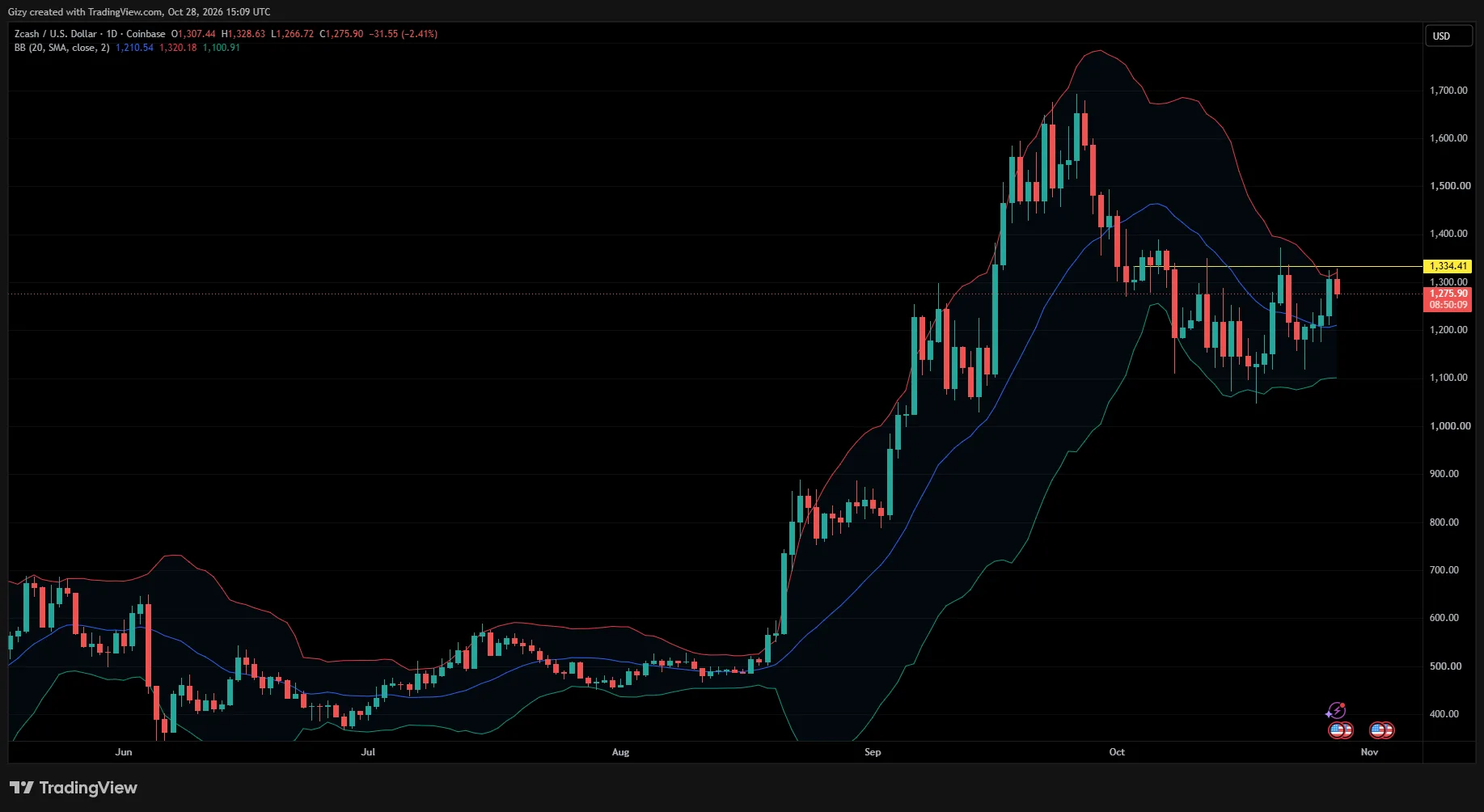
The technical outlook also presents a challenge for the bulls. On the 1-day chart, Zcash has faced repeated rejection at a key resistance level, increasing the risk of further declines.
Since October 8, $1,335 has acted as a barrier, and prices have failed to break decisively above it. ZEC tested this level twice in the last 24 hours but failed on both attempts. The latest rejection triggered the ongoing selloff, which has pushed prices down by more than 2%.
Additionally, the $1,335 level coincides with the upper Bollinger Band. Although not always, testing the upper band is a known sell signal. If the trend plays out this time, the altcoin will plummet even lower. Previous price movement paints the $1,120 support as the next support to watch.
However, a bullish scenario remains possible. If ZEC attracts renewed buying pressure and decisively breaks above $1,335, it could open the door to a move toward $1,500. Sustained ETF inflows would further support this outlook.
For now, the direction of ZEC’s next move may depend on whether buyers can overcome the $1,335 barrier and whether the Fed’s decision strengthens or weakens demand for the altcoin.
The post Zcash Maintains ETF Inflow, But Will it be Enough to Retest $1.5k? appeared first on CoinTab News.
0
0

 Manage all your crypto, NFT and DeFi from one place
Securely connect the portfolio you’re using to start.


