
Anza readies Solana direct mapping for mainnet but sets no activation date

0
0
Anza, the team behind Solana’s (SOL) main validator software, said Thursday that direct mapping is heading for activation on the mainnet this cycle.
There isn’t a set date yet for when direct mapping will be activated, and the change could break on-chain programs that rely on unsafe memory shortcuts.
Anza queues the memory checks gate for epoch 1092
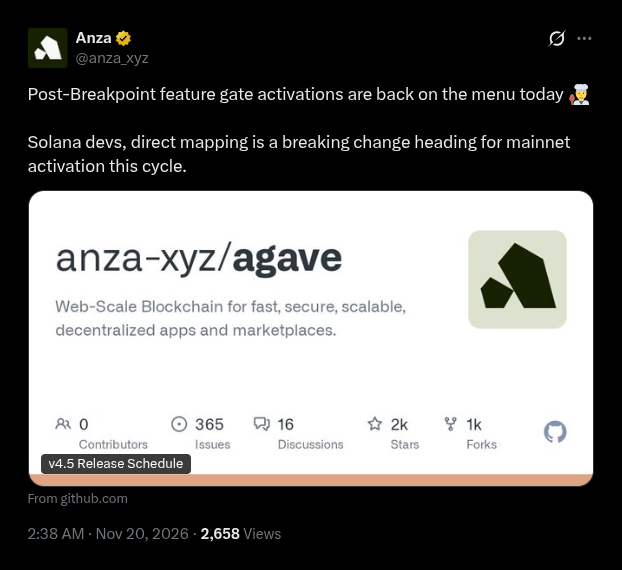
Anza wrote about it in a post on X, which also said that feature gate activations had started up again after the Breakpoint conference. There is a switch called a feature gate that makes the whole network use a protocol change when a new epoch starts.
“Solana devs, direct mapping is a breaking change heading for mainnet activation this cycle,” Anza wrote. In its post, Anza didn’t give a calendar date, and the Solana Foundation’s upgrade page says that the expected mainnet date hasn’t been set yet.
On-chain data shows that virtual_address_space_adjustments, the gate that adds the new memory checks, was queued for mainnet activation on November 19.
The Foundation’s status table shows that the checks gate is live in epoch 1092, the next epoch.
The second gate, account_data_direct_mapping, eliminates the need to duplicate account data. Mainnet hasn’t turned it on yet.
Both gates have been live on Solana’s devnet and testnet since May 2026. The new rules are already in place for the programs that developers put on those networks.
Anchor programs older than 1.2.2 risk instruction errors
Under the current rules, it is possible for a program to read past the end of an account, write to a read-only account as long as it puts the old value back, and reach across two memory regions in one access. Not a single error stops any of the three today.
All three moves fail with an instruction error as soon as the checks gate is turned on.
There is a quieter risk when the stack layout is altered. According to the Foundation, a program’s functionality can be altered by the new stack layout without generating an error. This means that a successful transaction does not demonstrate the security of code that depends on the stack.
Code is deemed exposed if it reads raw account bytes rather than using the SDK’s account types, modifies account sizes, or utilizes unsafe Rust blocks or raw pointers. When they call another program and reassign a typed account, Anchor programs older than 1.2.2 are also vulnerable.
Anza played back previous mainnet transactions and contacted teams with programs that would break. Since the replay only included traffic that Anza had already seen, the Foundation advises developers to test their own code rather than wait for a call.
Most app developers, validator operators, and users don’t need to do anything. The exception is a program they call that doesn’t follow the rules.
Today, the validator pulls the data from each account into a program’s virtual machine before the program begins and then transfers it back. Calls between programs, or cross-program invocations, repeat that round-trip.
Copying is eliminated via direct mapping. The virtual machine reads and writes account data where it already exists, with up to four copies per instruction going to zero, according to the Foundation.
After the new rules are put into effect, a different proposal called SIMD-0268 extends the depth to which programs can nest such calls from four to eight. Because a related pointer gate named syscall_parameter_address_restrictions went active on the mainnet on June 30, 2026, cross-program calls operating on the mainnet are already compliant.
The update comes after Alpenglow, a protocol redesign scheduled for October 21 that eliminates the TowerBFT voting method in use since 2020 and strives for transaction finality under 150 milliseconds, according to Cryptopolitan. After the compute limit per block was raised by 66%, Solana registered a record 169.9 million non-vote transactions in a single day on August 4.
At the time of writing, SOL was trading at $72.86, down 1.2% over the past 24 hours.
Don’t just read crypto news. Understand it. Subscribe to our newsletter. It's free.
0
0


 Manage all your crypto, NFT and DeFi from one place
Securely connect the portfolio you’re using to start.


