
Orbinum Network News: Spec 20 Brings Solana Wallets to the Testnet

0
0
Orbinum Testnet Gets a Spec 20 Runtime Upgrade
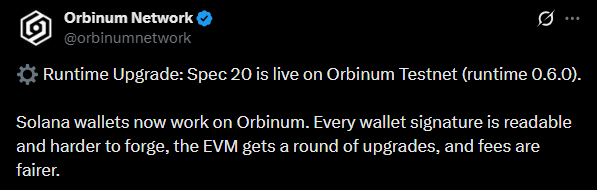
Orbinum Network news today centers on a runtime upgrade for the testnet. Spec 20, tagged runtime 0.6.0, is now live. The project announced it in a thread on its official X account on Oct 26, 2026.
This blockchain update bundles six changes, from wallet access to fee pricing. A GitHub release published for node version 0.6.0 lists the matching code changes since v0.5.0.
Orbinum Network News on Solana Wallets and Plain Text Signing
Phantom, Solflare, and Backpack now connect to the chain directly, according to the project. A Solana key serves as the account, and the address stays the same.
Users can shield, send privately, and unshield from the same wallet. Shielding means moving tokens into a private balance. The faucet and explorer accept Solana addresses too.
Signing also changes. Wallets now display plain text with the action, the recipient, and the amount.
The chain rebuilds that text from the real transaction and checks it. If a site shows one transaction but sends another, the signature fails. For wallet users, this is the most visible change in Orbinum Network news this week.
Source: Official X Post
Stricter Signature Rules and EVM Precompile Updates
Every signature type now accepts one valid encoding and refuses weak keys. A raw ed25519 signature never counts as a transaction. So a login signature cannot be replayed as a transfer. Replay means reusing a valid signature in a new place.
Area | Spec 20 change |
ed25519 | Small-order keys are refused |
sr25519 | The identity key is refused |
ECDSA | Only canonical low-s signatures pass |
Balances precompile | No delegatecall, static, or value calls |
EIP-155 | Replay protection enforced on-chain |
EIP-7825 | Per-transaction gas cap |
EIP-7823 and EIP-7883 | Updated modexp pricing |
Precompiles are built-in contracts that Solidity code calls like any other contract. The release also stores a stub at each Orbinum precompile, so high-level Solidity calls reach them.
Proof Checks, Fee Pricing, and Node Operator Rules
Three more items in this Orbinum Network news cover proofs, fees, and node software.
Safer proofs: retired circuit keys are blocked on-chain for good, and new verification keys face stricter checks.
Merkle root window: proofs made against a recently replaced Merkle root (a compact fingerprint of a data tree) stay valid for the full retention window, so fewer private transfers fail.
Fair fees: native substrate transactions are priced like EVM gas, and a transfer costs about 0.000016 ORB.
Node operators: version 0.6.0 is now the minimum to author blocks.
The release notes put the earlier transfer cost near 3e-10 ORB. At that price, account and block spam was nearly free.
Expert Take on Spec 20
Spec 20 focuses on account safety, and spam costs more than new features. Readable signing narrows the gap between what a user sees and what the chain verifies.
Pricing transactions like EVM gas gives block space a real cost. Orbinum Network news of this kind is best judged by user safety. Since this runs on a testnet, mainnet results remain untested.
Conclusion
Spec 20 packs wallet access, signing, key rules, proof checks, and fees into one testnet release.
Readers following Orbinum Network news can check the release notes for the full change list. Mainnet timing was not part of this thread, so the crypto news stays focused on the testnet.
Glossary
Runtime: the core logic that defines how a blockchain processes transactions.
Precompile: a built-in contract that smart contracts can call directly.
ed25519: a digital signature scheme used by Solana wallets.
Modexp: modular exponentiation, a math operation used in some cryptography.
YMYL Disclaimer: This article is for educational and informational purposes only. It is not financial advice, a price prediction, or a guarantee of returns. Readers should do their own research before making any decision.
0
0

 Manage all your crypto, NFT and DeFi from one place
Securely connect the portfolio you’re using to start.


