
Dogecoin price: 4.2 percent between the day's high and low, nothing net

0
0

The evidence: Dogecoin trades at $0.0790 on Thursday afternoon, 0.10 percent below where it stood 24 hours earlier. Within those 24 hours the daily high was $0.080673 and the daily low $0.077427, and 4.19 percent separates the two points. Our assessment follows further down: a range that wide with no result at the end matters more in practice than the zero on the daily balance, because it decides where a sell level sensibly sits.
Look only at the day's percentage and you see an uneventful Thursday. Look at the range and you see a market that changed direction twice in a single day. For the question of whether a stop level at $0.0775 makes sense, or whether it would already have triggered on Thursday morning, that is the whole difference.
Dogecoin at $0.0790: high and low lie 4.19 percent apart
The Dogecoin price stands at $0.0790 in the early afternoon of October 29. The market value of all circulating DOGE is 12.36 billion dollars, which is rank 12 among all crypto assets. Daily turnover comes to 457.7 million dollars. The all-time high of May 2021 remains 89.2 percent away.
The two corner points of the day: the high sat at $0.080673, the low at $0.077427. Measured from the low, that is a gap of 4.19 percent. On a stake of 1,000 euros, roughly 42 euros separate the two points, and that on a day that shows up in the balance as a flat round.
What the daily range actually measures
The daily range is the gap between the highest and the lowest price of a trading day, measured as a percentage of the low. The range says how far the price travelled. The daily result says where it ended up. The two figures can diverge completely, and on Thursday they did: 4.19 percent of distance, 0.10 percent of result.
In practice the first figure counts for more than the second. A sell level, a buy-the-dip limit and every automated order key off the prices actually reached during the day, not off the closing level. An order executes when the price touches it, even if ten minutes later the price is back where it was.
Twelve coins compared: plenty of distance, little result
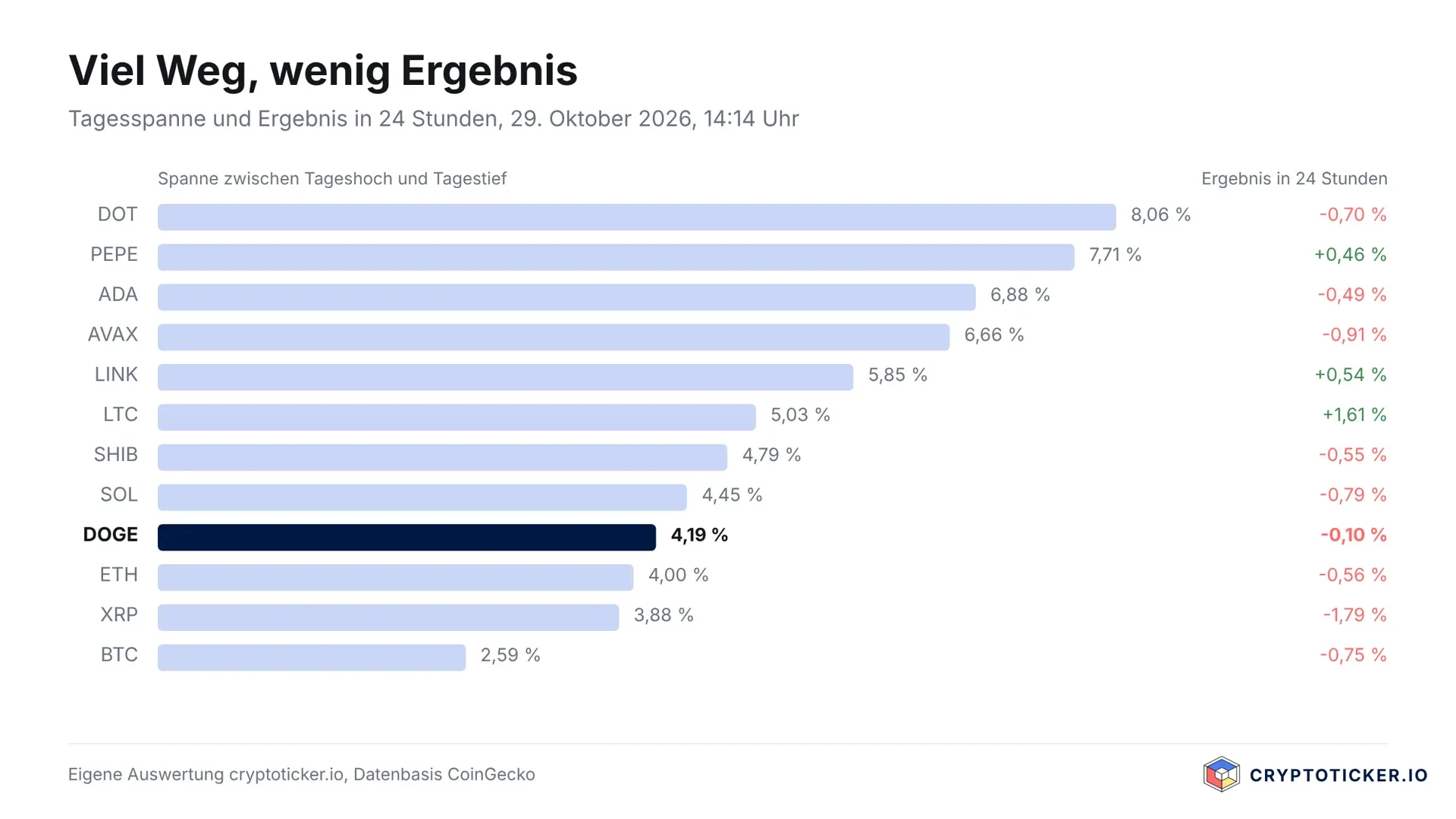
To judge whether Thursday was a special case for Dogecoin, we laid the daily high, daily low and daily result side by side for twelve large crypto assets. Cryptoticker.io compiled this analysis itself on October 29, 2026; the figures are as of 2:14 p.m. German time.
The widest range belonged to Polkadot at 8.06 percent, followed by Pepe at 7.71 percent and Cardano at 6.88 percent. At the other end sits Bitcoin at 2.59 percent. Dogecoin lands mid-table at 4.19 percent, between Solana at 4.45 and Ethereum at 4.00 percent. On the result, all twelve fall into a narrow band between plus 1.61 percent for Litecoin and minus 1.79 percent for XRP.
That is the actual finding: in eleven of twelve assets the daily range was a multiple of what was left of it by the end. For Dogecoin the range was 42 times the daily result, for Polkadot 11 times, for Cardano 14 times. Only Litecoin, at plus 1.61 percent, produced a result that half-way reflects the day's movement.
A wide daily range is not yet a trend
How does a range like that arise when nothing moves on balance? Three mechanisms work together, and all three can be traced in Thursday's numbers.
The first is the leveraged market. When the price drops below a level where many leveraged positions sit, those positions are force-closed. Every forced closure is a sale that pushes the price further down until the wave has run through. After that the selling pressure is gone and the price returns. The same thing happens in the other direction with leveraged short positions. On October 27 we reported that leveraged long positions on Dogecoin cost 7.4 percent a year at that point; where leverage is expensive, it sits loose.
The second is order book depth. An order book is the list of all open buy and sell orders on an exchange. If the levels immediately below the price hold only thin orders, a mid-sized sell order is enough to clear several levels at once. The price then falls not because anything has changed, but because there was nothing in the book.
The third is the calendar. The market came out of the US Federal Reserve's rate decision on Wednesday evening and is running into the month-end on Saturday. In phases like that, large traders reposition their books without taking a direction. That generates turnover, but no trend.
Wednesday's rate decision and what it did not change about the price
The US Federal Reserve's open market committee decided on October 28, 2026 to leave the target range for the policy rate at 3.75 to 4.00 percent. The decision carried ten votes to two; the statement says inflation remains elevated. That can be read in the Federal Reserve Board's release.
For crypto assets that was the confirmation of a situation, not a change to it. An unchanged policy rate removes the market's reason to reposition fundamentally. What it does not remove is the nervousness built up ahead of a scheduled date. That is exactly where the pattern in the chart above comes from: movement in both directions, no result.
That Dogecoin sits mid-table on range is worth noting. Meme coins usually react more strongly to rate dates than large crypto assets, because proportionally more leveraged money sits in them. On Thursday, Pepe at 7.71 percent did indeed travel three times as far as Bitcoin, while Dogecoin covered only about one and a half times the distance.
Since Wednesday afternoon: $0.0001 of difference, 4.2 percent of distance
On Wednesday we opened up Dogecoin's October balance in this spot: a loss of 16.1 percent at the time for the running month, the second losing month in a row. Since then, next to nothing has happened to the level. Twenty-four hours ago the price sat at roughly $0.0791, now at $0.0790.
What has happened lies between those two points. In the meantime the price was at $0.080673, and it was at $0.077427, which is only 3.2 percent above the 65-day low of $0.0750 that we measured on October 24. The October balance is untouched by all this: two trading days remain until Saturday, and the monthly loss still sits in the region of 16 percent.
The level that matters now is the daily high at $0.080673. As long as the price stays below it, it is moving inside the range Thursday staked out. To the downside, the next justified level is the daily low at $0.077427, and below that follows the 65-day low at $0.0750.

Stop-loss inside a range: tight levels would have triggered on Thursday
A stop-loss is an automatic sell order that triggers as soon as the price reaches a set level. It is meant to limit losses. In a market that swings 4.19 percent wide and ends at zero, it turns into a cost trap.
The arithmetic is plain. Anyone in the market at $0.0791 on Wednesday afternoon who set a stop two percent below that, at $0.0775, was executed on Thursday, because the daily low was $0.077427. The sale went through at a price around two percent below entry, and a few hours later the price was back at $0.0790. The loss is real, the movement was not.
Anyone who chose three percent of distance instead, at $0.0767, stayed invested. For the coming days that means something concrete: a stop below the daily low of $0.077427 has a chance in this market, one just above it does not. If you set a level, anchor it to the daily range as actually measured rather than to a round percentage.
Limit orders and book depth at 458 million dollars of daily turnover
The second lever lies in the order type. A market order buys or sells immediately at the next best price in the book, a limit order only at a price you set yourself. In a wide range the difference is hard cash.
Dogecoin is comparatively well placed here: 457.7 million dollars of daily turnover against 12.36 billion dollars of market value means 3.7 percent of the stock changes hands in a day. For Bitcoin it is 1.7 percent. Even so, the rule holds: whoever put a market order into Thursday morning's decline got one of the worst prices of the day, and whoever set a limit just above the low got one of the best.
There is a practical point for euro-based investors on top of that. As we measured on October 23, 96 percent of DOGE trading runs through the dollar stablecoin Tether and only 0.13 percent against the euro. Buy in euros and you are trading in a thinner book than the dollar side, and you should look at the spread, the gap between the buy and the sell price, before placing the order. Which providers carry which pairs and fees is set out in our overview of the best crypto exchanges.
The three numbers that decide an order in this situation
First the spread: with a thin book, entering and exiting costs money before the price has moved at all. Second the order size relative to book depth: an order that clears several price levels moves the price against itself. Third the fee per execution: split a large order into pieces and you pay it several times over, and below a few hundred euros that eats up the advantage of the better fill.
From the editorial desk: a range with no follow-through
Our assessment: Thursday was not a turning point but a confirmation of the situation since mid-October. Three pieces of evidence support that. The price did not hold the daily high at $0.080673. The range of 4.19 percent is not unusual for Dogecoin; it sits mid-table among the twelve assets examined. And the result of minus 0.10 percent shows that neither buyers nor sellers settled the day in their favour.
Against that stands the fact that Thursday night was the first trading stretch after the rate decision, and large addresses tend to rebuild positions with a delay. A break above the daily high in the coming days is therefore not ruled out. That cannot be substantiated today, and so it stands here as what it is: an open point, not an expectation. What Dogecoin is and how the protocol works is explained by the project on its own site.
Dogecoin range: only above $0.0807 does distance become direction
Three steps follow from this day's numbers:
- Anchor sell levels to the measured range. The daily low at $0.077427 is the point the market tested that day. A level above it will very probably be touched in a sideways phase. If you store levels in a trading application, the terms for that are in our overview of the best crypto brokers.
- Look at the spread before the next order. With the euro accounting for 0.13 percent of DOGE trading, the choice of trading pair decides the fill. A limit instead of a market order costs patience and saves more in a wide range than the fee amounts to. The providers' fee models are listed under the best crypto exchanges.
- Document the month's executions. October ends on Saturday, and every sale this month belongs in the record for your tax return, including a stop that triggered by accident. Tools that log purchases and sales automatically are in our comparison of crypto tax software and portfolio trackers.
(As of October 29, 2026. This article is not investment advice. Prices and fee structures change; check the terms with the provider before you buy.)
0
0

 Manage all your crypto, NFT and DeFi from one place
Securely connect the portfolio you’re using to start.


